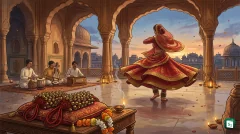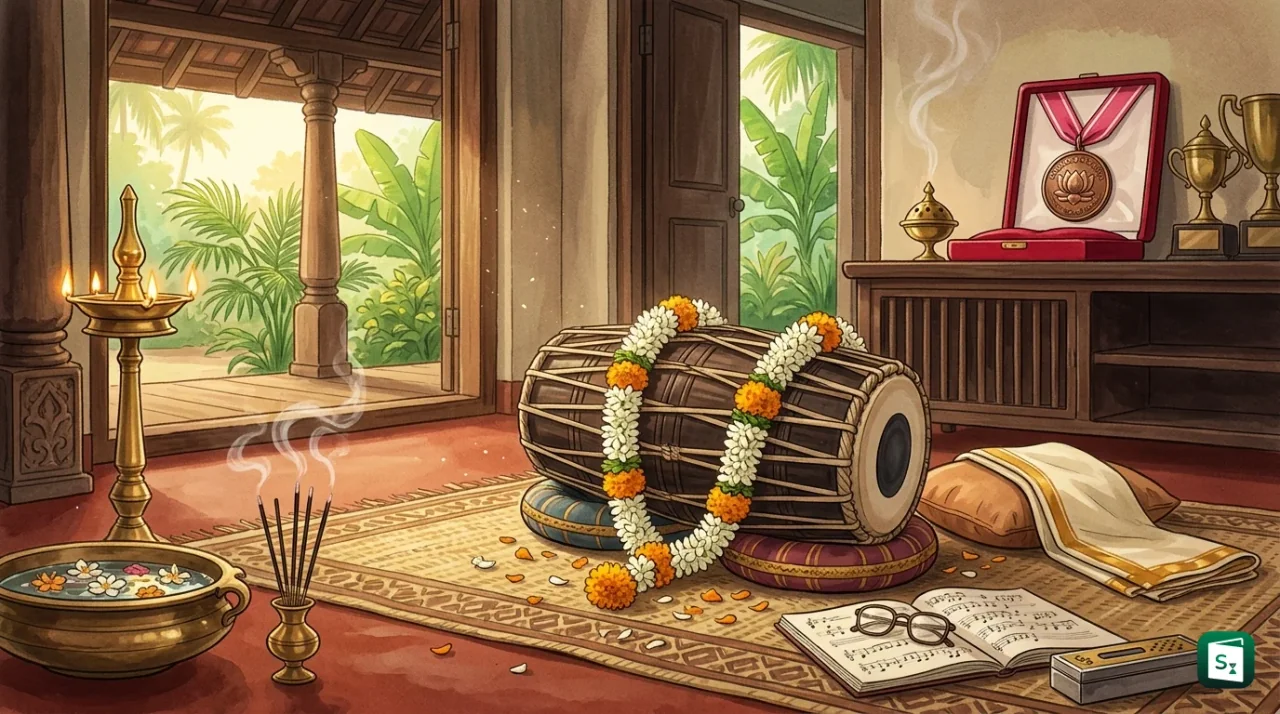
Guruvayur Dorai, one of the most respected mridangam maestros in Carnatic music and a recipient of the Padma Shri in 2025, passed away in Chennai on 10 October 2026 at the age of 91. For more than eight decades he stood beside the biggest names in South Indian classical music, shaping a rhythm that travelled from temple towns in Kerala to concert halls across the world. His death closes a long chapter in the history of the mridangam, the double-headed drum that forms the backbone of Carnatic percussion.
Who Was Guruvayur Dorai?
Guruvayur Dorai was a mridangam vidwan, a master player of the double-headed South Indian drum, and a leading exponent of the Pudukottai school of percussion. He was born Vaidyanathan on 2 July 1935 in the temple town of Guruvayur in Kerala’s Thrissur district, to G.S. Krishna Iyer, a temple priest, and Meenakshi. Music ran through the household: his elder sister Guruvayur Ponnammal became a noted vocalist, and his brother G.K. Rajamani a respected violinist.
A bout of polio at the age of five left Dorai weak in one leg and interrupted his schooling. His father, worried about the boy’s future, noticed that he would tap rhythms on his own body even in his sleep and decided to train him in the mridangam so that the siblings could perform as a family. Dorai began lessons at six under Palghat Subba Iyer, and also learned from E.P. Narayana Pisharody of Eranallur.
His concert debut, or arangetram, came at the age of eight, when he accompanied the legendary vocalist Chembai Vaidyanatha Bhagavathar at the Guruvayur temple. Chembai took a keen interest in the boy and later helped him study under the mridangam master Palani Subramaniam Pillai. Dorai met Pillai in 1949, and after the master moved to Madras (now Chennai) in 1953, the young artist lived in his home for nearly nine years in the traditional gurukulavasam style, in which a student learns by living with the teacher.
What Is the Mridangam in Carnatic Music?
The mridangam is a double-headed, barrel-shaped drum made of jackfruit wood and is the primary percussion instrument of Carnatic music, the classical music tradition of South India. It sets the rhythmic accompaniment, called laya, in vocal and instrumental concerts as well as in Bharatanatyam dance. Guruvayur Dorai was associated with playing this instrument across more than eight decades.
The Two Faces of the Drum
The body of the mridangam is carved from a single hollowed block of jackfruit wood and shaped like a slight barrel. Its two openings are covered with layered hides of goat, cow and buffalo, pulled tight by leather straps running along the length of the drum. The right head, called valanthalai, is smaller and carries a black tuning paste of rice flour, ferric oxide and starch that gives the drum its bright metallic tone. The left head, called thoppi, is wider and produces the deep bass notes. Before a concert, a temporary paste of semolina is applied to the thoppi to sharpen and sustain the bass.
The name mridangam comes from the Sanskrit words mrid (clay) and ang (body), recalling the days when early drums were made of hardened clay. In temple sculpture the drum is linked to Nandi, the bull that accompanies Lord Shiva, and is therefore called Deva Vaadyam, or the instrument of the gods. The Nobel laureate C.V. Raman did pioneering work on the mathematics of the drum and its unusual harmonics, the layered overtones produced by its two unlike faces.
Tala, Laya and the Solo Segment
Carnatic music is built on rhythmic cycles known as tala, and a mridangam player must also master laya (tempo) and shruti (pitch). The instrument is tuned to the pitch of the main performer so that its strokes blend with the melody rather than merely marking time. A much-awaited feature of a Carnatic concert is the tani avartanam, a solo passage where the percussionist weaves improvised patterns around the tala while the main artist pauses to listen.
The Pudukottai Style and the Guruvayur Bani
A bani or school is a shared way of playing an instrument, passed down from teacher to student over generations. The Pudukottai school, to which Guruvayur Dorai belonged, was founded by Manpoondia Pillai and developed by his disciples Dakshinamurthy Pillai and Palani Muthiah Pillai. Because several of its early masters first trained on the thavil, a loud temple drum, the school became known for intricate rhythmic patterns and a powerful bass.
Dorai absorbed this tradition from Palani Subramaniam Pillai, a towering figure of the school. Pillai is remembered, along with Palghat Mani Iyer and Ramanathapuram C.S. Murugabhoopathy, as one of the three great masters of the mridangam. The Pudukottai approach is often described as rettai kai, or two-handed playing, in which both faces of the drum speak as equal partners instead of one simply supporting the other.
Within this tradition, Dorai built his own signature, widely known as the Guruvayur bani. Officials who documented his Padma Shri citation noted his special command of the thoppi, the bass face, and his remarkable gumki, a gliding bass stroke that bends and colours the sound. He was also admired for softening his playing to suit gentle instruments such as the veena and the flute, and for lending lively tabla-style touches to lighter pieces at the close of a concert.
A Career Beside Carnatic Music’s Greatest Voices
Guruvayur Dorai accompanied an extraordinary range of Carnatic musicians over a career of nearly eight decades. By his own account he shared the stage with almost every leading artist of his time. The list reflects the sweep of 20th century Carnatic music.
| Era | Artists He Accompanied |
|---|---|
| Early vocalists | Chembai Vaidyanatha Bhagavathar, Musiri Subramania Iyer, Semmangudi Srinivasa Iyer, G.N. Balasubramaniam, M.D. Ramanathan |
| Instrumentalists | T.R. Mahalingam (Flute Mali), Dwaram Venkataswamy Naidu, Mysore T. Chowdiah, S. Balachander, Chitti Babu |
| Later and contemporary | M. Balamuralikrishna, K.J. Yesudas, T.N. Krishnan, T.V. Sankaranarayanan, T.N. Seshagopalan, Chitravina N. Ravikiran |
He was among the rare mridangam players to perform with giants of the nagaswaram, a large South Indian wind instrument. He accompanied Thiruvengadu Subramaniam Pillai in 1951, T.N. Rajarathnam Pillai in Bangalore in 1956, and Namagiripettai Krishnan from the 1960s onward. Such pairings were uncommon because the sheer volume and style of the nagaswaram demanded a very different kind of percussion support.
For many years, Dorai was a regular mridangam accompanist for M.S. Subbulakshmi, the most celebrated Carnatic vocalist of the modern age. He played for her at Carnegie Hall in New York, one of the landmark moments in the global journey of Carnatic music. He also played the mridangam for the popular film song Nakshathra Deepangal Thilanghi from the Malayalam film Nirakudam, a reminder that the instrument reached audiences beyond the concert stage.
Padma Shri 2025 and a Lifetime of Honours
The Padma Awards are among India’s highest civilian honours and are given in three categories. Padma Vibhushan recognises exceptional and distinguished service, Padma Bhushan recognises distinguished service of a high order, and Padma Shri recognises distinguished service in any field. The awards are announced every year on Republic Day and are conferred by the President of India at a ceremony at Rashtrapati Bhavan, usually in March or April. In 2025, a total of 139 Padma Awards were announced: 7 Padma Vibhushan, 19 Padma Bhushan and 113 Padma Shri.
Guruvayur Dorai was named for the Padma Shri in 2025 in the field of Art, with his citation from the government listing significant work in Tamil Nadu. He was already the holder of a long list of honours from across India and abroad.
| Honour | Year | Conferred By |
|---|---|---|
| Padma Shri | 2025 | Government of India |
| Sangeet Natak Akademi Tagore Ratna | 2011 | Sangeet Natak Akademi |
| Sangeetha Kalasikhamani | 2003 | Indian Fine Arts Society, Chennai |
| Sangeet Natak Akademi Award | 1996 | Sangeet Natak Akademi |
| Kalaimamani | 1990 | Government of Tamil Nadu |
The Sangeet Natak Akademi is India’s national academy of music, dance and drama and works under the Ministry of Culture. It was set up in 1952 and began giving its awards even before the academy was formally inaugurated. Dorai was also made an Asthana Vidwan of the Kanchi Kamakoti Peetam, a title given to scholars and artists associated with the institution.
Teaching, Global Reach and the Guruvayur Dorai Trust
Beyond the concert stage, Dorai was a dedicated teacher who carried the mridangam to universities across the world. He served as visiting faculty at institutions such as the University of Washington in Seattle, Western Michigan University, Kalamazoo College, and the universities of Pittsburgh, San Francisco and Sydney. Many of his students went on to become stage performers in India and abroad.
He was also a cultural ambassador in the truest sense. Sponsored by the Indian Council for Cultural Relations (ICCR), the government body that promotes Indian culture overseas, he toured and performed in more than 20 countries. His travels began in 1958 and took him to the United States, Britain, Russia, Canada, Malaysia, Singapore and South Africa, including the Festivals of India abroad.
To preserve and encourage his art, he founded the Guruvayur Dorai Trust, which honours percussion artists every year. In 2015, on his 80th birthday, a Guruvayur Dorai Music Centre was opened at Kalpathy near Palakkad in Kerala. He also kept alive the written tradition of his craft by publishing E.P. Narayana Pisharody’s instructional book Mridanga Nada Manjari in 2001.
Key Takeaways
- Guruvayur Dorai, the mridangam maestro and Padma Shri 2025 awardee, passed away in Chennai on 10 October 2026 at the age of 91.
- He made his concert debut, or arangetram, at the age of eight, accompanying the legendary vocalist Chembai Vaidyanatha Bhagavathar.
- He was a leading exponent of the Pudukottai school of mridangam and developed his own signature, the Guruvayur bani, known for its masterful handling of the bass face, the thoppi.
- The mridangam is a double-headed drum made of jackfruit wood and is the primary percussion instrument of Carnatic music.
- The Padma Shri is India’s fourth-highest civilian award; the 2025 list had 139 Padma Awards in all, including 113 Padma Shri.
- Dorai won the Sangeet Natak Akademi Award, the Kalaimamani and the Sangeet Natak Akademi Tagore Ratna, and accompanied M.S. Subbulakshmi at Carnegie Hall in New York.