Roshan Kumari, the celebrated Jaipur gharana exponent of Kathak, passed away in Mumbai on 5 October 2026 at the age of 82 after age-related illness. The Padma Shri awardee died at Holy Family Hospital in Bandra and was laid to rest at Santa Cruz Kabrastan the next day. Her seven-decade career linked classical purity with cinema, teaching and national honours.
Who Was Roshan Kumari?
Roshan Kumari Fakir Mohammad was among the foremost classical dancers of independent India and a leading face of the Jaipur gharana of Kathak. She was born on 24 December 1937 in Ambala, in present day Haryana, into a family where music was a daily practice. Her father, Chaudhury Fakir Mohammad, was a noted tabla and pakhawaj player who worked as a session musician in Hindi cinema. Her mother, Zohrabai Ambalewali, was a celebrated classical and playback singer remembered for the song Akhiyan Milake in the 1944 film Rattan.
Roshan Kumari remained unmarried and lived in Mumbai. She stopped public performance after her father died in 1994, yet she continued to teach till late in life. Her quiet funeral in Mumbai was attended by a small group of students, including actor and disciple Saira Banu.
Roshan Kumari Is an Exponent of Which Classical Dance?
Roshan Kumari was an exponent of Kathak, the classical dance of North India and one of the eight classical dance forms recognised by the Sangeet Natak Akademi. The Akademi, set up in 1953 and headquartered in New Delhi, is the national academy for music, dance and drama. Roshan Kumari belonged specifically to the Jaipur gharana, the school known for speed, stamina and rhythmic precision.
A gharana literally means house. In classical arts, the word refers to a lineage in which style, compositions and training methods pass from guru to disciple within a family or school. Roshan Kumari trained in this system from the age of five and stayed loyal to its Jaipur idiom through her entire performing life.
What Is Kathak and What Defines the Jaipur Gharana?
Kathak traces its name to the Sanskrit word katha, which means story, and to the kathakars, the travelling storytellers who narrated tales from the Ramayana, Mahabharata and Krishna lore with gesture, song and rhythm. The form grew in temples during the Bhakti movement and later matured in Mughal and Rajput courts, which is why it blends Hindu devotional themes with Persian court manners. A complete recital moves between nritta, which is pure rhythmic dance with footwork and spins, and abhinaya, which is expressive storytelling through face, eyes and hands.
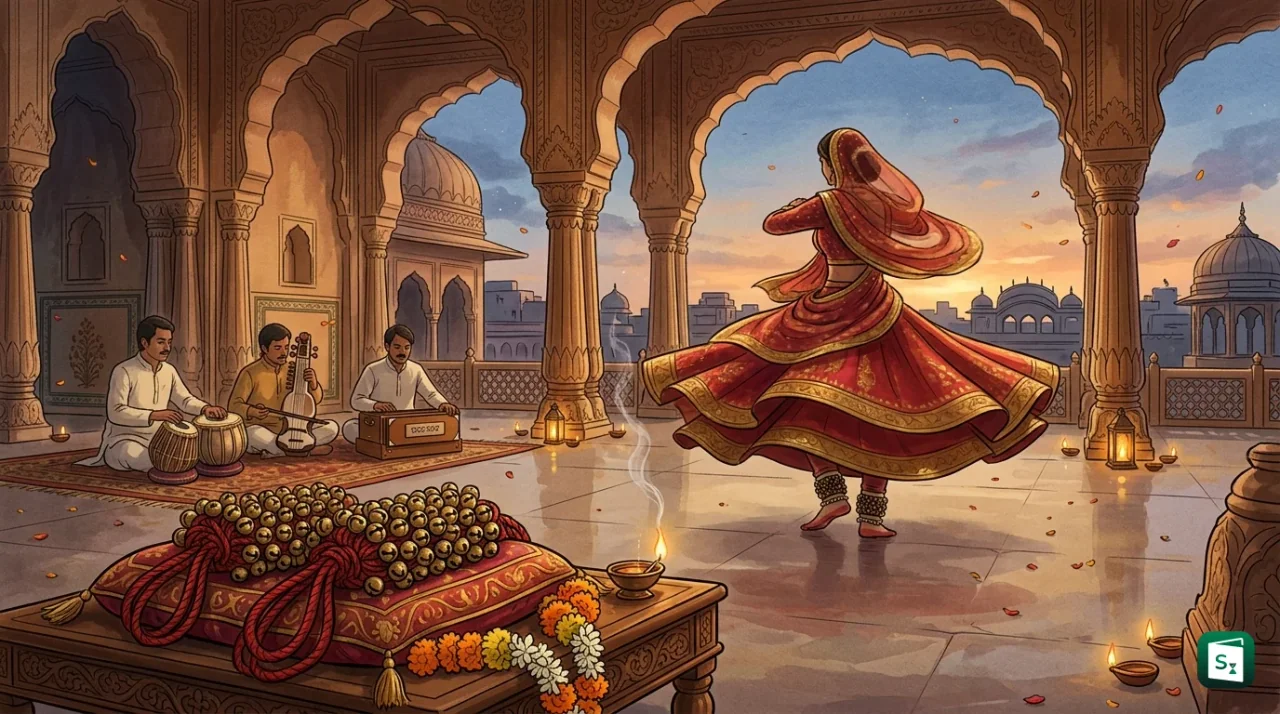
Kathak is most closely linked to Uttar Pradesh in its origin, with early roots placed in Varanasi, and later centres in Lucknow and Jaipur. Today it is practised across North India and taught in major institutions such as Kathak Kendra in New Delhi. Dancers wear small bells called ghungroos around the ankles, and performances are set to Hindustani music with tabla and often pakhawaj accompaniment.
The Jaipur gharana developed under Rajput patronage in Amber and Jaipur. It is nritta pradhan, which means it gives first place to pure dance. Its hallmarks are forceful tatkar or footwork, fast chakkars or spins, complex layakari or play with rhythm, and compositions such as tora, tukra, paran and tihai. Observers described Roshan Kumari’s recitals as vigorous, precise and mathematical, with heavy ghungroos that made her control of time even more striking.
How the Three Main Gharanas Differ
| Gharana | Home Court and Attributed Founder | Core Emphasis |
|---|---|---|
| Jaipur | Rajput courts of Jaipur, traced to Bhanuji | Rhythmic virtuosity, speed, footwork and spins |
| Lucknow | Court of Nawab Wajid Ali Shah of Awadh, traced to Ishwari Prasad, refined by Bindadin Maharaj and Kalka Prasad | Grace and abhinaya, expressive thumri based storytelling |
| Banaras | Varanasi, traced to Janakiprasad | Balance and symmetry, clear bols, restrained use of spins |
Roshan Kumari’s generation is often remembered with two other masters. Sitara Devi carried the Lucknow spirit to mass fame, Damayanti Joshi bridged stage and institution, and Birju Maharaj became the most celebrated face of the Lucknow Kalka Bindadin lineage. Roshan Kumari stood beside them as the clearest stage voice of Jaipur power and precision.
From Ambala to the Silver Screen: Training, Films and Teaching
Roshan Kumari began learning Kathak at five under K. S. Moray, a dance director in Hindi cinema. She then trained at the Maharaj Bindadin School of Kathak in Mumbai under Sunder Prasad of the Jaipur gharana. She later refined her art under Ghulam Hussain Khan and Hanuman Prasad, and she also studied Bharatanatyam under Govindraj Pillai and Mahalingam Pillai. Her father accompanied her long practice sessions on tabla and pakhawaj and shaped the stamina and time sense that defined her dance.
Her first solo concert at thirteen in Kolkata, before about 1,500 people, made her name known beyond Mumbai. Invitations followed from Rashtrapati Bhavan and government programmes. She performed before leaders including Jawaharlal Nehru, Indira Gandhi, Nikita Khrushchev and the King of Nepal. When women dancers still struggled for social acceptance, her parents backed public performance, including the portrayal of Krishna leela themes central to Kathak storytelling.
Cinema carried her art to a wider public. As a performer she appeared in Parineeta (1953), Waris (1954), Mirza Ghalib (1954) and Basant Bahar (1956). Her most remembered screen work is the nine minute dance as Krishna Bai in Jalsaghar (1958), directed by Satyajit Ray with music by Ustad Vilayat Khan. Later she worked as a choreographer for Chaitali (1975), Gopi (1970), Lekin (1990) and Sardari Begum (1996). A Films Division documentary on Kathak released in 1970 also features her alongside other leading exponents.
The Nine Minute Jalsaghar Performance
The Jalsaghar sequence shows a zamindar hosting a final grand baithak in his music room. Roshan Kumari, then only nineteen, performs a traditional chaturang, a four part Jaipur composition, after an alaap by Ustad Waheed Khan. She presents tora, tukra, parans and Krishna based gat bhaav before a large mirror, building speed through percussive footwork and rapid chakkars. Four cameras tracked her movement. Her headgear is seen opening during the take, yet she dances on without a break, a detail still noted as proof of her focus and physical control.
In 1971 Roshan Kumari founded Nritya Kala Kendra at Bandra in Mumbai. The school became a centre for Jaipur style training. Her students include Mukta Joshi, Aditi Bhagwat, Nandita Puri Dhanoa, Nigaar Bano and actor Saira Banu. Disciples recall large ghungroos weighing about 1.5 kg on each foot, strict stress on posture and daily riyaz, and a home she described as a temple to her parents.
Honours and Legacy: Padma Shri and National Recognition
Roshan Kumari received the Nritya Shiromani title from Prayag Sangeet Samiti in 1963 and the Sangeet Natak Akademi Award for Kathak for 1975. The Sangeet Natak Akademi Award is the highest national recognition for performing arts practice in India. The Sur Singar Samsad honoured her with Nritya Vilas in 1977.
The Government of India conferred the Padma Shri on her on 24 March 1984. The Padma Shri, instituted on 2 January 1954, is the fourth highest civilian award of the Republic of India, after the Bharat Ratna, Padma Vibhushan and Padma Bhushan. It is announced each year on Republic Day for distinguished contribution in fields including arts, education, literature, science, medicine, social service and public affairs. Her later honours included the Vishwa Unnyyan Samsad award from West Bengal in 1989, the Maharashtra Gaurav Puraskar in 1990, the Man Patra from Kathak Kendra, Jaipur in 1993, an Emeritus Fellowship of the Government of India, the All India Bhuwalka Award (2005) and the Hanumant Award (2008).
Her legacy rests on three clear contributions. She kept the Jaipur emphasis on rhythmic purity alive on the concert stage at a time when film work pulled many dancers toward lighter styles. She proved that classical technique could hold a cinema frame without dilution, as Jalsaghar still shows. She passed the system on through Nritya Kala Kendra, so her sense of time, speed and discipline continues through her students.
Key Takeaways
- Roshan Kumari, Jaipur gharana exponent of Kathak, passed away in Mumbai on 5 October 2026 at the age of 82.
- Roshan Kumari was an exponent of Kathak, the North Indian classical dance linked in origin to Uttar Pradesh.
- The Jaipur gharana of Kathak is nritta pradhan and stresses fast footwork, chakkars and layakari, while the Lucknow gharana stresses abhinaya and grace.
- Her nine minute dance as Krishna Bai in Jalsaghar (1958) presented a traditional Jaipur chaturang and remains a landmark of classical dance in cinema.
- Roshan Kumari founded Nritya Kala Kendra at Bandra, Mumbai in 1971 to train the next generation in Jaipur style Kathak.
- Roshan Kumari received the Sangeet Natak Akademi Award for 1975 and the Padma Shri on 24 March 1984.