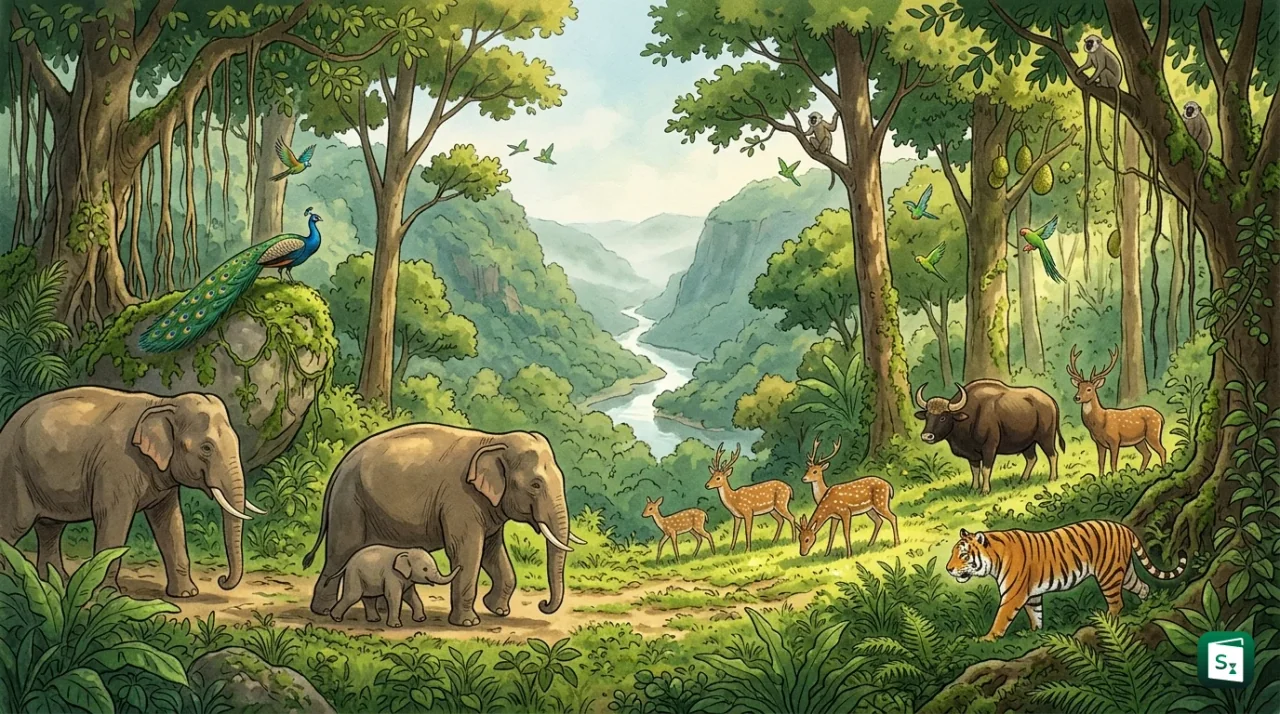
India is observing National Wildlife Week from 2 to 8 October 2026 under the theme Connecting Habitats, Thriving Wildlife. The annual event begins on Gandhi Jayanti and promotes protection of wild animals, plants and their habitats across the country. This year the focus is on linking fragmented forests through wildlife corridors so animals can move safely and populations can thrive.
What Is National Wildlife Week?
National Wildlife Week is India’s annual national observance dedicated to protection of wild animals, birds, plants and their habitats. It is celebrated every year from 2 to 8 October across all states and Union Territories with awareness drives, school programmes and field activities in and around protected areas.
The National Board for Wildlife, the apex body chaired by the Prime Minister, along with the Ministry of Environment, Forest and Climate Change, State Forest Departments, zoo authorities, the Wildlife Institute of India (WII) in Dehradun and conservation groups anchor the celebrations. WII was set up in 1982 and works as the country’s premier training and research institute for wildlife science. The core mandate is simple. Build public support for conservation, explain why habitats matter as much as individual species, and push for daily action against poaching, habitat loss and human wildlife conflict.
When Is Wildlife Week Celebrated and Why These Dates?
National Wildlife Week is observed every year from 2 October to 8 October, in the month of October. In Hindi it is called Vanya Jeev Saptah and it is celebrated from Gandhi Jayanti to 8 October to link wildlife protection with non violence and compassion for living beings.
The choice of 2 October, the birth anniversary of Mahatma Gandhi, is deliberate. Gandhi’s message of non violence extends to animals and nature in public messaging around the week. Starting on this date gives the programme high visibility, since schools, colleges and government offices are already holding commemorative events. It also places the observance in early October, just after the monsoon, when parks and sanctuaries reopen and field visits, bird watching and nature walks are easier to organise.
What Is the Theme for Wildlife Week 2026?
The theme for National Wildlife Week 2026 is Connecting Habitats, Thriving Wildlife. The theme underlines that isolated forests alone cannot save wildlife and that safe ecological corridors between protected areas are essential for movement, breeding and long term survival of species.
Habitat fragmentation means a once continuous forest is broken into small patches by roads, railway lines, farms, towns and dams. Small patches support fewer animals. They trap tigers, elephants, leopards and deer in pockets where food is limited and inbreeding rises. Corridors are narrow strips of natural habitat that join two larger habitats. They let animals disperse, find mates and shift range during drought or floods.
This idea matters sharply in India today. India holds about 3,682 tigers as per the 2022 All India Tiger Estimation, which is nearly 75 percent of the world’s wild tigers. Elephant numbers have also stabilised in many landscapes, so large animals now move far beyond reserve boundaries. Forest departments in states like Sikkim, Maharashtra and Uttarakhand framed their 2026 programmes around this message, with cleanliness drives in butterfly parks, school lessons on corridors, snake rescue demonstrations and village meetings on sharing landscapes safely.
How Did Wildlife Week Begin in India?
National Wildlife Week grew out of India’s early post Independence conservation efforts. The Government of India set up the Indian Board for Wildlife (IBWL) in 1952 to advise on protection of fauna and to create public awareness. The Board was chaired by the Prime Minister.
At first the country observed Wildlife Day in 1955. The response showed that one day was too short for school outreach and field action. In 1957 the observance was expanded into a full week from 2 to 8 October. Since then Wildlife Week has been held every year without break, making the 2026 observance nearly seven decades old.
| Year | Milestone in India’s Wildlife Week history |
|---|---|
| 1952 | Indian Board for Wildlife constituted as advisory body |
| 1955 | First Wildlife Day observed |
| 1957 | Wildlife Week launched from 2 to 8 October |
| 1972 | Wildlife Protection Act enacted on 9 September |
| 1973 | Project Tiger launched on 1 April at Jim Corbett |
| 2003 | National Board for Wildlife replaced IBWL through 2002 amendment |
Legal Framework and Conservation Mandate
The Wildlife Protection Act, 1972 is India’s principal law for wildlife conservation. Parliament passed the Act on 9 September 1972 as Act No. 53 of 1972 to protect wild animals, birds and plants and to regulate hunting, trade and habitat management. Before the Act, India had only five designated national parks. The Act created a uniform legal system for declaring protected areas and banning hunting of listed species.
The Act provides for four types of protected areas. These are national parks under Section 35, wildlife sanctuaries under Section 26A, conservation reserves and community reserves. National parks enjoy the strictest protection, with no grazing or private rights allowed. Sanctuaries can permit certain regulated uses under the supervision of the Chief Wildlife Warden. Conservation and community reserves cover buffer lands and community or private lands and involve local management committees.
The Act was amended in 1991, 2002 and 2022. The 2002 amendment created the National Board for Wildlife, which came into existence through a notification dated 22 September 2003. The Board has 47 members, with the Prime Minister as Chairperson and the Union Minister for Environment, Forest and Climate Change as Vice Chairperson. Its duties include framing conservation policy, advising central and state governments on poaching and illegal trade, recommending new parks and sanctuaries, assessing project impacts on habitats, and publishing a wildlife status report at least once in two years. Enforcement is carried out by forest departments, the Wildlife Crime Control Bureau (WCCB), Customs and the Central Bureau of Investigation (CBI) in serious trafficking cases.
Protected Area Network and Habitat Context
India’s wildlife sanctuary network forms the backbone of the habitat that Wildlife Week seeks to connect. A wildlife sanctuary is a protected area declared for conservation of animals, birds, plants and their habitat, where limited human activity may be allowed under regulation. A national park is a stricter category where human use is largely prohibited.
As of April 2026, India has 107 national parks and 573 wildlife sanctuaries. Together with conservation reserves and community reserves, the country has more than 1,000 protected areas covering about 5.3 percent of its land area. The first national park was Hailey National Park, set up in 1936 in present day Uttarakhand and later renamed Jim Corbett National Park in 1957. Madhya Pradesh has the highest number of national parks at 12, while Maharashtra and the Andaman and Nicobar Islands have very high sanctuary counts.
| Category | Count (as of early 2026) | Legal basis | Key point |
|---|---|---|---|
| National parks | 107 | Wildlife Protection Act, Section 35 | No grazing or private rights, boundary change needs state legislature approval |
| Wildlife sanctuaries | 573 | Wildlife Protection Act, Section 26A | Regulated grazing and rights can be permitted |
| Tiger reserves | 58 | Wildlife Protection Act, Section 38V | Core and buffer model, managed under Project Tiger |
| Elephant reserves | 33 | Executive notification under Project Elephant | Focus on corridors and human elephant conflict |
| Biosphere reserves | 18 | Executive notification | Large landscapes for research and sustainable use |
Tiger reserves deserve special attention during Wildlife Week. Project Tiger began on 1 April 1973 with 9 reserves, starting with Jim Corbett. The network has grown to 58 tiger reserves across 18 states, covering about 84,487 sq km. The newest is Madhav Tiger Reserve in Madhya Pradesh, notified in 2025. The National Tiger Conservation Authority (NTCA), created through the 2006 amendment, administers the programme and conducts the All India Tiger Estimation every four years.
Wildlife Conservation in India and National Initiatives
Wildlife conservation in India follows a landscape approach. This means protecting not only parks but also the corridors, wetlands, forests and farmlands that connect them. The National Wildlife Action Plan (2017 to 2031) is the current national roadmap. Unveiled on 2 October 2017 by the Ministry of Environment, Forest and Climate Change, it is India’s third such plan after the 1983 to 2001 and 2002 to 2016 plans.
The 2017 to 2031 plan has 17 chapters, 103 conservation actions and 250 projects. For the first time it directly addresses climate change impact on wildlife and calls for climate proofing of management plans. It stresses securing corridors, recovering threatened species, managing tourism, controlling poaching and illegal trade, reducing human wildlife conflict, conserving inland and coastal ecosystems, and ensuring steady funding.
Two flagship species programmes support this plan. Project Tiger protects the Bengal tiger, whose scientific name is Panthera tigris tigris. Project Elephant, launched in 1992, supports elephant corridors across 14 states and funds measures like water holes, anti poaching camps and village relocation on a voluntary basis. The Central Zoo Authority, set up in 1992 and headquartered in New Delhi, regulates zoos and captive breeding of endangered species. Zoos like the National Zoological Park in New Delhi and Chhatbir Zoo in Punjab hold special education events during Wildlife Week.
How Is Wildlife Week Celebrated?
National Wildlife Week is not a public holiday. It is a working week of learning and field action. State Forest Departments publish a seven day schedule well before 2 October. In Maharashtra, for example, the Principal Chief Conservator of Forests issued detailed instructions on 4 September 2026 asking every deputy conservator and wildlife warden to prepare day wise outreach on corridors, conflict response and community participation.
Schools and colleges hold quiz contests, painting and poster making competitions, debates, speeches, slogan writing and rangoli events on wildlife themes. Forest divisions organise nature walks, bird watching, photography exhibitions, documentary screenings and guided visits to sanctuaries for students. In villages near protected areas, staff hold meetings on crop protection, livestock safety, compensation for wildlife damage and safe response during leopard or snake encounters. The Forest Research Institute (FRI) in Dehradun, set up in 1906 and operating under the Indian Council of Forestry Research and Education (ICFRE), hosted a national webinar on 8 October 2026 on habitat connectivity with researchers and students.
The closing ceremonies often involve public officials. In Uttarakhand in 2026, the week opened on 1 October at the ICFRE auditorium and closed on 8 October at Lok Bhavan with the Governor presiding, where officials flagged human wildlife conflict as a continuing challenge in a state where settlements sit close to rich forests.
National Wildlife Week, National Wildlife Day and World Wildlife Day
Three observances are often confused, so the distinction matters. National Wildlife Week is India’s domestic week from 2 to 8 October. World Wildlife Day is a global observance held every year on 3 March. The United Nations General Assembly declared 3 March as World Wildlife Day on 20 December 2013 at its 68th session. The date marks the signing of the Convention on International Trade in Endangered Species of Wild Fauna and Flora (CITES) on 3 March 1973. The CITES Secretariat in Geneva facilitates the global celebration.
Their themes also differ each year. India’s 2026 theme is Connecting Habitats, Thriving Wildlife. The World Wildlife Day 2026 theme is Medicinal and Aromatic Plants: Conserving Health, Heritage and Livelihoods, which highlights plants like aloes, frankincense and orchids and the pressures of habitat loss and overharvesting. National Wildlife Day is a separate allied reference used in search and school calendars, but India’s main statutory week remains the October event backed by the National Board for Wildlife.
| Observance | Date | Started by | Focus |
|---|---|---|---|
| National Wildlife Week | 2 to 8 October every year | Indian Board for Wildlife, since 1957 | Indian habitats, corridors and public participation |
| World Wildlife Day | 3 March every year | United Nations General Assembly in 2013 | Global fauna and flora, CITES and trade control |
| World Wildlife Day 2026 theme | 3 March 2026 | CITES Secretariat with UNDP and IFAW | Medicinal and aromatic plants |
Key Takeaways
- National Wildlife Week 2026 was observed from 2 to 8 October under the theme Connecting Habitats, Thriving Wildlife.
- Wildlife Week was first expanded from Wildlife Day (1955) into a week in 1957 after conceptualisation by the Indian Board for Wildlife (1952).
- The Wildlife Protection Act, 1972 was enacted on 9 September 1972 and provides for national parks, sanctuaries, conservation reserves and community reserves.
- India has 107 national parks and 573 wildlife sanctuaries, along with 58 tiger reserves covering about 84,487 sq km (as of early 2026).
- World Wildlife Day is observed globally on 3 March, marking the signing of CITES on 3 March 1973, with the 2026 theme on medicinal and aromatic plants.