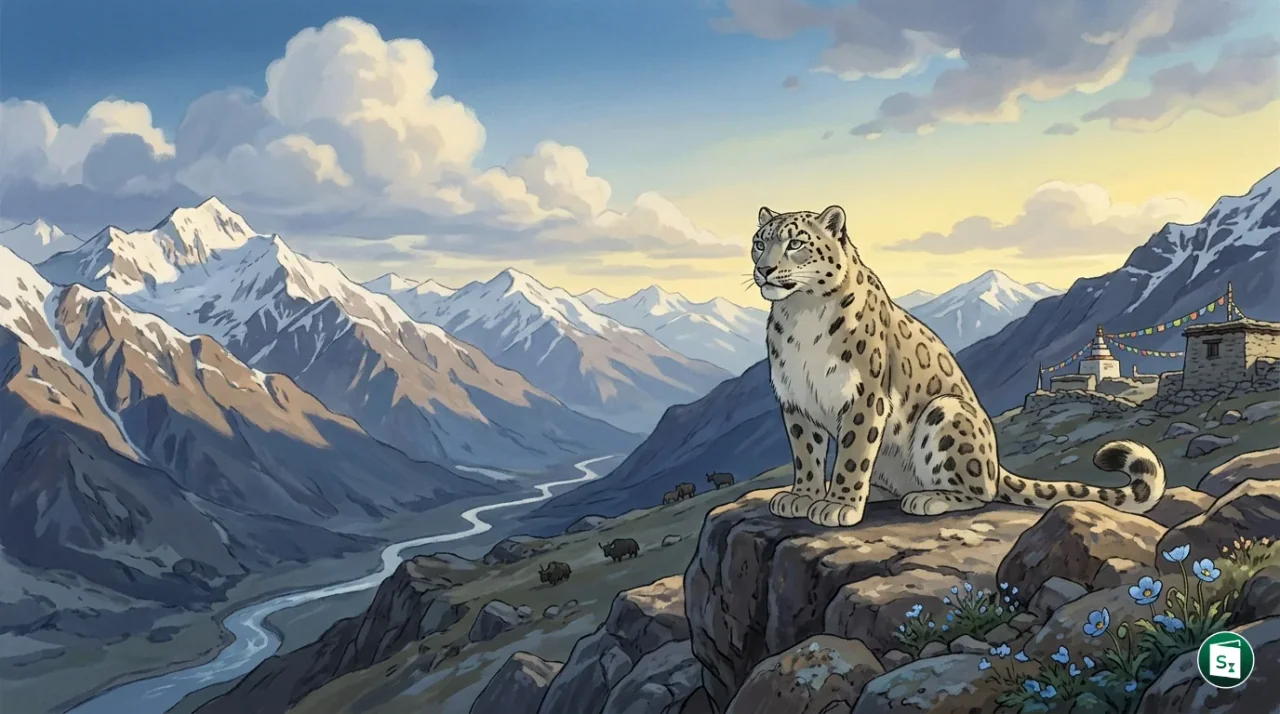
The Lieutenant Governor of Ladakh, Vinai Kumar Saxena, approved the creation of the Snow Leopard and High-Altitude Nature (SHAN) Conservation Society on June 16, 2026. This newly established institutional body is the first dedicated, government-backed initiative for protecting fragile alpine ecosystems and the endangered snow leopard in the union territory. The formation of the society highlights Ladakh’s strategic effort to institutionalize wildlife conservation while addressing local community livelihoods and ecological challenges.
Formation of the SHAN Conservation Society
The Snow Leopard and High-Altitude Nature (SHAN) Conservation Society has been established as a registered body under the Department of Environment and Forests in Ladakh. In the local Ladakhi language, “Shan” is the traditional term for the snow leopard, making the acronym culturally symbolic and deeply connected to the regional identity. The society was formed to address the growing need for a dedicated, permanent authority that can coordinate conservation measures, manage financial resources, and implement field programs.
Prior to the society’s formation, wildlife conservation in Ladakh relied heavily on temporary project-based funding and voluntary efforts by non-governmental groups. By establishing a formal, state-approved society, the administration aims to create a sustainable financial and administrative framework. This structure allows the local government to mobilize resources from diverse channels, including central government grants, CSR funds, and international conservation agencies, ensuring long-term support for environmental protection.
Structure and Governing Body
The governing body of the society is designed as a multi-stakeholder platform to ensure coordination between local leaders, administrative heads, and national conservation experts. The Lieutenant Governor of Ladakh acts as the Chairman of the society, steering its policy direction and execution. The ex-officio members include the Chief Secretary of Ladakh, the Member of Parliament representing the Union Territory, the Chief Executive Councillors of the Ladakh Autonomous Hill Development Councils of Leh and Kargil, and the Principal Secretary of the Department of Forest, Ecology and Environment.
To incorporate scientific expertise and local participation, the board features prominent non-official members. Conservation sector specialists such as Dr. Sejal Worah, Programme Director at WWF India, and Sandesh Kadur, Explorer Trustee of the National Geographic Society Board of Trustees, provide technical and scientific guidance. Local representation is ensured by Palga Rinpoche, Head of the Naljorling Monastery, Ghulam Mohammad Khan, Chairman of the Ladakh Centre for Peace and Sustainable Development, and the President of the Women’s Alliance of Ladakh. This mix of administrative authority, scientific expertise, and grassroots involvement aims to balance ecological conservation with local development needs.
Objectives and Focus Areas
The SHAN Conservation Society operates with a multi-dimensional mandate that addresses both ecological conservation and community welfare. Its primary objective is the conservation of the snow leopard, its prey base, and the fragile alpine habitat of Ladakh. The society is tasked with promoting scientific research and biodiversity monitoring to collect baseline ecological data. This information is critical for designing targeted intervention plans to preserve the region’s unique wetlands and cold desert landscapes.
A major focus of the society is the mitigation of human-wildlife conflict. Because livestock predation by snow leopards is a frequent issue in high-altitude villages, the society aims to establish robust compensation and insurance frameworks for pastoralists. Additionally, it will work to build predator-proof corrals to prevent conflict. The society also seeks to create sustainable livelihood opportunities for local communities through community-led eco-tourism, including homestay networks and wildlife guiding, turning local residents into active custodians of their environment.
Snow Leopard Population Status in India
The creation of the SHAN Conservation Society comes in the wake of the Snow Leopard Population Assessment in India (SPAI), which was released in January 2024. The assessment represents the first-ever systematic and scientific nationwide census of snow leopards in India, conducted between 2019 and 2023 under the coordination of the Wildlife Institute of India (WII). The study estimated the total population of snow leopards in India to be 718, with the vast majority located in the high-altitude regions of Ladakh.
The census covered approximately 120,000 square kilometres of high-altitude habitat, representing more than 70 percent of the species’ potential range in the country. It employed occupancy-based sampling and camera-trap abundance estimation at nearly 2,000 locations, generating around 180,000 trap nights. The state-wise breakdown highlights Ladakh’s status as the primary stronghold for the species in India:
| State / Union Territory | Estimated Snow Leopard Population |
|---|---|
| Ladakh | 477 |
| Uttarakhand | 124 |
| Himachal Pradesh | 51 |
| Arunachal Pradesh | 36 |
| Sikkim | 21 |
| Jammu and Kashmir | 9 |
| Total Population | 718 |
Conservation Efforts and Protected Habitats
The snow leopard, scientifically known as Panthera uncia, is a flagship species of the high-altitude Himalayan ecosystem. It is listed as Vulnerable on the International Union for Conservation of Nature (IUCN) Red List and is protected under Schedule I of the Indian Wildlife (Protection) Act, 1972, which grants it the highest level of legal protection against hunting and trade. Additionally, it is listed in Appendix I of the Convention on International Trade in Endangered Species (CITES), prohibiting commercial international trade of the species.
Ladakh’s conservation landscape features several key habitats, most notably Hemis National Park. Established in 1981, Hemis is the largest national park in India, spanning over 4,400 square kilometres, and is globally recognized as the snow leopard capital of the world due to its high density of the species. India’s broader conservation strategies include Project Snow Leopard, launched by the Ministry of Environment, Forest and Climate Change in 2009 to promote a landscape-level conservation approach. This is supplemented by the Secure Himalaya project, a joint initiative by the Indian government, the Global Environment Facility (GEF), and the United Nations Development Programme (UNDP) to protect high-altitude biodiversity and secure local livelihoods.
Key Takeaways
- The Snow Leopard and High-Altitude Nature (SHAN) Conservation Society was approved by the Lieutenant Governor of Ladakh on June 16, 2026.
- The society is a dedicated institutional mechanism functioning under the Department of Environment and Forests in the Union Territory of Ladakh.
- The Governing Body of the society is chaired by the Lieutenant Governor of Ladakh and includes representatives from WWF India and the National Geographic Society.
- According to the 2024 Snow Leopard Population Assessment in India, there are 718 snow leopards in the country, with 477 of them located in Ladakh.
- The snow leopard is protected under Schedule I of the Wildlife (Protection) Act, 1972, and is classified as Vulnerable on the IUCN Red List.
- Hemis National Park, established in 1981 in Ladakh, is India’s largest national park and a critical habitat for the snow leopard.