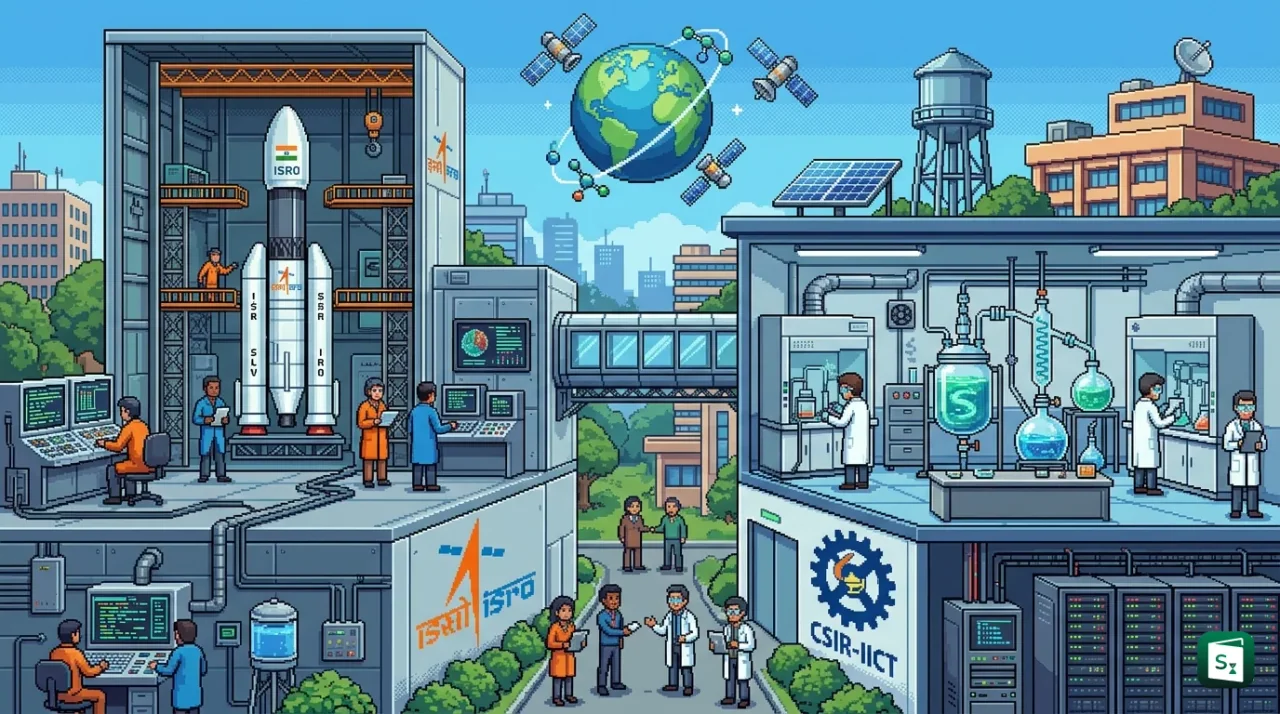
The Vikram Sarabhai Space Centre (VSSC), ISRO’s lead centre for launch vehicle development, has signed a Memorandum of Understanding with the CSIR-Indian Institute of Chemical Technology (CSIR-IICT) to jointly develop indigenous technology for next-generation environmentally sustainable blowing agents. The collaboration targets HydroFluoro-Olefins (HFOs), a class of chemicals with zero Ozone Depletion Potential and ultra-low Global Warming Potential, to replace conventional high-emission blowing agents used in industrial foams and insulation. This partnership brings together IICT’s expertise in fluorochemical synthesis and VSSC’s application-specific requirements for strategic and space-grade materials.
What Are Blowing Agents?
Blowing agents are chemical substances used to create a cellular structure in various materials, resulting in lightweight polymer foams. When added to polymers during manufacturing, they generate gas that expands the material into a foam, producing characteristics such as thermal insulation, structural damping, and acoustic protection. These foams are widely used in refrigeration, building insulation, automotive components, and aerospace applications.
In the space sector, blowing agents play a critical role in developing thermal insulation for launch vehicles, structural damping materials for spacecraft, and lightweight core materials that are essential for payload optimisation and structural integrity. The performance of these foams depends heavily on the chemical properties of the blowing agent used.
The chemistry of blowing agents has evolved over the decades. Chlorofluorocarbons (CFCs) were the first generation of blowing agents, but they were found to deplete the stratospheric ozone layer and were banned under the Montreal Protocol of 1987. They were replaced by Hydrochlorofluorocarbons (HCFCs) and later Hydrofluorocarbons (HFCs) . While these alternatives did not harm the ozone layer, HFCs turned out to be potent greenhouse gases with high Global Warming Potential (GWP), some ranging from 12 to 14,000 times that of carbon dioxide.
The Shift to HFOs: Zero ODP and Ultra-Low GWP
HydroFluoro-Olefins (HFOs) represent the next generation of environmentally sustainable fluorochemicals. Unlike their predecessors, HFOs have zero Ozone Depletion Potential (ODP) and an ultra-low Global Warming Potential (GWP) , making them the preferred replacement for high-GWP HFCs across multiple industries.
The global transition from HFCs to HFOs is being driven by the Kigali Amendment to the Montreal Protocol, adopted in October 2016 in Kigali, Rwanda. Under this amendment, parties to the Montreal Protocol committed to phasing down the production and consumption of HFCs by 80 to 85 per cent by the late 2040s. India ratified the Kigali Amendment in September 2021 and is required to complete its HFC phase-down in four steps: a 10 per cent reduction by 2032, 20 per cent by 2037, 30 per cent by 2042, and 85 per cent by 2047, with a freeze on HFC consumption starting in 2028.
This regulatory push has created a growing demand for low-GWP alternatives such as HFOs, which are now being adopted in refrigeration, air conditioning, and foam blowing applications worldwide.
What the VSSC-IICT Collaboration Entails
The MoU was signed by the directors of both institutions at VSSC in Thiruvananthapuram. IICT was represented by its Director Dr D. Srinivas Reddy, along with distinguished scientists Dr Nettem Choudary, Dr Pravin Likhar, and project lead Dr Punna Nagender. VSSC Director Dr Rajeev U.P. led the VSSC delegation.
Under the agreement, IICT will contribute its expertise in fluorochemical synthesis, process development, and scale-up, while VSSC will provide application-specific requirements and technical evaluation capabilities for strategic-grade materials. A key asset in this partnership is IICT’s Fluoroorganics Laboratory, which possesses specialised infrastructure for the safe handling of anhydrous Hydrogen Fluoride (HF) , a highly reactive and corrosive chemical that is critical for synthesising next-generation fluorochemicals. Such expertise is available only in a handful of laboratories globally.
The collaboration aims to develop indigenous HFO-based blowing agent technology that can be commercially scaled. Dr Punna Nagender stated that the project would strengthen India’s capabilities in advanced fluorochemicals while reducing dependence on imported specialty chemicals.
Strategic Significance for India’s Space and Industrial Sectors
This collaboration is significant on multiple fronts. For ISRO, indigenous HFO technology means access to high-performance foams for launch vehicles and spacecraft without relying on foreign suppliers. Lightweight thermal insulation and structural foams are critical for reducing payload weight and improving mission efficiency. The ability to develop and produce these materials domestically aligns with ISRO’s broader push toward self-reliance in materials and propulsion.
For India’s industrial sector, the development of domestic HFO capacity addresses a growing need as international HFC phase-down deadlines approach. India currently imports most of its specialty fluorochemicals, including HFOs, from countries such as China, Japan, and the United States. Indigenous production would not only save foreign exchange but also insulate Indian manufacturers from global supply chain disruptions.
From an environmental perspective, the shift to HFOs supports India’s commitments under both the Kigali Amendment and its broader climate goals. The HFC phase-down under the amendment is expected to prevent emissions of up to 105 million tonnes of CO2 equivalent of greenhouse gases globally and help avoid up to 0.5 degree Celsius of global temperature rise by 2100.
About the Partner Institutions
The Vikram Sarabhai Space Centre was established in 1963 as the Thumba Equatorial Rocket Launching Station and was renamed after Dr Vikram Sarabhai, the father of India’s space programme, following his death in 1971. Headquartered in Thiruvananthapuram, it is ISRO’s lead centre for the design and development of launch vehicle technology, including the PSLV, GSLV, and LVM3 families. VSSC employs about 4,500 people and houses the Trisonic Wind Tunnel, inaugurated in 2024.
The CSIR-Indian Institute of Chemical Technology was established in 1944 and is headquartered in Tarnaka, Hyderabad. It is one of the oldest national laboratories under the Council of Scientific and Industrial Research (CSIR) . IICT conducts research in basic and applied chemistry, biochemistry, chemical engineering, and holds one of the highest numbers of patents among CSIR laboratories.
Key Takeaways
- VSSC and CSIR-IICT signed an MoU to jointly develop indigenous HydroFluoro-Olefin (HFO) based blowing agents with zero ODP and ultra-low GWP.
- Blowing agents are chemicals used to create lightweight polymer foams essential for thermal insulation, structural damping, and acoustic protection in space launch vehicles.
- The Kigali Amendment to the Montreal Protocol (adopted 2016, ratified by India in 2021) mandates an 85 per cent phase-down of HFCs by 2047.
- India must freeze HFC consumption in 2028 and achieve reductions of 10 per cent by 2032, 20 per cent by 2037, 30 per cent by 2042, and 85 per cent by 2047.
- IICT’s Fluoroorganics Laboratory in Hyderabad possesses specialised infrastructure for safe handling of anhydrous HF, a capability available in very few laboratories worldwide.
- VSSC, established in 1963 and headquartered in Thiruvananthapuram, is ISRO’s lead centre for launch vehicle development, employing about 4,500 people.