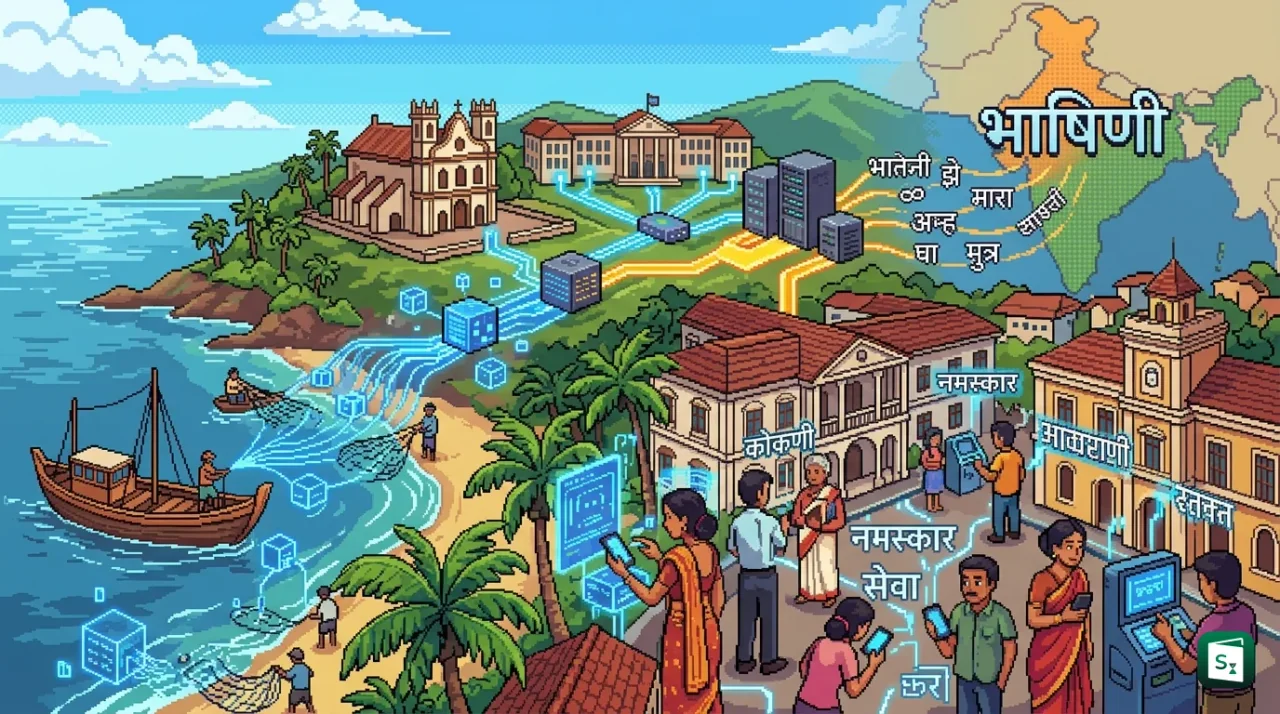
The Digital India BHASHINI Division (DIBD), under the Ministry of Electronics and Information Technology (MeitY), partnered with the Goa government to organise the BHASHINI Rajyam: State Engagement Workshop in Panaji. The workshop brought together policymakers, industry leaders, and language technology experts to advance Konkani-focused AI solutions and expand voice-first digital public services. Chief Minister Dr. Pramod Sawant and IT Minister Rohan A. Khaunte attended the event, underscoring the state’s commitment to language-inclusive digital governance.
What Is BHASHINI?
BHASHINI, short for BHASha INterface for India, is India’s national AI-powered language translation platform. It was launched in July 2022 as the National Language Translation Mission (NLTM) by the Prime Minister during Digital India Week in Gandhinagar, Gujarat. The platform is developed and operated by the Digital India BHASHINI Division (DIBD), an Independent Business Division under Digital India Corporation (DIC), which is a non-profit company established by MeitY.
BHASHINI uses Natural Language Processing (NLP) and artificial intelligence to provide real-time translation, speech recognition, text-to-speech conversion, and transliteration across Indian languages. It currently supports 36 Indian text languages, 23 Indian voice languages, and 35 international languages. The platform powers more than 800 government websites, has enabled over 8 billion AI inferences, and processes over 20 million AI inferences daily.
The platform operates through the National Hub for Language Technology (NHLT), which provides scalable speech and text-based AI services. BHASHINI offers a range of products including BHASHINI App Mitra, BHASHINI Mitra, and BHASHINI Pravakta, each designed to integrate AI-powered multilingual capabilities into government and citizen-facing applications.
BHASHINI Rajyam: Bringing Language AI to States
BHASHINI Rajyam is the division’s flagship state engagement initiative designed to accelerate the adoption of language technology across Indian states and Union Territories. It functions as a co-creation platform where state governments collaborate with DIBD to build voice-first digital public infrastructure tailored to regional linguistic needs.
The initiative focuses on five pillars: voice-first digital governance, digital and linguistic inclusion, domain-specific customisation, language model training, and collaborative co-creation. As of mid-2026, BHASHINI Rajyam has onboarded over 5,000 users across state governments, translated more than 400 government websites through its translation plugin, and built over 1.5 million glossary terms for regional language AI models.
The Rajyam workshops have been held in multiple states, including Gujarat and Jammu, before the Goa chapter. Each workshop identifies state-specific use cases and builds partnerships with local academic institutions, startups, and language experts to strengthen regional language datasets.
The Goa Workshop: Key Highlights
The Goa chapter of BHASHINI Rajyam featured technical sessions on the National Hub for Language Technology (NHLT) and live demonstrations of AI-powered language solutions. Participants experienced voice-based translation, transcription, and document processing tools that can be integrated into government platforms.
In his keynote address, Amitabh Nag, CEO of DIBD, outlined BHASHINI’s vision for a language-first Digital Public Infrastructure and highlighted its growing impact across governance, tourism, healthcare, education, banking, and citizen services. He stressed the need for stronger partnerships among governments, academia, startups, and language experts to develop regional language ecosystems.
A dedicated session focused on strengthening the Konkani language ecosystem. Discussions explored expanding language datasets, improving AI models for Konkani, and identifying Goa-specific use cases. An Open Mic on Use Cases session encouraged participants to propose practical applications of multilingual AI across sectors such as tourism, education, and healthcare.
The workshop also showcased a simulated voice journey of a Goan youth, demonstrating how citizens could interact with government schemes, digital services, and education platforms entirely through voice commands in Konkani.
Goa AI Mission and the Konkani Large Language Model
As part of the Goa AI Mission 2027, the state government has signed a Memorandum of Understanding (MoU) with BHASHINI to develop a Conversational Konkani Large Language Model (LLM). This LLM will enable citizens to interact with digital platforms in their mother tongue, making government services accessible through natural, voice-based conversations.
IT Minister Rohan Khaunte explained that the MoU would give government departments access to AI-powered translation tools. He cited the example of the Printing and Stationery Department, which publishes the official Konkani Gazette. Currently, departmental notifications are uploaded in English, but with the integration of BHASHINI tools, farmers and other citizens will receive government information directly in Konkani.
The Goa AI Mission is building a comprehensive AI ecosystem in the state through four pillars: skilling, startups, innovation, and venture capital. The mission ensures that Konkani remains at the centre of the state’s digital transformation. The initiative also complements programmes such as Mahila Digital Sashaktikaran, which aims to improve digital literacy among women, empower self-help groups, and help rural communities access online marketplaces and government services.
Konkani: A Language of Constitutional Significance
Konkani is the official language of Goa, declared through the Goa, Daman and Diu Official Language Act, 1987, with the Devanagari script as its official script. The Goa Legislative Assembly passed this legislation on 4 February 1987, making Konkani the sole official language of the state.
Konkani is also one of the 22 scheduled languages of India under the Eighth Schedule of the Constitution. It was added through the 71st Constitutional Amendment Act, 1992, along with Manipuri and Nepali. The language is spoken by over 7 million people primarily in Goa, coastal Karnataka, Maharashtra, and Kerala, though it has several dialects across these regions.
The development of a Konkani LLM through BHASHINI is significant because it addresses a longstanding gap. While India’s major languages have seen rapid AI adoption, smaller scheduled languages like Konkani have lacked the digital infrastructure and datasets needed for advanced language technologies. The BHASHINI Rajyam initiative directly tackles this by building high-quality Konkani datasets and training AI models specifically for the language.
Key Takeaways
- BHASHINI (BHASha INterface for India) is India’s national AI-powered language translation platform, launched in July 2022 as part of the National Language Translation Mission (NLTM) under MeitY.
- The BHASHINI Rajyam: State Engagement Workshop in Panaji, Goa, focused on promoting multilingual AI and building a Konkani language ecosystem for voice-first government services.
- The Goa government signed an MoU with BHASHINI under the Goa AI Mission 2027 to develop a Conversational Konkani Large Language Model (LLM).
- BHASHINI powers over 800 government websites, supports 36 Indian text languages and 23 Indian voice languages, and processes over 20 million AI inferences daily.
- Konkani was added as a scheduled language under the Eighth Schedule of the Constitution through the 71st Amendment Act, 1992, and is the official language of Goa under the Goa, Daman and Diu Official Language Act, 1987.
- The Digital India BHASHINI Division (DIBD) operates under Digital India Corporation (DIC), a non-profit established by MeitY to drive digital inclusion through language AI.