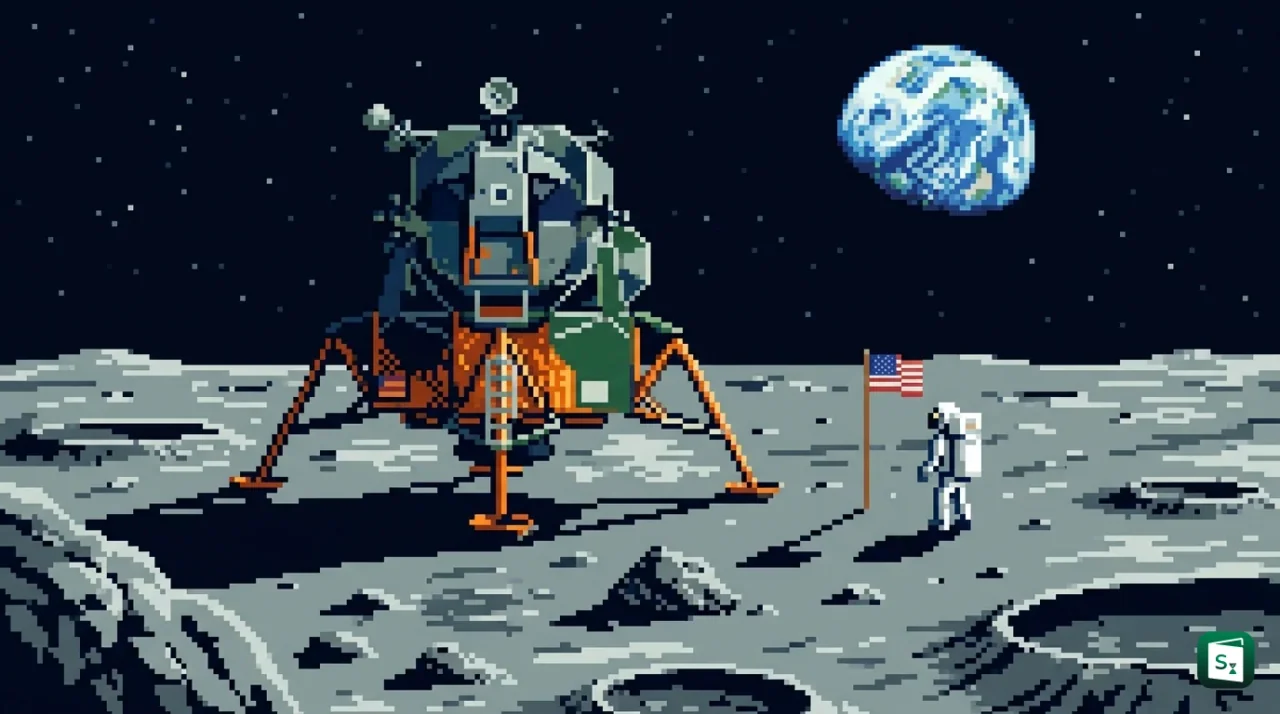
The United Nations observes International Moon Day every year on July 20 to mark the anniversary of the first human landing on the Moon. The Apollo 11 mission achieved this historic feat in 1969, when astronauts Neil Armstrong and Buzz Aldrin became the first humans to set foot on the lunar surface. First observed in 2022, the day celebrates past achievements in lunar exploration while raising awareness about the sustainable future of Moon exploration.
How International Moon Day Came to Be
The United Nations General Assembly (UNGA) declared International Moon Day through its Resolution A/RES/76/76 on December 9, 2021. The resolution was adopted under the agenda item on international cooperation in the peaceful uses of outer space. The date July 20 was chosen to honour the anniversary of the Apollo 11 lunar landing.
The declaration followed a proposal by the Moon Village Association, a non-governmental organisation that promotes global collaboration in lunar exploration. The proposal was first endorsed by the United Nations Committee on the Peaceful Uses of Outer Space (COPUOS), the primary UN body dealing with international space cooperation. COPUOS was established in 1959 and operates under the UN Office for Outer Space Affairs (UNOOSA), which is headquartered in Vienna, Austria. The first observance of International Moon Day took place on July 20, 2022.
The Apollo 11 Mission: A Giant Leap for Mankind
The Apollo 11 mission was the culmination of the Apollo programme run by the National Aeronautics and Space Administration (NASA) of the United States. The programme was set in motion by President John F. Kennedy’s challenge in 1961 to land a man on the Moon and return him safely to Earth before the end of the decade.
The mission launched on July 16, 1969, from the Kennedy Space Center in Florida aboard a Saturn V rocket, the most powerful rocket ever built at the time. The spacecraft had three main components: the Command Module Columbia, which carried the crew; the Service Module, which provided propulsion and life support; and the Lunar Module Eagle, which descended to the lunar surface.
The crew consisted of three astronauts. Neil Armstrong, the mission commander and a civilian test pilot, was the first person to walk on the Moon. Edwin “Buzz” Aldrin, the Lunar Module Pilot and a US Air Force pilot, followed him approximately 19 minutes later. Michael Collins, the Command Module Pilot, remained in orbit around the Moon aboard Columbia, piloting the spacecraft alone while his crewmates were on the surface.
On July 20, 1969, the Lunar Module Eagle touched down in the Sea of Tranquility (Mare Tranquillitatis). Armstrong radioed the now famous words: “Houston, Tranquility Base here. The Eagle has landed.” Hours later, he stepped onto the lunar surface and declared: “That is one small step for a man, one giant leap for mankind.”
The astronauts spent about 21 hours on the lunar surface, including 2.5 hours of extravehicular activity. They collected 21.6 kilograms of lunar rock and soil samples, deployed scientific instruments including a seismometer to measure moonquakes and a laser retroreflector for precise Earth-Moon distance measurements, and planted the US flag. The crew splashed down safely in the Pacific Ocean on July 24, 1969.
India’s Journey to the Moon
India’s lunar exploration programme, Chandrayaan (meaning “Moon vehicle” in Sanskrit), is one of the most ambitious space science endeavours of the Indian Space Research Organisation (ISRO). ISRO was established in 1969, the same year as the Apollo 11 landing, and is headquartered in Bengaluru, Karnataka.
Chandrayaan 1: The Discovery of Water
India’s first lunar mission, Chandrayaan 1, was launched on October 22, 2008, from the Satish Dhawan Space Centre in Sriharikota, Andhra Pradesh. The spacecraft orbited the Moon at an altitude of 100 km and made a pioneering discovery: the presence of water molecules on the lunar surface. It also carried a Moon Impact Probe (MIP) that deliberately crash-landed near the lunar south pole, confirming the presence of water ice in that region. This discovery reshaped the scientific understanding of the Moon and elevated India’s standing in planetary science. The mission operated for 312 days.
Chandrayaan 2 and 3: Building on Success
Chandrayaan 2, launched on July 22, 2019, was a more complex mission comprising an orbiter, a lander named Vikram, and a rover named Pragyan. While the orbiter continues to function and has produced high-resolution maps of the lunar surface, the lander lost contact during its attempted soft landing. The orbiter, however, remains operational and continues to send valuable scientific data.
Chandrayaan 3, launched on July 14, 2023, was a follow-on mission focused solely on demonstrating the capability for a safe and soft landing on the lunar surface. On August 23, 2023, the Vikram lander successfully touched down near the lunar south pole, making India the first country to land a spacecraft near the south pole and the fourth country overall to achieve a soft landing on the Moon, after the United States, the Soviet Union, and China. The Pragyan rover deployed and conducted in-situ chemical analysis of the lunar soil, confirming the presence of sulphur, aluminium, and other elements.
| Mission | Launch Date | Key Outcome |
|---|---|---|
| Chandrayaan 1 | October 22, 2008 | Discovered water molecules on the Moon; operated for 312 days |
| Chandrayaan 2 | July 22, 2019 | Orbiter functional; lander Vikram lost during descent |
| Chandrayaan 3 | July 14, 2023 | First successful soft landing near the lunar south pole on August 23, 2023 |
The New Space Race: Why Nations Are Returning to the Moon
International Moon Day arrives at a time when global interest in lunar exploration is at its highest in decades. The driving force behind this renewed focus is the lunar south pole, a region that contains water ice in permanently shadowed craters. This water could potentially be used for drinking, oxygen generation, and even conversion into rocket fuel. Establishing a sustainable human presence on the Moon is now a scientific and strategic objective for several nations.
NASA’s Artemis programme, named after the twin sister of Apollo in Greek mythology, aims to return humans to the Moon and establish a long-term presence. Artemis II, which took place from April 1 to April 11, 2026, carried four astronauts on a crewed flyby around the Moon, marking the first crewed mission beyond low Earth orbit since Apollo 17 in 1972. The mission travelled beyond the far side of the Moon and returned safely to Earth after ten days. Future Artemis missions are expected to land astronauts near the lunar south pole.
China has also made significant progress with its Chang’e programme, named after the Chinese Moon goddess. Chang’e 4 achieved the first-ever landing on the far side of the Moon in 2019, while Chang’e 5 returned lunar samples to Earth in 2020. Russia’s Luna 25 attempted a south pole landing in 2023, though it crashed. Japan’s SLIM mission achieved a precision landing in early 2024. These efforts reflect the growing international consensus that the Moon is the next frontier for scientific discovery and resource utilisation.
| Country / Agency | Mission | Year | Key Achievement |
|---|---|---|---|
| NASA (US) | Apollo 11 | 1969 | First human landing on the Moon |
| Soviet Union | Luna 2 | 1959 | First spacecraft to reach the Moon |
| ISRO (India) | Chandrayaan 1 | 2008 | Discovered water molecules on the Moon |
| CNSA (China) | Chang’e 4 | 2019 | First landing on the far side of the Moon |
| ISRO (India) | Chandrayaan 3 | 2023 | First landing near the lunar south pole |
| JAXA (Japan) | SLIM | 2024 | First precision landing within 100 metres of target |
| NASA (US) | Artemis II | 2026 | First crewed lunar flyby in 54 years |
The Legal Framework for Lunar Exploration
The exploration and use of the Moon are governed by international space law, primarily the Outer Space Treaty of 1967, often called the “Magna Carta of Space.” This treaty, which entered into force on October 10, 1967, establishes that outer space, including the Moon and other celestial bodies, shall be free for exploration and use by all states and cannot be claimed by any nation through sovereignty. It also mandates that the Moon and other celestial bodies shall be used exclusively for peaceful purposes.
A more specific instrument, the Moon Agreement of 1979 (formally the Agreement Governing the Activities of States on the Moon and Other Celestial Bodies), declares the Moon and its natural resources to be the common heritage of mankind. It calls for the establishment of an international regime to govern the exploitation of lunar resources once such exploitation becomes feasible. However, the Moon Agreement has not been ratified by major spacefaring nations, including the United States, Russia, China, and India, which limits its practical impact.
The UN Committee on the Peaceful Uses of Outer Space (COPUOS) continues to serve as the primary forum for discussing the governance of lunar activities. As more nations and private companies plan missions to the Moon, questions around resource extraction, property rights, and environmental protection on the lunar surface are becoming increasingly urgent.
Key Takeaways
- International Moon Day is observed annually on July 20, declared by the UN General Assembly through Resolution A/RES/76/76 on December 9, 2021.
- The day commemorates the Apollo 11 mission of 1969, during which Neil Armstrong and Buzz Aldrin became the first humans to walk on the Moon while Michael Collins orbited above.
- CHANDRAYAAN 1 (2008) was India’s first lunar mission and made the landmark discovery of water molecules on the Moon.
- CHANDRAYAAN 3 (2023) made India the first nation to land near the lunar south pole and the fourth country to achieve a soft landing on the Moon overall.
- Lunar exploration is governed by the Outer Space Treaty of 1967, which prohibits national sovereignty over celestial bodies and mandates their peaceful use.
- The UN Office for Outer Space Affairs (UNOOSA), headquartered in Vienna, Austria, serves as the secretariat for the Committee on the Peaceful Uses of Outer Space (COPUOS).