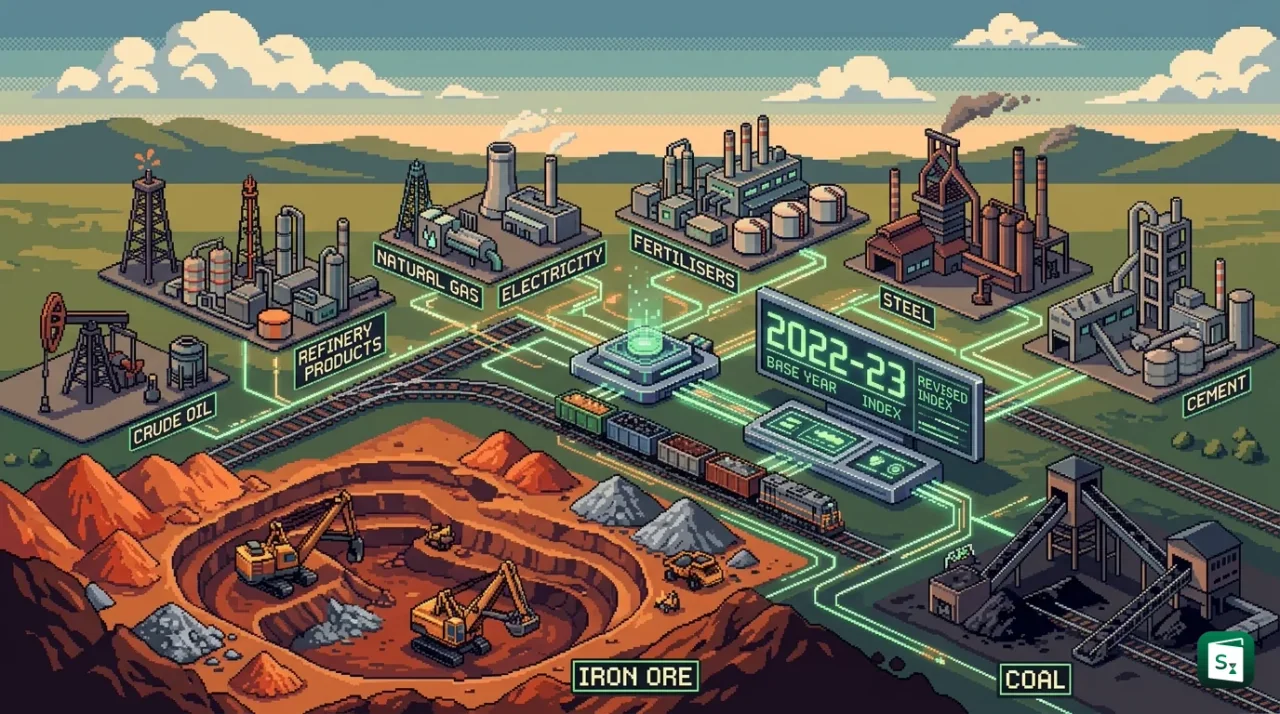
The Office of Economic Adviser (OEA) under the Ministry of Commerce and Industry has released a revised series of the Index of Core Industries (ICI), updating the base year from 2011-12 to 2022-23. For the first time, iron ore has been included as a core industry, expanding the basket from eight to nine sectors. The revision, aligned with similar updates to GDP, WPI, and IIP data, ensures that the index reflects the current structure of India’s industrial economy more accurately.
What Is the Index of Core Industries (ICI)?
The Index of Core Industries is a monthly production volume index that tracks the combined and individual output of India’s most essential infrastructure industries. It is compiled by the Office of Economic Adviser (OEA), an attached office of the Department for Promotion of Industry and Internal Trade (DPIIT), which functions under the Ministry of Commerce and Industry. The OEA is also responsible for compiling the monthly Wholesale Price Index (WPI) and providing economic policy inputs on industrial development.
The ICI serves as a lead indicator for the broader Index of Industrial Production (IIP), which is compiled by the National Statistical Office (NSO) under the Ministry of Statistics and Programme Implementation (MoSPI). Because the ICI tracks a focused set of foundational industries, its performance often signals the direction of overall industrial output. A combined weight of these core industries in the IIP now stands at 32.88%, down from 40.27% under the old 2011-12 series, due to the methodological changes and weight redistribution.
The Nine Core Industries
The revised ICI basket now covers the following nine industries:
| Industry | Revised Weight (%) | Industry | Revised Weight (%) |
|---|---|---|---|
| Electricity | 30.932 | Crude Oil | 7.430 |
| Refinery Products | 22.572 | Coal | 5.596 |
| Steel | 17.584 | Iron Ore | 4.905 |
| Natural Gas | 3.841 | Cement | 4.410 |
| Fertilizers | 2.731 |
The provisional ICI for a reference month is normally released on the 20th of the following month, or on the next working day if the 20th is a holiday. Alongside the revised series, the OEA also released a back series of ICI data from April 2023 to May 2026 (38 months) to allow for historical comparison.
Key Changes in the Revised ICI Series
The revision introduced several important methodological changes beyond just updating the base year.
Addition of Iron Ore
Iron ore was added as the ninth core industry in recognition of its intensive use in steel manufacturing and its significant contribution to industrial development. India is the world’s second-largest producer of crude steel, and iron ore is the primary raw material for steel production. The newly added sector has been assigned a weight of 4.905% in the index.
Shift to Gross Production for Steel Index
The steel index will now be compiled using gross production data instead of net production data, aligning it with the methodology used in the IIP. This change eliminates inconsistencies that arose from the earlier approach of deducting internal consumption within steel plants.
Removal of Double Counting in Coal
Only raw coal has been retained in the new series, while coal middling and washed coal have been excluded. Both are derived products made from raw coal, and including them in the old series led to double counting of the same coal output. This correction makes the coal index more accurate.
Linking Factor for Continuity
To ensure comparability between the old and new series, the government introduced a linking factor. The linking factor for the overall ICI has been set at 1.47. It is calculated as the ratio of the geometric mean of the monthly ICI of the old series for 2022-23 to that of the new series. This allows users to convert data from one series to the other for historical analysis.
Revised Weightage: Winners and Losers
The weight redistribution in the new series reveals which industries have gained or lost relative importance in India’s economy over the past decade.
| Industry | Old Weight (2011-12) | New Weight (2022-23) | Change |
|---|---|---|---|
| Electricity | 19.853% | 30.932% | +11.079% |
| Fertilizers | 2.628% | 2.731% | +0.103% |
| Crude Oil | 8.983% | 7.430% | -1.553% |
| Cement | 5.372% | 4.410% | -0.962% |
| Coal | 10.334% | 5.596% | -4.738% |
| Natural Gas | 6.877% | 3.841% | -3.036% |
| Refinery Products | 28.037% | 22.572% | -5.465% |
| Steel | 17.917% | 17.584% | -0.333% |
| Iron Ore | - | 4.905% | New |
Electricity is the biggest winner, with its weight rising from 19.85% to 30.93%. This sharp increase is driven by two factors: a large rise in the Gross Value Added of the electricity sector over the past decade, and the inclusion of renewable energy sources (solar, wind, hydro) in the calculation of electricity weights in the IIP 2022-23 series, compared to only conventional sources in the 2011-12 series. Electricity now has the highest weight in the index.
Refinery products, despite remaining the second-largest sector, saw the biggest absolute decline, dropping from 28.04% to 22.57%. Coal lost nearly half its weight, falling from 10.33% to 5.60%, reflecting its relatively slower GVA growth compared to other sectors. Natural gas also saw a significant reduction from 6.88% to 3.84%.
ICI and Its Link to the Index of Industrial Production
The ICI is often described as a subset of the IIP because the items tracked in the ICI are drawn from the IIP basket. The weights of ICI items are derived from the corresponding weights in the IIP and then redistributed on a pro-rata basis to total 100.
| Aspect | Index of Core Industries (ICI) | Index of Industrial Production (IIP) |
|---|---|---|
| Compiling Agency | Office of Economic Adviser, DPIIT | National Statistical Office, MoSPI |
| Coverage | 9 core infrastructure industries | 3 broad sectors: Mining, Manufacturing, Electricity (hundreds of item groups) |
| Release Schedule | 20th of every month (provisional) | Around 12th of every month |
| Role | Early indicator of industrial activity | Comprehensive measure of industrial production |
| Weight in IIP | 32.88% (under 2022-23 base) | 100% |
The ICI is a more focused index that tracks the industries forming the backbone of the economy, while the IIP provides a broader picture of industrial output across all sectors. Because core industries have deep forward and backward linkages with the rest of the economy, their performance often signals the direction in which overall industrial output is headed.
Significance of the Base Year Revision
Base year revisions are a routine statistical exercise undertaken for all major macroeconomic indicators to keep them relevant. The previous ICI base year of 2011-12 had become outdated given the structural changes in the Indian economy over 15 years.
The revision brings the ICI in line with the common base year of 2022-23 already adopted for GDP, WPI, and IIP. This alignment allows for more coherent cross-dataset analysis. For instance, policymakers can now directly compare growth rates in core industries with overall GDP growth without adjusting for differing base years.
The inclusion of iron ore addresses a long-standing gap. India is the world’s second-largest steel producer and the fourth-largest iron ore producer, yet iron ore was not tracked as a separate core industry. Its addition ensures that the index captures the mining sector’s contribution to industrial output more comprehensively.
The correction in coal methodology (removing double counting) and the shift to gross steel production improve the statistical accuracy of the index. The government has stated that these changes were recommended by a committee chaired by the Principal Economic Adviser and comprising representatives from ministries of coal, steel, petroleum, fertilizers, and power.
Under the new series, the ICI recorded 5.0% year-on-year growth in June 2026, up from 3.2% in May 2026. Iron ore (43.9%), electricity (9.8%), and cement (9.8%) were the top performers, while natural gas, crude oil, refinery products, and fertilizers registered negative growth. The cumulative ICI growth for April-June 2026 stood at 3.6%, compared to 1.0% in the same period last year.
Key Takeaways
- The Index of Core Industries (ICI), compiled by the Office of Economic Adviser under the Ministry of Commerce and Industry, has been revised with a new base year of 2022-23, replacing the 2011-12 series.
- Iron ore has been added as the ninth core industry, raising the total from eight to nine, with a weight of 4.905%.
- The electricity sector now has the highest weight (30.93%), up from 19.85%, driven by the inclusion of renewable energy in the IIP weight calculation.
- The combined weight of core industries in the IIP has been revised from 40.27% to 32.88% under the new base year.
- A linking factor of 1.47 has been introduced to enable historical comparison between the old and new ICI series.
- The steel index now uses gross production data instead of net production data, and only raw coal is tracked to eliminate double counting.