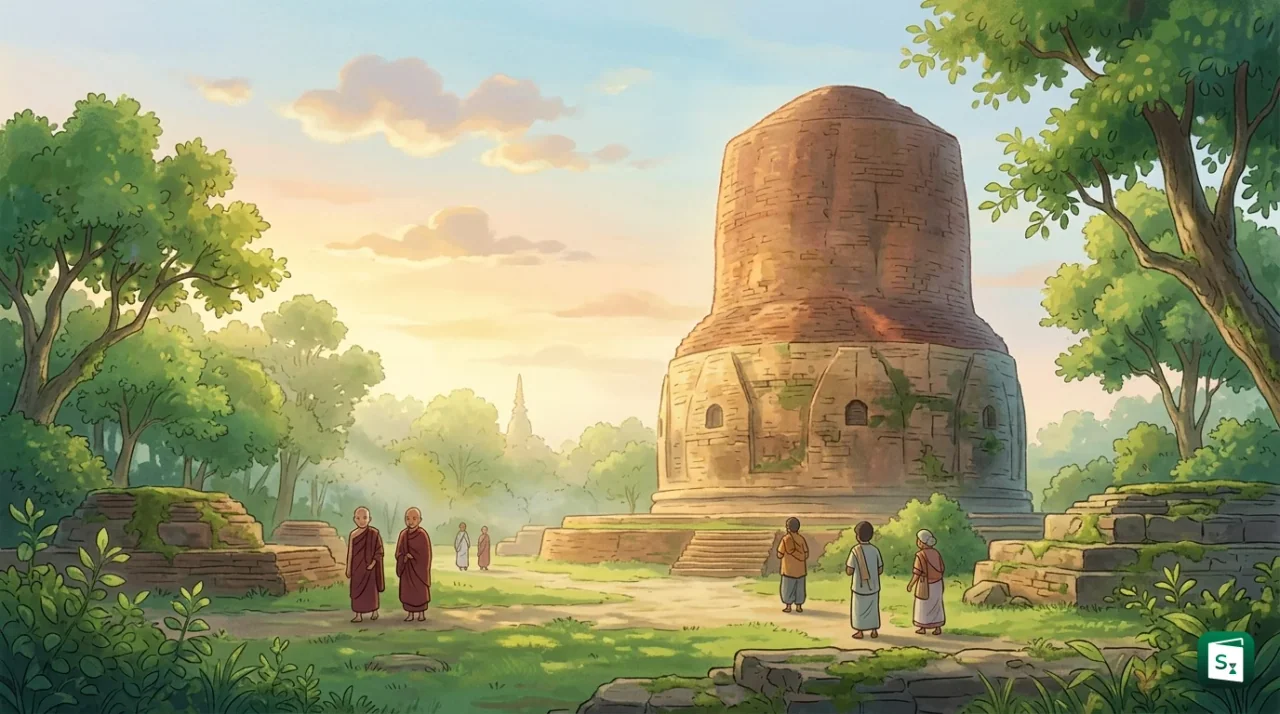
Sarnath, the ancient Buddhist site in Varanasi where Gautama Buddha delivered his first sermon after attaining enlightenment, has been inscribed on the UNESCO World Heritage List. The announcement was made on July 25, 2026, during the 48th session of the World Heritage Committee (WHC) in Busan, South Korea, making it India’s 45th UNESCO World Heritage Site. The recognition ends a 28-year wait for the site, which had been on UNESCO’s Tentative List since July 1998.
Sarnath: Where Buddhism First Found Its Voice
Sarnath, located about 8 kilometres northeast of Varanasi in Uttar Pradesh, is one of the four most sacred pilgrimage sites in Buddhism. It was here, around 528 BCE, that the Buddha delivered his first sermon known as the Dhammacakkappavattana Sutta (Setting the Wheel of Dharma in Motion) to his five original disciples. This event marked the founding of the Buddhist Sangha, the community of monks, and is considered the beginning of Buddhism as an organized faith.
The site’s deep Buddhist heritage is visible in its monumental remains. The Dhamek Stupa, rising 39 metres high and 28 metres in diameter, marks the spot where the first sermon is believed to have been delivered. The Dharmarajika Stupa is one of the few pre-Ashokan stupas remaining at Sarnath. The Ashokan Pillar, erected by Emperor Ashoka in 250 BCE, once stood here with its famous Lion Capital on top, which today serves as the State Emblem of India and appears on every Indian currency note and government document. The capital’s 32-spoke wheel, the Dharmachakra, is also featured on the national flag of India.
Over the centuries, Sarnath grew into a major centre of Buddhist learning, drawing scholars and monks from across Asia. Chinese pilgrims Faxian (5th century CE) and Xuanzang (7th century CE) both visited and left detailed accounts of a thriving monastic complex with hundreds of monks. The site declined after the 12th century CE following invasions and fell into obscurity until its rediscovery by British archaeologists in the 18th and 19th centuries.
The 28-Year Road to UNESCO Recognition
Sarnath was first included in UNESCO’s Tentative List on July 3, 1998, as part of India’s inventory of properties considered suitable for World Heritage nomination. For 28 years, the site remained on this waiting list, competing with dozens of other Indian heritage properties for the country’s limited nomination slots under UNESCO rules, which allow each country to submit only one or two nominations per year.
The nomination process gained momentum in 2024 and 2025. In August 2025, Union Culture Minister Gajendra Singh Shekhawat informed the Lok Sabha that India had submitted a formal dossier titled “Ancient Buddhist Site, Sarnath” to the UNESCO World Heritage Centre for the 2025-26 nomination cycle. The dossier was evaluated by the International Council on Monuments and Sites (ICOMOS), the advisory body to the World Heritage Committee, before being placed for final consideration at the 48th session.
The decision was ultimately made by the 21-member World Heritage Committee, the intergovernmental body responsible for implementing the 1972 World Heritage Convention. India is a signatory to this convention, having ratified it on November 14, 1977.
What the UNESCO Listing Covers
The inscribed property, officially named the Ancient Buddhist Site of Sarnath, comprises two separate component parts. Together these zones preserve the core architectural and archaeological remains of the site, covering a total area of 8.05 hectares with a buffer zone of 72.2 hectares.
| Component | Key Monuments Included |
|---|---|
| Chaukhandi Stupa | Marks the spot where the Buddha met his first five disciples. Capped with an octagonal brick tower built by Emperor Akbar in 1588 CE in memory of his father Humayun |
| Archaeological Remains of Sarnath | Dhamek Stupa, Dharmarajika Stupa, Mulagandha Kuti Vihara, Ashokan Pillar, and several ancient monasteries |
The site was inscribed under cultural criteria (iii) and (vi) of UNESCO’s designation system:
- Criterion (iii): Bears exceptional testimony to the Buddhist tradition as the location of the Buddha’s first sermon, marking the beginning of the Buddhist Sangha
- Criterion (vi): Directly associated with events of outstanding universal significance in Buddhist history
The Sarnath Archaeological Museum, established in 1910, houses the original Lion Capital of Ashoka and the famous 5th century CE sandstone sculpture of Buddha Preaching His First Sermon, making it an integral part of the visitor experience.
Why the UNESCO Tag Matters
The World Heritage inscription brings several tangible and intangible benefits. For conservation, the site now qualifies for technical assistance and funding from the World Heritage Fund, which supports the preservation of properties of Outstanding Universal Value. It also requires India to submit periodic State of Conservation reports to UNESCO, ensuring sustained attention to the site’s upkeep.
On the tourism front, the recognition is expected to significantly boost both domestic and international visitor numbers. Sarnath already attracted over 1.5 million visitors annually before the pandemic, with a large share being international Buddhist pilgrims from Japan, Thailand, Sri Lanka, Myanmar, Cambodia, Vietnam, South Korea, and Mongolia. The UNESCO tag is likely to accelerate the development of Uttar Pradesh’s Buddhist Circuit, a tourism corridor connecting Sarnath with other key Buddhist sites such as Kushinagar, Bodh Gaya, and Shravasti.
The inscription also carries cultural diplomacy value. As the Culture Ministry noted, World Heritage status reinforces India’s identity as the birthplace of Buddhism and strengthens cultural engagement with Buddhist-majority nations across Asia. This aligns with India’s broader Act East Policy, which uses shared Buddhist heritage as a soft power tool.
India on the UNESCO World Heritage Map
With this inscription, India now has 45 World Heritage sites (37 cultural, 7 natural, 1 mixed), ranking 6th globally behind Italy, China, Germany, France, and Spain. India is also 2nd in the Asia-Pacific region. The country has 69 properties on its Tentative List, indicating further potential additions in future years.
Uttar Pradesh now has 4 UNESCO World Heritage Sites, the highest among Indian states along with Maharashtra. The other three are all in the Agra region: the Taj Mahal (inscribed 1983), Agra Fort (1983), and Fatehpur Sikri (1986).
The Archaeological Survey of India (ASI), established in 1861 by Alexander Cunningham, serves as the primary custodian of Sarnath and most other cultural World Heritage sites in the country. The ASI functions under the Ministry of Culture.
Key Takeaways
- Sarnath was inscribed as India’s 45th UNESCO World Heritage Site on July 25, 2026, during the 48th session of the World Heritage Committee in Busan, South Korea.
- The site was on UNESCO’s Tentative List for 28 years, since July 1998.
- Sarnath is where Gautama Buddha delivered his first sermon (the Dhammacakkappavattana Sutta) around 528 BCE, marking the founding of the Buddhist Sangha.
- The inscribed property comprises two components: the Chaukhandi Stupa and the Archaeological Remains of Sarnath, including the Dhamek Stupa and the Ashokan Pillar.
- This is the 4th UNESCO World Heritage Site in Uttar Pradesh, joining the Taj Mahal, Agra Fort, and Fatehpur Sikri.
- The Lion Capital of Ashoka from Sarnath is the State Emblem of India, and its Dharmachakra (wheel) appears on the national flag of India.
- With 45 sites, India ranks 6th globally and 2nd in the Asia-Pacific region in the number of World Heritage properties.