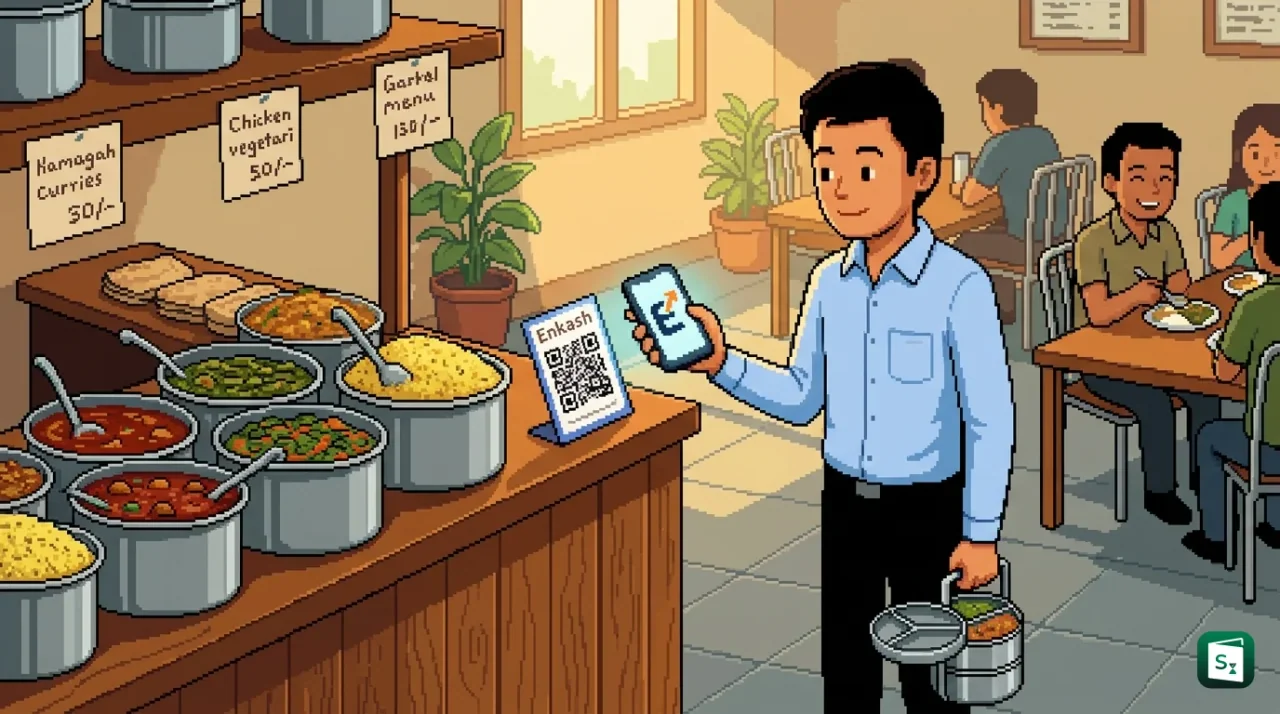
EnKash, a leading business payments and spend management platform in India, has become the first company in the country to enable UPI-based payments on meal cards. Employees can now make direct payments from their meal card balance by scanning eligible UPI QR codes at food and grocery merchants. The move brings the convenience of India’s most popular digital payment method to the structured employee meal benefit segment for the first time.
What Is EnKash?
EnKash is India’s first full-stack payments and spend management platform, founded in 2018 by Hemant Vishnoi, Naveen Bindal, and Yadvendra Tyagi. The company is headquartered in Mumbai and serves more than 5,000 businesses across the country. It holds multiple regulatory licenses from the Reserve Bank of India (RBI), including a Payment Aggregator (PA) license and a Prepaid Payment Instrument (PPI) license, along with a Bharat Connect (BBPOU) license for bill payments.
The platform provides businesses with a unified suite covering corporate cards, expense management, employee benefits, petty cash management, payment gateways, and rewards. EnKash has raised $23 million in funding and partners with leading banks and networks such as NPCI and Visa. The company’s PPI license authorises it to issue prepaid instruments like meal cards, which fall under RBI’s regulatory framework for stored-value payment tools.
How the UPI-Enabled Meal Card Works
Meal cards have traditionally been prepaid instruments that employees use at select partner outlets through physical swipes or taps at point-of-sale machines. EnKash’s innovation adds a UPI scan-and-pay layer to this existing infrastructure. Employees can now scan any eligible UPI QR code at participating food and grocery merchants and pay directly from their meal card balance.
The card runs on the RuPay network, India’s domestic card payment network launched by NPCI in 2012. RuPay’s near-universal acceptance across Indian merchants gives the meal card a much wider reach than earlier closed-loop meal vouchers that worked only at select outlets. EnKash also includes merchant category-based spending controls, ensuring that the meal balance is used only for eligible food and grocery purchases.
| Feature | Description |
|---|---|
| Payment method | Scan any eligible UPI QR code |
| Card network | RuPay (domestic network of NPCI) |
| Spending controls | Merchant category based restrictions |
| Card types | Physical card and virtual card |
| Management | Centralised issuance, loading, and tracking for employers |
Employers retain full control through a centralised dashboard where they can issue cards, load meal balances, set spending limits, and monitor transactions in real time. The solution builds on the UPI infrastructure that EnKash already offers across its broader PPI portfolio.
Tax Benefits Under the Revised Income Tax Rules
The launch is timed with significant changes to India’s income tax rules on meal benefits. Under the Income Tax Rules, 2026, the tax-exempt limit for meal vouchers has been raised from ₹50 per meal to ₹200 per meal. This exemption is now available under both the old and new tax regimes.
Based on this revised limit, employees can receive up to ₹1,05,600 annually as a tax-free meal benefit (calculated at ₹200 per meal for two meals per day across 22 working days per month for 12 months). Previously, the maximum annual exemption was approximately ₹26,400.
The tax treatment of meal vouchers is governed by Section 17(2) of the Income Tax Act, 1961, read with relevant rules, which classify non-cash meal benefits provided by employers as perquisites that are exempt from tax up to the prescribed limit when delivered through approved instruments such as meal cards or vouchers. By integrating UPI into the meal card, EnKash enables employees to use this tax-efficient benefit through a payment method they already use daily.
Significance for the Fintech and Employee Benefits Sector
The introduction of UPI on meal cards marks a notable shift in the employee benefits landscape. Until now, meal cards operated largely as closed-loop instruments with limited acceptance points. Employees often had to carry a separate card and hope the merchant had a compatible point-of-sale machine. With UPI integration, the acceptance base expands to virtually any food or grocery merchant that displays a UPI QR code.
For employers, the centralised platform simplifies administration. Companies can issue cards, load balances, and enforce category-level spending controls from a single dashboard, reducing the compliance burden associated with managing meal benefit programmes manually.
The development also aligns with the broader vision of the National Payments Corporation of India (NPCI) to deepen UPI’s penetration into newer use cases beyond peer-to-peer transfers and retail payments. NPCI, established in 2008 under the Payment and Settlement Systems Act, 2007, operates under the oversight of the RBI and the Government of India. By enabling UPI on meal cards, the RuPay-UPI stack extends into the employee benefits segment, a domain traditionally dominated by standalone prepaid cards and paper vouchers.
Key Takeaways
- EnKash became the first company in India to enable UPI-based payments on meal cards, allowing employees to scan and pay from their meal balance at food and grocery merchants.
- The meal card runs on the RuPay network, which was launched by NPCI in 2012, giving it wide acceptance across Indian merchants.
- EnKash was founded in 2018 and is headquartered in Mumbai, holding RBI licenses as a Payment Aggregator and PPI issuer.
- Under the Income Tax Rules, 2026, employees can receive up to ₹1,05,600 annually as a tax-free meal benefit, up from the earlier limit of approximately ₹26,400.
- The National Payments Corporation of India (NPCI), established in 2008 under the Payment and Settlement Systems Act, 2007, is the umbrella organisation for retail payment systems in India.