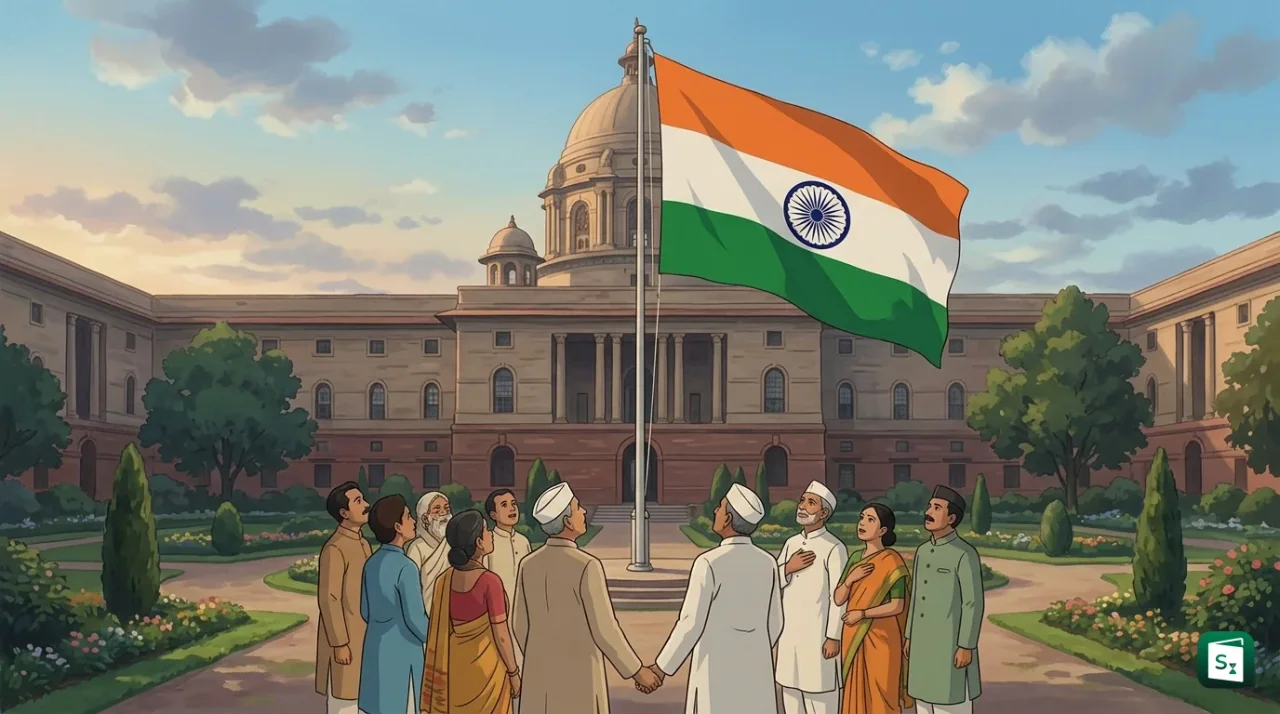
India observes National Flag Adoption Day on July 22 every year to commemorate the day in 1947 when the Constituent Assembly adopted the Tricolour in its current form. The adoption took place at the Constituent Hall in New Delhi with Dr Rajendra Prasad in the Chair, and the motion was moved by Jawaharlal Nehru, who described the flag as a symbol of freedom not just for India but for all people who see it. This date marks a pivotal moment in India’s journey toward independence, coming just 23 days before the country became free from colonial rule on August 15, 1947.
What Happened on July 22, 1947?
The Constituent Assembly met on the morning of July 22, 1947, at the Constituent Hall in New Delhi, with Dr Rajendra Prasad, who later became the first President of India, presiding over the session. The first item on the agenda was the adoption of the National Flag. Jawaharlal Nehru rose to move a formal Resolution describing the flag: a horizontal tricolour of deep saffron, white, and dark green in equal proportions, with a navy blue wheel (representing the Charkha) in the centre of the white band. The design of the wheel was specified as the one appearing on the abacus of the Sarnath Lion Capital of Ashoka.
Nehru spoke at length about the significance of the moment, recalling the sacrifices of freedom fighters who had held the flag aloft through decades of struggle. He clarified that the colours carried no communal significance and were chosen for their beauty and for representing the spirit and tradition of the nation. The resolution was adopted by the Assembly, with all members standing, at the end of the day.
Two amendments had been prepared but neither was moved. H V Kamath had proposed inscribing a Swastika inside the Chakra but withdrew it after seeing the design. Dr P S Deshmukh had preferred retaining the original Charkha but chose not to press his amendment. Several members, including S Radhakrishnan, Sarojini Naidu, and Chaudhri Khaliquzzaman, spoke in support of the resolution.
The Journey of the Tricolour: From 1906 to 1947
Pingali Venkayya and the First Design
The story of the Indian flag begins long before 1947. The initial design is credited to Pingali Venkayya (1876-1963), a freedom fighter, geologist, agriculturist, and polyglot from what is now Andhra Pradesh. While serving in the British Indian Army in South Africa during the Second Boer War (1899-1902), Venkayya first realised the need for a national flag when Indian soldiers were required to salute the Union Jack.
In 1921, Venkayya presented his flag design to Mahatma Gandhi during the Congress session in Vijayawada (then Bezawada). The original design had red and green stripes, representing Hindus and Muslims respectively. On Gandhi’s suggestion, Venkayya added a white stripe to represent all other communities. This flag, bearing a Charkha (spinning wheel) as a symbol of the common Indian and the Swadeshi movement, was used informally at Congress meetings from 1921 onwards. The flag was modified in 1931 when the Congress committee reordered the stripes and changed the red to saffron.
The Final Modifications by Surayya and Badruddin Tyabji
The transition from the Congress flag to the National Flag involved important refinements by Surayya Tyabji (1919-1978), an Indian artist, and her husband Badruddin Tyabji, a civil servant. The couple replaced the Charkha with the Ashoka Chakra, a 24-spoke wheel from the Lion Capital of Ashoka at Sarnath. This change was made because the Charkha looked different on each side of the flag (the spindle faced opposite directions), making it impractical as a national symbol. The Ashoka Chakra provided symmetry and carried deep historical significance as a symbol of India’s ancient civilisation and the righteous rule of Emperor Ashoka.
The Tyabjis also chose the specific shades of saffron, white, and green, personally supervised the stitching of the first flag, and also contributed to the design of the State Emblem of India (the Lion Capital).
What the Tricolour Symbolises
The three colours and the wheel of the Indian flag carry distinct meanings that go beyond the visual. Saffron at the top represents courage, sacrifice, and the spirit of renunciation. It reminds the nation of the sacrifices made by generations of freedom fighters. The white band in the middle stands for truth, peace, and purity. It is the guiding principle of India’s civilisational ethos. The green band at the bottom symbolises faith, fertility, and the connection to the land, representing India’s agricultural roots and its commitment to growth and prosperity.
The Ashoka Chakra in navy blue at the centre of the white band is perhaps the most significant element. It has 24 spokes, representing the 24 hours of the day and symbolising that the nation must be in constant motion and progress. The Chakra is derived from the Lion Capital of Ashoka at Sarnath (now in Uttar Pradesh), which dates back to the 3rd century BCE. It represents the eternal wheel of law (Dharma Chakra) and signifies that there is life in movement and death in stagnation. In his Constituent Assembly speech, Nehru noted that the Ashoka association was chosen because it connects India’s present to its glorious ancient past.
The Flag Code of India and Legal Framework
The display and use of the National Flag is governed by the Flag Code of India, 2002, which came into effect on January 26, 2002. It consolidated all earlier laws, conventions, and practices relating to the flag, including provisions from the Emblems and Names (Prevention of Improper Use) Act, 1950, and the Prevention of Insults to National Honour Act, 1971.
The Code is divided into three parts. Part I contains a general description of the flag, including its exact specifications. Part II deals with the display of the flag by members of the public, private organisations, and educational institutions. Part III covers display by Union and State governments and their agencies.
Key Provisions of the Flag Code
The flag must be made only as per the specifications laid down by the Bureau of Indian Standards (BIS), which first published Indian Standard IS 1:1968 for the National Flag. The flag’s ratio of width to length must be 2:3. The Ashoka Chakra must have exactly 24 equally spaced spokes and be in navy blue colour. The Code specifies nine standard sizes for the flag, ranging from 6300 x 4200 mm (Size 1) to 150 x 100 mm (Size 9).
| Provision | Rule |
|---|---|
| Hoisting time | Can be flown from sunrise to sunset; may be flown at night if properly illuminated |
| Half-masting | Ordered by the President on occasions of national mourning |
| Vehicle display | Restricted to President, Vice President, Prime Minister, Governors, Chief Ministers, and other specified constitutional authorities |
| Position of honour | Always on the right (observer’s left), higher than other flags |
| Disposal | Must be disposed of in private, with dignity, not thrown on the ground |
The 2021 Amendment
A significant amendment to the Flag Code was made on December 30, 2021. Before this amendment, the flag could only be made of Khadi (hand-spun cloth) as per BIS specifications. The amendment allowed the use of polyester and machine-made fabric for the flag. It also clarified that there is no restriction on the display of the flag by the general public, consistent with the dignity and honour of the flag. This amendment democratised access to the flag and enabled large-scale public participation in flag-related campaigns.
The Har Ghar Tiranga Campaign
In 2022, as part of the Azadi Ka Amrit Mahotsav celebrating 75 years of India’s Independence, the government launched the Har Ghar Tiranga campaign. The initiative was launched on July 22, 2022, deliberately coinciding with the anniversary of the flag’s adoption by the Constituent Assembly. The campaign encouraged every citizen to hoist the Tricolour at their homes between August 13 and 15 each year.
The campaign marked a significant shift in the relationship between citizens and the flag. Before the 2021 Flag Code amendment, many citizens were unsure about their right to fly the flag. The Har Ghar Tiranga campaign, combined with the legal clarity provided by the amendment, resulted in the mass production and display of flags across the country. The campaign has since become an annual event, with the government expanding its scope to include schools, offices, and public institutions.
Key Takeaways
- National Flag Adoption Day is observed on July 22 every year to mark the Constituent Assembly’s adoption of the Tricolour in 1947.
- The motion for adopting the flag was moved by Jawaharlal Nehru in the Constituent Assembly with Dr Rajendra Prasad presiding.
- The initial design was created by Pingali Venkayya in 1921, and the final design incorporating the Ashoka Chakra was refined by Surayya Tyabji and Badruddin Tyabji.
- The flag has three colours: saffron (courage and sacrifice), white (truth and peace), and green (faith and fertility), with a navy blue Ashoka Chakra of 24 spokes in the centre.
- The Flag Code of India, 2002 governs the display and use of the flag, and was amended in December 2021 to allow polyester and machine-made flags.
- The Har Ghar Tiranga campaign was launched on July 22, 2022 under the Azadi Ka Amrit Mahotsav to encourage citizens to hoist the flag at their homes.