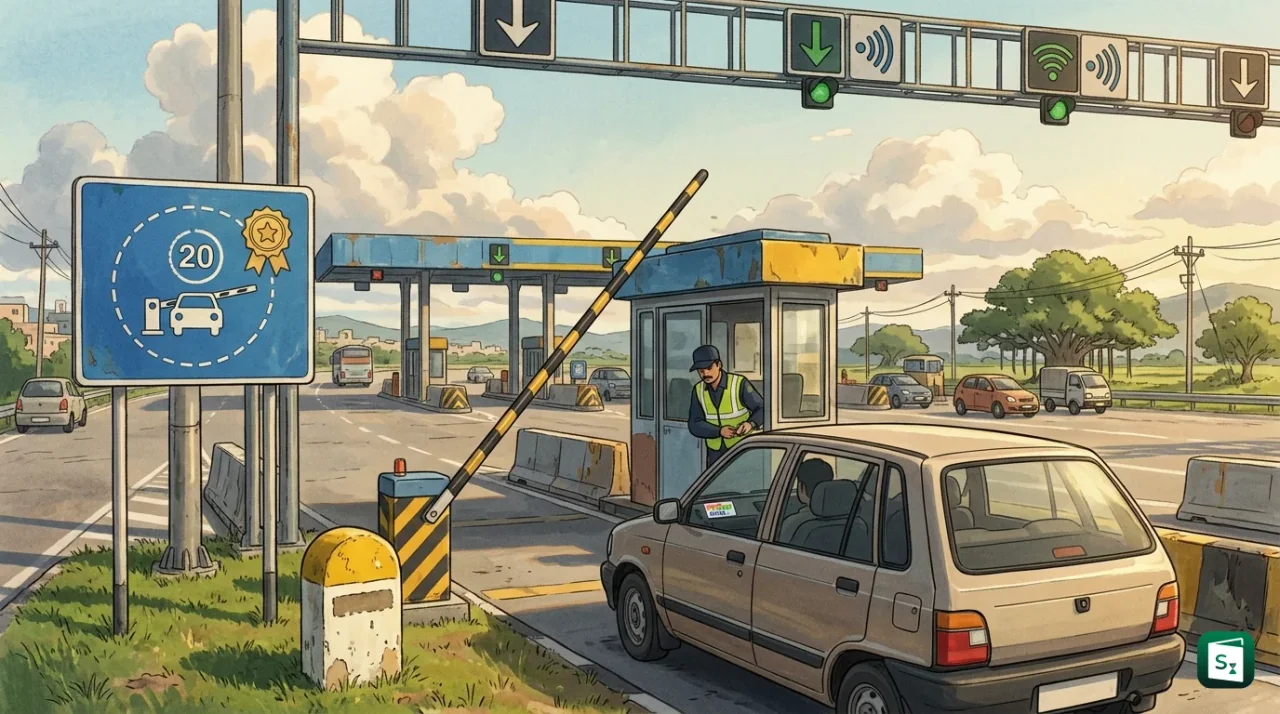
The Central Government has introduced a Concessional Local Pass for private vehicle owners living within 20 km of a National Highway fee plaza. The pass takes effect from November 1, 2026 and allows unlimited crossings at one designated plaza for a full year at ₹1,500 or ₹3,000. It aims to lower daily travel costs for local residents who cross the same plaza for work, education and routine needs.
What Is a Toll Plaza and What Is Toll Tax?
A toll plaza is a set of toll lanes built across a National Highway where vehicles pass through barriers or electronic readers and pay a user fee. Toll tax is the fee a road user pays for using a highway section, bridge, bypass or tunnel built and maintained with public or private funds.
On National Highways, the official term is fee plaza and user fee. People commonly say toll plaza and toll tax. The National Highways Authority of India (NHAI) manages toll collection on highways entrusted to it by the Central Government. NHAI was set up under the NHAI Act, 1988 and became operational in February 1995. It works under the Ministry of Road Transport and Highways (MoRTH).
The legal power to charge toll comes from Section 7 of the National Highways Act, 1956. The detailed rates, vehicle categories and collection method are fixed in the National Highways Fee (Determination of Rates and Collection) Rules, 2008. Toll rates depend on the length of the highway section, usually around 60 km per plaza, plus the cost of structures such as bridges, tunnels and bypasses.
Most Indian toll roads follow an open system. A fixed fee is charged at each plaza. In a closed system, the entry and exit points are recorded and the fee depends on the exact distance travelled. This distinction matters for the new local pass, as closed system stretches are excluded.
What Is the New Concessional Local Pass?
The Concessional Local Pass is a yearly FASTag linked pass that allows unlimited crossings at one specific National Highway fee plaza for one year. The Central Government notified it on October 26, 2026 through the National Highways Fee (Determination of Rates and Collection) (Fifth Amendment) Rules, 2026. The rules were issued under Section 9 of the National Highways Act, 1956 and come into force on November 1, 2026.
The pass is linked to the vehicle FASTag. FASTag is an electronic toll payment tag that uses Radio Frequency Identification (RFID) technology. It is fixed on the windscreen of the vehicle and the toll amount is debited automatically from the linked wallet or bank account when the vehicle crosses a plaza.
The new pass does not replace the existing monthly local pass. An eligible owner can choose either the monthly pass or the yearly Concessional Local Pass for the same plaza. The yearly option removes the need for monthly renewal and works out cheaper for people who cross the plaza every day.
Who Can Get the Local Pass and What Is the 20 Km Rule?
The Concessional Local Pass is available only to owners of mechanical vehicles that meet all three conditions. The vehicle must be registered for non commercial use, such as a private car, jeep or van. It must have a valid and functional FASTag. The owner must reside within 20 km of the fee plaza.
The 20 km distance is measured from the fee plaza to the residential address recorded in official records. Verification is done digitally through DigiLocker and VAHAN. DigiLocker provides the address proof linked to Aadhaar, while VAHAN, the national vehicle registration database, confirms the vehicle class and registration details. A GIS based check then confirms whether the address falls inside the 20 km radius.
The pass is valid only for the plaza for which it is issued. It cannot be transferred to another vehicle or used at any other plaza. If the owner sells the vehicle or changes the FASTag, a fresh pass is needed for the new vehicle.
Commercial vehicles such as taxis, trucks, buses and vehicles with national permits are not eligible. Government vehicles on duty, ambulances and other exempt categories do not need this pass because they are already outside the toll net under separate rules.
How Much Does the Local Pass Cost?
The yearly fee depends on the location of the fee plaza in relation to municipal or town limits.
| Location of fee plaza | Annual fee for Concessional Local Pass |
|---|---|
| Outside the limits of a municipal or local town area | ₹1,500 per year |
| Within the limits of a municipal or local town area | ₹3,000 per year |
Plazas around large cities such as Delhi NCR and other urban agglomerations will generally fall in the ₹3,000 slab. Plazas on rural highway stretches will generally cost ₹1,500.
The older monthly local pass costs ₹350 per month, which totals ₹4,200 in a year. The current press note also mentions a prevailing monthly charge of ₹360 at some plazas, which totals ₹4,320 in a year. In either case, the new yearly pass is sharply cheaper for daily users.
The notification states that the Central Government may revise the annual rates every year, with revisions taking effect on April 1.
How Is the Local Pass Different From the FASTag Annual Pass?
Many readers confuse the local pass with the national FASTag Annual Pass launched on August 15, 2025. The two schemes serve different needs.
| Feature | Concessional Local Pass (from Nov 1, 2026) | FASTag Annual Pass (from Aug 15, 2025) |
|---|---|---|
| Who can buy | Only residents within 20 km of the plaza, for non commercial vehicles | Any private car, jeep or van owner with valid FASTag, no residence condition |
| Where valid | Only at one specific fee plaza, unlimited crossings for one year | At about 1,150 NHAI plazas on National Highways and National Expressways, up to 200 trips or one year |
| Fee | ₹1,500 or ₹3,000 per year based on plaza location | ₹3,000 per year (₹3,075 including service charges on some purchase channels) |
| Purpose | Relief for daily local commuting across the home plaza | Savings for long distance travel across the highway network |
A resident within 20 km of a plaza can hold the national annual pass for highway trips and also needs to decide which pass suits the home plaza. For daily crossing of the same plaza, the local pass allows unlimited use through the year. The national pass is capped at 200 plaza crossings.
Where the Local Pass Will Not Apply
The notification lists two clear exclusions. No Concessional Local Pass will be issued for travel on a National Highway or Expressway where toll is collected under a closed user fee collection system. No pass will be issued where a service road or alternative road is available for use by the driver.
A closed system records entry and exit and charges for distance covered, as on several modern expressways. Where such ticketing applies, per trip charging continues. Similarly, if a free service lane runs alongside the tolled highway, commuters are expected to use it instead of seeking a concessional pass.
The pass also does not automatically cover bridges and sea links run under separate project frameworks. For example, the Mumbai Trans Harbour Link (Atal Setu) and the Bandra Worli Sea Link operate under their own toll structures. Travel on state highways, state managed expressways and municipal toll roads also remains outside this central scheme.
Who Does Not Have to Pay Toll at All?
Toll exemption on National Highways is governed by Rule 11 of the 2008 Fee Rules and by the Indian Toll (Army and Air Force) Act, 1901. Exemption applies to the vehicle when it is used for a specified official purpose, not merely because of who owns or drives it.
Exempt categories include the President, Vice President, Prime Minister, Governors, Chief Justices and judges of the Supreme Court and High Courts, Union Cabinet Ministers, Chief Ministers, Speakers, Members of Parliament, and Members of State Legislatures within their states on production of identity proof. Gallantry award winners holding the Param Vir Chakra, Ashok Chakra, Maha Vir Chakra, Kirti Chakra, Vir Chakra and Shaurya Chakra are exempt on showing authenticated photo identity.
Vehicles used for official purposes by the Ministry of Defence, central and state armed forces in uniform including paramilitary forces and police, executive magistrates, fire fighting departments, NHAI inspection vehicles, ambulances, funeral vans and vehicles specially designed for persons with physical disabilities are also exempt. Serving defence personnel in private vehicles are covered only when the vehicle is on official duty with prescribed documents. Personal travel in a private vehicle does not qualify.
Electric vehicles do not enjoy a general national toll exemption on NHAI highways. Unless a specific plaza notification grants relief, EV cars pay the same user fee as other private cars.
Key Takeaways
- The Concessional Local Pass takes effect from November 1, 2026 for non commercial vehicles within 20 km of a National Highway fee plaza.
- The yearly fee is ₹1,500 for plazas outside municipal limits and ₹3,000 for plazas within municipal limits.
- The pass is valid for one specific plaza only and requires a valid FASTag with verification through DigiLocker and VAHAN.
- The scheme was notified through the Fifth Amendment Rules, 2026 to the National Highways Fee Rules, 2008 under the National Highways Act, 1956.
- No local pass is issued on closed tolling systems or where a service or alternative road is available.