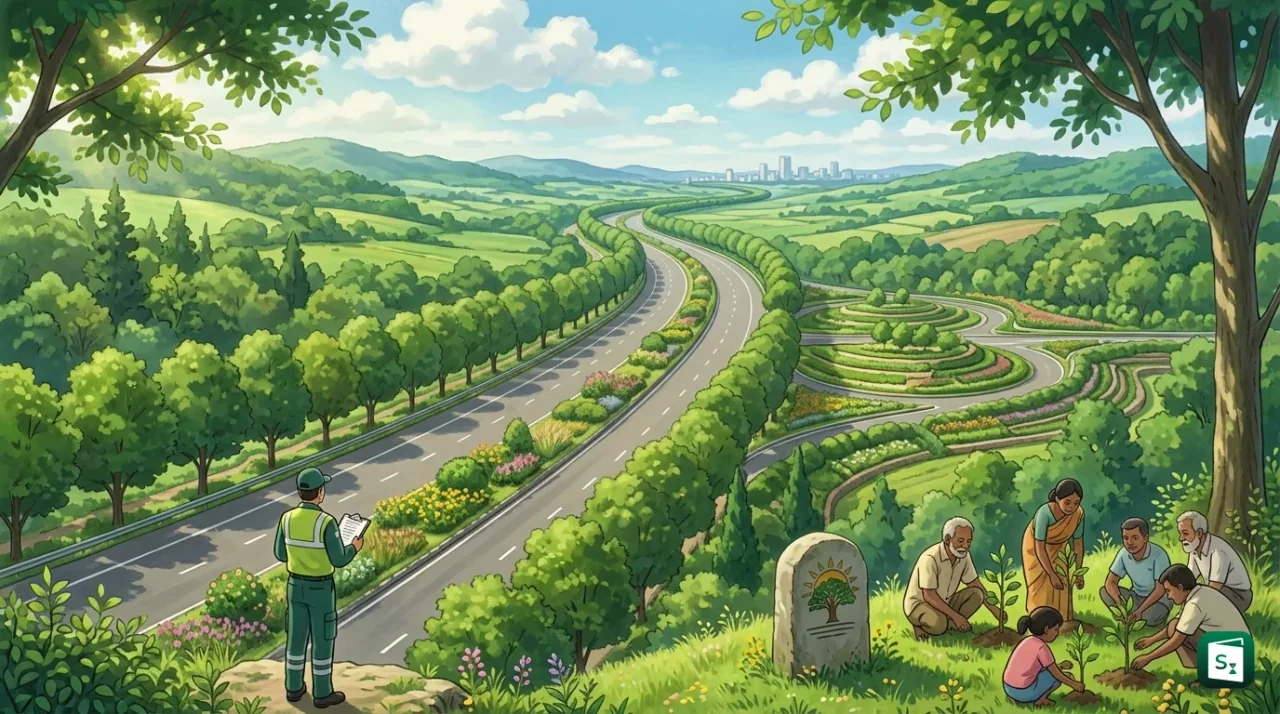
The National Highways Authority of India (NHAI) announced the winners of the Green Highways Excellence Awards 2026 on 3 September 2026, honouring the best plantation and landscaping work along national highways. Instituted in 2025 under the Green Highways (Plantation, Transplantation, Beautification and Maintenance) Policy, 2015, the awards recognise projects that turn highways into green corridors, stretches lined with trees and shrubs that reduce pollution, prevent erosion and improve the travel experience. This year the top honours went to the Chilakaluripet Bypass on NH-16 for avenue plantations, the Hyderabad-Yadgiri section of NH-163 for median plantations and the Jamtha Clover Leaf on NH-44 for plantation in land parcels.
What Are Green Highways Excellence Awards 2026?
The Green Highways Excellence Awards were instituted by NHAI in 2025 as mandated by the Green Highways Policy, 2015 to promote healthy and sustainable plantation practices along national highways. The 2026 edition is the second edition of the awards and winners were announced on 3 September 2026 in New Delhi.
The awards recognise best practices in landscaping, plantation and green management across the national highway network, which spans more than 1.46 lakh km. Entries were invited through an online portal and were open to NHAI field offices, concessionaires, contractors, government agencies, non-governmental organisations (NGOs) and private agencies involved in plantation projects along highway stretches.
A total of 86 nominations were received from across the country. These included 27 nominations for Avenue Plantations, 36 for Median Plantations and 23 for Plantation in Land Parcels. Nominations were supported by geo-tagged photographs, drone videos, site-specific plantation plans and survival rate data. After initial screening, projects were shortlisted and evaluated on plantation management, sustainability, survival rate and replicability of the model on other highway stretches. The highest weight was given to survival rate and scientific maintenance.
The objective is to encourage competition and reward agencies that consistently maintain green cover, while creating a knowledge base of successful models that can be replicated across India.
Winners Across Three Categories: Avenue, Median and Land Parcel Plantations
The awards were given in three categories. Each category addresses a different type of plantation space along highways. Together they cover the full highway landscape, from roadside to central divider to vacant parcels around interchanges.
Category I: Avenue Plantations, What Is It and Who Won?
Avenue plantation means planting trees and shrubs along both sides of the road, in rows called avenues. These plantations provide shade, act as windbreaks, reduce dust and noise, and improve aesthetics. Species are chosen based on soil, climate and local ecology, and the work follows IRC:SP:21-2009, the Indian Roads Congress guidelines for landscaping and tree plantation.
| Rank | Project | National Highway | Regional Office |
|---|---|---|---|
| 1st Prize | Six Laning of Chilakaluripet Bypass | NH-16, Andhra Pradesh | RO Vijayawada |
| 2nd Prize | Eight Lane Vadodara-Kim Expressway, Padra to Vadodara section of Vadodara-Mumbai Expressway | Gujarat | RO Gandhinagar |
| 3rd Prize | Gagariya-Bakhasar section of NH-925 and Satta-Gandhav section of NH-925A | Rajasthan (Thar Desert region) | RO Jaipur |
| Consolation Prize | Annual Maintenance including Incident Management of Trichy-Karaikudi section of NH-210, NH-336, NH-36 and NH-536 including Trichy Bypass | Tamil Nadu | RO Madurai |
The Chilakaluripet Bypass project stood out for its use of native species with a high survival rate and scientific maintenance along the bypass that connects Guntur district in Andhra Pradesh. The Rajasthan project was noted for achieving green cover in the arid Thar Desert using water efficient techniques, while the Vadodara-Kim section forms part of the Delhi-Mumbai Expressway corridor and used drought tolerant species.
Category II: Median Plantations, Meaning and Winners
Median plantation refers to planting on the central median or divider that separates traffic moving in opposite directions. Median plantations are usually low height flowering shrubs and grasses. They reduce glare from headlights of vehicles coming from the opposite side, guide drivers on curves and reduce wind effect.
| Rank | Project | National Highway | Regional Office |
|---|---|---|---|
| 1st Prize | Four Laning of Hyderabad-Yadgiri section | NH-163, Telangana and Karnataka | RO Hyderabad |
| 2nd Prize | Eight Lane Vadodara-Kim Expressway, Sanpa to Padra section of Vadodara-Mumbai Expressway | Gujarat | RO Gandhinagar |
| 3rd Prize | Varanasi Ring Road, Package I, Harahua to Sandaha section | NH-31, Uttar Pradesh | RO UP East (Varanasi) |
The Hyderabad-Yadgiri stretch won for planting flowering and low height native species that ensure both safety and visual appeal. The Vadodara-Kim Sanpa to Padra section was recognised for using median greening to improve road safety, while the Varanasi Ring Road demonstrated sustainable planting in a heavily trafficked pilgrimage corridor.
Category III: Plantation in Land Parcels
This category covers plantations on land parcels available within the highway right of way but not on the main carriageway. It includes clover leaves, interchanges, toll plazas, service areas and loop areas. These parcels are often large and can be turned into dense green zones, parks or urban forests.
| Rank | Project | Location and Feature | Regional Office |
|---|---|---|---|
| 1st Prize | Jamtha Clover Leaf and Oxygen Bird Park | NH-44, Nagpur, Maharashtra | RO Nagpur |
| 2nd Prize | Land parcels at Duhai Interchange under ToT Bundle-7, NE-II (Eastern Peripheral Expressway) | Uttar Pradesh | RO Delhi |
| 3rd Prize | Miyawaki Plantation in loop areas at Lucknow-Ayodhya Road and Lucknow Outer Ring Road Intersection | Uttar Pradesh | RO UP West (Lucknow) |
The Jamtha Clover Leaf Oxygen Bird Park on NH-44 near Nagpur was developed with the Social Forestry Department, Nagpur and has transformed a highway interchange into an ecological space that supports bird habitats and improves green cover. The Duhai Interchange project under the Tolling, Operation, Maintenance and Transfer (ToT) Bundle-7 shows how monetised public funded operational highways can still create green assets. The Lucknow project used the Miyawaki method, a Japanese technique for creating dense, fast growing native forests in small areas, to build an urban forest at a busy junction.
What Is the Green Highways Policy 2015 and National Green Highways Mission?
Understanding what is a green highway and what is a green corridor helps to answer a common search query. A green highway is not a separate road type but a national highway developed with systematic plantation, transplantation, beautification and maintenance to create an ecological corridor. A green corridor in the highway context means a road corridor lined with trees and shrubs that provides environmental benefits. This is different from a green corridor for organ donation, which is a traffic cleared route for ambulances, and from a green energy corridor, which transmits renewable power.
Green Highways (Plantation, Transplantation, Beautification and Maintenance) Policy, 2015
The Green Highways Policy, 2015 was launched on 29 September 2015 by the Ministry of Road Transport and Highways (MoRTH) under Union Minister Nitin Gadkari. It was promulgated to develop eco friendly national highways with participation of community, farmers, NGOs, private sector, government agencies and the Forest Department.
Key provisions of the policy include earmarking 1 per cent of the total project cost of every highway project for plantation and its maintenance. At the time of launch, the government estimated this would make about ₹1,000 crore per year available, since road projects worth about ₹1 lakh crore were planned annually. Plantation work is to be outsourced through competitive bidding to agencies empanelled by an agency authorised by MoRTH or NHAI, following the model Terms of Reference, IRC:SP:21-2009 and project specific requirements. The plantation agency has no right over the land and cannot use it for any other purpose. Emphasis is placed on survival rate, not just planting numbers, with strong monitoring through ISRO’s Bhuvan and GAGAN satellite systems where every planted tree is counted and audited. The policy also aims to bridge the gap between India’s actual forest and tree cover of about 22 per cent and the National Forest Policy target of 33 per cent.
The objectives of the policy are broad and exam relevant:
| Objective | Purpose |
|---|---|
| Develop a policy framework for plantation along highways | Create a systematic approach instead of ad hoc planting |
| Reduce air and dust pollution | Trees act as natural sinks for pollutants and help in carbon sequestration |
| Provide shade and reduce heat glare | Shade on hot roads in summer |
| Reduce noise pollution | Buffer against traffic noise |
| Arrest soil erosion on embankment slopes | Root systems stabilise slopes |
| Prevent headlight glare | Shrubs on median block light from opposite traffic |
| Moderate wind and radiation | Act as windbreaks |
| Generate employment for local communities | About five lakh jobs were projected, with 10 persons employed per km |
National Green Highways Mission (NGHM)
To implement the policy, MoRTH set up the National Green Highways Mission (NGHM) and housed it within NHAI. The Mission created a Green Highways Division (GHD) with environment and forestry experts for planning, implementation and monitoring.
The NGHM was formally launched with an initial plantation drive on 1,500 km of national highways at a cost of about ₹300 crore in July 2016. A workshop on the theme “Green Highways Projects: Way Ahead” unveiled the Guidelines for Implementation, the Vision Document 2016-2026 and Knowledge Reports. The Mission also launched two initiatives. The Adopt a Green Highway Programme engages corporates, public sector units and other institutions to adopt highway stretches for plantation under Corporate Social Responsibility (CSR). The Kisan Harit Rajmarg Yojana is a pilot scheme to extend the green belt beyond the existing Right of Way (RoW) by involving farmers and giving them an alternative livelihood.
Under the Mission, NHAI signed a charter with YES BANK to create awareness and planted more than 2 crore plants between 2016-17 and 2020-21. By August 2024, NHAI reported that 402.28 lakh plants had been planted along national highways under the policy. A Plantation Cell in MoRTH now monitors all plantation projects through regional offices of NHAI, National Highways and Infrastructure Development Corporation Limited (NHIDCL) and other agencies.
What Is the Green National Highways Corridor Project and National Highway Green Cover Index?
Green National Highways Corridor Project (GNHCP)
The Green National Highways Corridor Project (GNHCP) is an externally aided project that shows how highway construction can itself be made green, not just the plantations alongside it. The Government of India and the World Bank signed an agreement for the project on 22 December 2020. The World Bank provides a loan of $500 million from the International Bank for Reconstruction and Development (IBRD) with a maturity of 18.5 years including a 5 year grace period, against a total project cost of $1,288 million (about ₹7,662 crore).
The Project Development Objective is to demonstrate safe and green national highway corridors in selected states and to build the capacity of MoRTH in mainstreaming safety and green technologies.
In terms of coverage and features, the project spans a length of about 781 km to 783 km across Rajasthan, Himachal Pradesh, Uttar Pradesh and Andhra Pradesh. Out of this, about 704 km is financed for upgrading and five year maintenance through 21 civil works contracts, while the maintenance for five years after construction is funded by the government budget. Green technologies used include cement treated sub base, reclaimed asphalt pavement, use of local and marginal materials such as lime, fly ash and waste plastic, and bio engineering measures for slope protection such as hydroseeding and coco or jute fibre. The focus is on conservation of natural resources, reduction of greenhouse gas emissions, climate resilience and road safety, and disaster risk assessment of about 5,000 km of the national highway network is also part of the project. As of early 2025, 7 of the 21 packages had been completed and physical progress of about 433 km had been achieved. The project, originally approved on 27 March 2020 and effective from 10 February 2021, has been extended to 31 December 2025.
The GNHCP builds on the earlier National Highways Interconnectivity Improvement Project (NHIIP) and is implemented by MoRTH with support from its Project Implementation Units (PIUs) in the four states.
National Highway Green Cover Index (NHGCI)
The National Highway Green Cover Index (NHGCI), also referred to as NHAI-GCI or GCI 2025-26, is a measurement tool being developed to assess and rank the greenness of highway corridors. It uses parameters such as survival rate, canopy cover, species diversity and maintenance quality, often verified through geo-tagged images and drone videos submitted by field offices. Such an index helps create healthy competition among regional offices and provides transparent data to monitor the success of the Green Highways Policy. The first edition, the 1st National Highway Green Cover Index, is being rolled out alongside awards like the Green Highways Excellence Awards to institutionalise green monitoring.
Understanding NHAI and Its Role: How NHAI Differs from MoRTH, NHIDCL and BRO
What Is NHAI?
NHAI stands for National Highways Authority of India. It is an autonomous agency of the Government of India set up under the National Highways Authority of India Act, 1988. The Act was enacted on 16 December 1988 and came into force on 15 June 1989, but the Authority became operational only in February 1995 with the appointment of its first Chairman. It functions under the administrative control of the Ministry of Road Transport and Highways (MoRTH). Its headquarters is at Sector-10, Dwarka, New Delhi, and its current Chairman is Santosh Kumar Yadav (IAS). The organisation follows a three tier system consisting of Headquarters (HQ), Regional Offices (ROs) and Project Implementation Units (PIUs). PIUs are headed by Project Directors at site level and ROs are headed by officers of Chief General Manager level, with 26 Regional Offices and 185 PIUs as of 2019-20. Its mandate is to develop, maintain and manage national highways and any other highways entrusted to it by the Government of India, as per Section 16(1) of the NHAI Act, 1988. It is also responsible for toll collection and for implementing programmes such as the National Highway Development Project (NHDP) and the Bharatmala Pariyojana. In terms of legal status, it is not a profit making statutory company and is not listed on the stock market. It receives funding through cess, additional budgetary support, capital grants, plough back of toll revenue, multilateral loans and market borrowings such as 54EC capital gains bonds.
India’s national highway network carries about 40 per cent of total road traffic, though it is only about 2 per cent of the total road network.
NHAI vs MoRTH vs NHIDCL vs BRO
Many readers search for NHAI vs NHIDCL or NHAI vs MoRTH vs BRO. The differences are important for understanding who does what in road building.
| Entity | Full Form | Year Set Up | Primary Role | Area of Operation |
|---|---|---|---|---|
| MoRTH | Ministry of Road Transport and Highways | Central Ministry | Policy making, framing laws and rules for all national highways, approving projects, overall monitoring | Pan India, including through NHAI and NHIDCL |
| NHAI | National Highways Authority of India | Act 1988, operational 1995 | Nodal agency to develop, maintain and manage national highways entrusted to it | Mainly national highways in plains and developed areas, about 50,000 km to 92,851 km under its management at different times |
| NHIDCL | National Highways and Infrastructure Development Corporation Limited | 2014 | Develop highways in border and hilly areas, including the Northeast, Jammu and Kashmir, Ladakh, Uttarakhand and Himachal Pradesh | Strategic border roads and difficult terrain where speed and specialised work are needed |
| BRO | Border Roads Organisation | 1960 | Builds and maintains roads for defence purposes along borders, under the Ministry of Defence | Border areas, high altitude and conflict zones |
In short, MoRTH is the parent ministry and policy maker, NHAI is its main implementing arm for regular national highways, NHIDCL handles tough and border area national highways, and BRO builds defence roads.
Why Green Highways Matter: Environmental and Economic Significance
The Green Highways Excellence Awards are not just a beautification exercise. They link directly to India’s climate and development goals.
Environmental benefits: Avenue and median plantations act as carbon sinks and help sequester greenhouse gas emissions. Trees and shrubs reduce air pollution and dust, lower ambient temperature, control soil erosion on embankments and support biodiversity. The Oxygen Bird Park at Jamtha shows how highway land can be restored as a habitat for birds, while Miyawaki forests create dense biodiversity islands even at small interchanges. In states such as Andhra Pradesh, Rajasthan and Uttar Pradesh, where highways pass through different climatic zones, native and drought tolerant species ensure survival and ecological balance.
Road safety and user experience: Median plantations cut headlight glare and help guide drivers on long curves. Shade and windbreaks reduce driver fatigue on hot, glaring roads. Well maintained green corridors also reduce accidents caused by winds.
Economic and livelihood benefits: The policy creates rural employment. Greening of one km provides jobs to 10 people, and the 2016 launch of 1,500 km was projected to employ 15,000 people. At a larger scale, the policy was expected to generate about five lakh jobs. Farmers can earn by supplying saplings, maintaining plantations and, under the Kisan Harit Rajmarg Yojana, growing trees beyond the right of way. Biomass and waste from trees can be used to make fertilisers, with revenue shared between contractors and local panchayats.
Climate commitments: Green corridors help fulfil India’s voluntary commitment to reduce carbon emissions and build resilient ecosystems that can adapt to climate change. The Green Highways Division’s Vision Document 2016-2026 lays out strategy, mission and success indicators for this purpose.
Governance lesson: By making 1 per cent plantation cost mandatory, using empanelled plantation agencies, and tracking survival through Bhuvan and GAGAN satellites, the policy moved highway greening from a contractor’s side job to a specialised, accountable activity.
The Way Forward
The second edition of the awards in 2026 signals that green highways are now an institutional practice, not a one time campaign. The way forward involves several steps that are already outlined in official documents and project assessments.
First, saturation of all highway stretches with plantations is the stated aim. This means every new highway built under Bharatmala Pariyojana, which aims to develop about 34,800 km in Phase I connecting more than 600 districts, will have an integrated green component. Concessionaires, state forest departments and private plantation agencies will work together to cover existing and new stretches.
Second, survival and maintenance must improve. Awards give the highest weight to survival rate for this reason. Future monitoring through the National Highway Green Cover Index and continued drone and geo-tagging audits will push agencies to maintain what they plant, not just to plant.
Third, scaling of green technologies demonstrated in the GNHCP, such as use of fly ash, waste plastic, reclaimed asphalt and bio engineering, will need to be mainstreamed into regular highway design to reduce emissions during construction itself.
Fourth, community and private participation will remain crucial. Programmes such as Adopt a Green Highway allow corporates to fund plantations under CSR, while the Kisan Harit Rajmarg Yojana keeps farmers at the centre. Replication of models such as the Jaipur desert plantations and Nagpur bird park in other regions will show that sustainable methods work in diverse geographies.
If these steps are sustained, the highway network can contribute meaningfully to India’s goal of expanding tree cover, while making travel safer and more pleasant.
Key Takeaways
- The Green Highways Excellence Awards were instituted in 2025 by NHAI and winners for 2026 were announced on 3 September 2026 across three categories.
- In Category I Avenue Plantations, Chilakaluripet Bypass on NH-16 (RO Vijayawada) won the first prize, while in Category II Median Plantations, Hyderabad-Yadgiri section of NH-163 (RO Hyderabad) secured first place.
- In Category III Plantation in Land Parcels, the Jamtha Clover Leaf Oxygen Bird Park on NH-44 (RO Nagpur) received the top award for transforming an interchange into a bird habitat.
- The awards are mandated under the Green Highways (Plantation, Transplantation, Beautification and Maintenance) Policy, 2015, launched on 29 September 2015 by MoRTH, which earmarks 1 per cent of total project cost for plantation.
- The National Green Highways Mission (NGHM) within NHAI implements the policy and launched the initial 1,500 km plantation drive in July 2016 with its Vision Document 2016-2026.
- The Green National Highways Corridor Project (GNHCP) is a $500 million World Bank (IBRD) supported project for about 781 km in Rajasthan, Himachal Pradesh, Uttar Pradesh and Andhra Pradesh demonstrating green technologies and climate resilience.
- NHAI was constituted under the National Highways Authority of India Act, 1988 and became operational in February 1995, headquartered at Sector-10, Dwarka, New Delhi, as an autonomous agency under MoRTH.