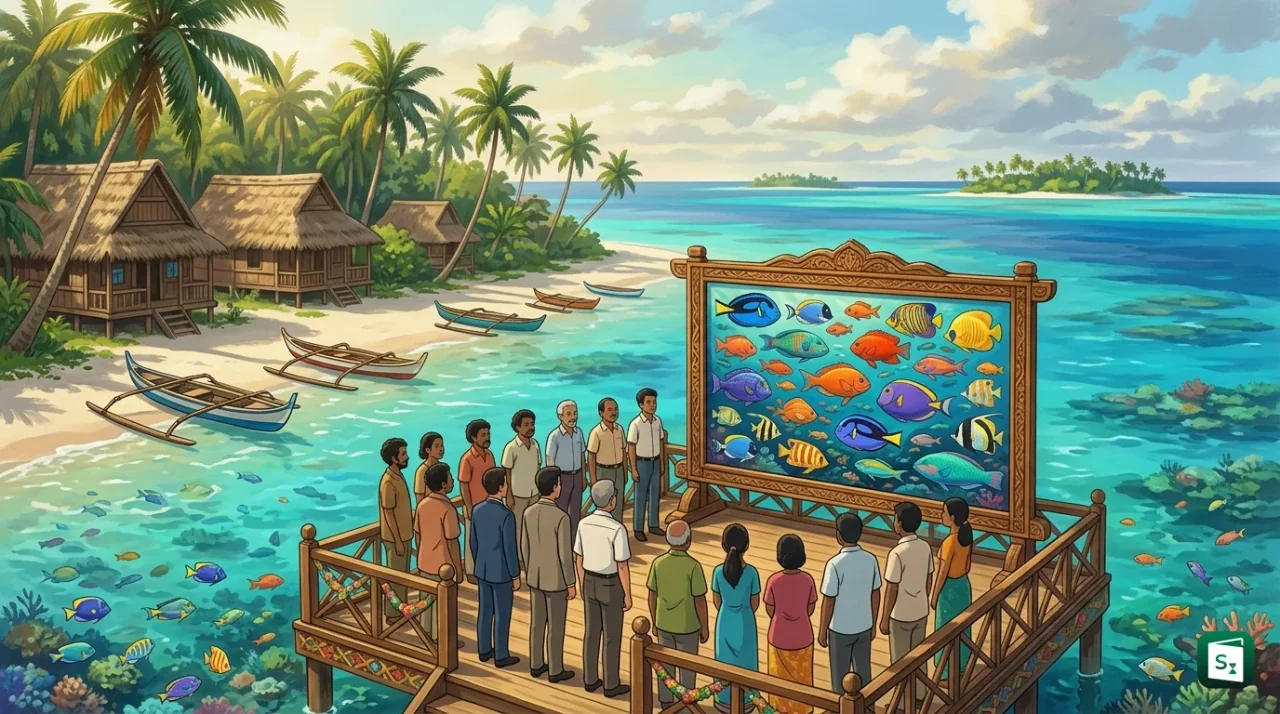
Vice President C P Radhakrishnan released Mission Rangeen Machhli 2031, the Strategic Action Plan for Ornamental Fisheries Development, on 31 August 2026 at Agatti in Lakshadweep during the Fisheries Outreach Programme organised by the Department of Fisheries. The mission provides a uniform national framework for scientific management, biosecurity, quality assurance and regulatory compliance across the ornamental fisheries value chain. It aims to turn India’s fragmented aquarium fish sector into an organised, sustainable and export-ready industry while strengthening island livelihoods and the Blue Economy.
What Is Ornamental Fisheries and Why Does It Matter?
Ornamental fisheries refers to the breeding, rearing, trading and keeping of ornamental fish, which are colourful fish kept for decorative purposes in aquariums and garden ponds rather than for food. Related terms are often searched together. Ornamental fish culture means the scientific breeding and rearing of these species in controlled conditions, while ornamental fish farming refers to raising them commercially for sale. Aquarium fish is the common name used by hobbyists for the same group.
This sector matters because it connects biodiversity, livelihoods and trade. Globally, aquarium keeping is the second most popular hobby with about 100 million hobbyists, and the global ornamental fish market is valued at around $18 to 20 billion. More than 2,500 species are traded across 125 countries, with about 60 percent freshwater and 40 percent marine species. Common varieties include guppy, tetra, goldfish, neon tetra, angel fish, discus, oscar, flower horn, zebra danio and clownfish. Most Indian trade, about 90 percent, is in freshwater species, with goldfish being the most popular among hobbyists.
For India, ornamental fisheries offer a low-investment, high-value livelihood. Backyard units can be set up with small tanks and need little space, which makes the activity suitable for women, small farmers and self-help groups. At the same time, the business depends on biosecurity, which means preventing diseases and pathogens from spreading in hatcheries and farms, and traceability, which means tracking fish from breeding to sale. Without these standards, exports face rejection and local stocks face disease risks.
What Is Mission Rangeen Machhli 2031?
Mission Rangeen Machhli 2031 is the Strategic Action Plan for Ornamental Fisheries Development prepared by the Department of Fisheries under the Ministry of Fisheries, Animal Husbandry and Dairying. The name Rangeen means colourful in Hindi, reflecting the vibrant nature of ornamental species. The mission was released by Vice President C P Radhakrishnan on 31 August 2026 at the Fisheries Outreach Programme in Agatti, Lakshadweep.
The programme was attended by Union Fisheries Minister Rajiv Ranjan Singh alias Lalan Singh, Ministers of State Prof. S P Singh Baghel and George Kurian, and Lakshadweep Administrator Praful Khoda Patel, along with fishers, fish farmers, women beneficiaries, cooperative members and officials from scientific institutions. During the event, benefits under the Pradhan Mantri Matsya Sampada Yojana (PMMSY) were also distributed, including support for Deep Sea Fishing Vessels, replacement of boats and nets, safety kits, Kisan Credit Cards (KCC) for fishers, and communication and tracking devices.
The core purpose of the mission is to provide a uniform framework for the organised growth of the sector, which has so far been fragmented and largely dependent on wild collection.
A Uniform Framework for the Whole Value Chain
The action plan covers the entire chain from breeding to export, with emphasis on science, standards and sustainability. Its main pillars include scientific management of broodstock, which means maintaining healthy parent fish for breeding, standard protocols for breeding, hatchery operations and rearing, quarantine and biosecurity measures, quality assurance and certification, and traceability for domestic and international trade.
It also promotes regulatory compliance, so that breeders and traders follow the same rules across states and union territories, and supports captive breeding of indigenous species instead of wild collection. This approach aims to conserve biodiversity in hotspots like the North-East Region and the Western Ghats, while meeting market demand. The framework is linked to training, market linkage and branding, including convergence with the Marine Products Export Development Authority (MPEDA) and digital marketplaces such as the Open Network for Digital Commerce (ONDC).
Why Was Lakshadweep Chosen for the Launch?
Lakshadweep is a Union Territory in the Arabian Sea with its capital at Kavaratti and connectivity through Agatti Airport, the only airport in the islands. The territory was chosen because it demonstrates both the potential and the gaps in India’s marine economy. The Vice President described the islands as a priceless maritime asset and a sunrise sector for the Blue Economy.
The numbers explain the choice. Lakshadweep has a lagoon area of about 4,200 sq km, territorial waters of 20,000 sq km, a coastline of about 132 km, and an Exclusive Economic Zone (EEZ) of nearly 4 lakh sq km, which is about 17 percent of India’s total EEZ of about 24 lakh sq km. An EEZ is the sea zone up to 200 nautical miles from the coast where a country has special rights over marine resources under the United Nations Convention on the Law of the Sea (UNCLOS).
Against an estimated annual fisheries potential of more than 1 lakh tonnes, including about 94,000 tonnes of tuna and tuna-like species such as skipjack and yellowfin tuna, the current harvest is only about 15,000 tonnes, rising to 16,891 tonnes in 2024-25. The islands are known for the traditional pole and line fishing method, found only in Lakshadweep within India, and for the use of anchored Fish Aggregating Devices (FADs).
For ornamental fisheries, Lakshadweep hosts more than 300 ornamental fish species across 35 families in its coral reef waters, including clownfish, gobies, dottybacks and damsels, which are valued in the global aquarium trade. An ornamental fish hatchery has been established at Agatti, and three rearing units have been approved under PMMSY. The islands have also been notified as a Seaweed Cluster, with a seaweed seed bank at Kadmat and a seaweed hatchery at Chetlat, and 19 recreational fishing units have been sanctioned to link fisheries with tourism.
Fisheries development projects worth more than ₹62 crore have been approved for Lakshadweep under PMMSY, and 16 Deep Sea Fishing Vessels costing about ₹1.2 crore each have been sanctioned with full financial assistance. About 575 seaweed cultivation units with an investment of around ₹2 crore are being promoted for women, youth and self-help groups.
The Rangeen Machhli App and Other Government Support Measures
The Rangeen Machhli App is the digital face of the ornamental fisheries push. It was launched on 12 September 2024 by Union Minister Rajiv Ranjan Singh at the Indian Council of Agricultural Research Central Institute of Freshwater Aquaculture (ICAR-CIFA) in Bhubaneswar. The app was developed by ICAR-CIFA, which was established in 1987 and is headquartered in Bhubaneswar, Odisha, with support from PMMSY.
The app provides information on popular ornamental fish species in eight Indian languages, making it accessible to hobbyists, shop owners and farmers across the country. Its key features include detailed guidance on care, breeding and maintenance, a Find Aquarium Shops tool that works as a dynamic directory updated by shop owners to help users locate nearby reliable stores, and two educational modules. The Basics of Aquarium Care module covers types of aquariums, filtration, lighting, feeding and daily maintenance, while the Ornamental Aquaculture module focuses on breeding and rearing practices.
Institutionally, the sector is anchored by the Department of Fisheries, which was created as a separate department in 2019 when the Ministry of Fisheries, Animal Husbandry and Dairying was formed by bifurcating the earlier Ministry of Agriculture and Farmers Welfare. The Ministry is headed by Rajiv Ranjan Singh and is headquartered at Krishi Bhawan, New Delhi. Related bodies include the National Fisheries Development Board (NFDB) in Hyderabad, the Fishery Survey of India (FSI) in Mumbai, and the Central Institute of Coastal Engineering for Fishery (CICEF) in Bengaluru.
Under PMMSY, which was launched in May 2020 with an outlay of ₹20,050 crore for five years from 2020-21 to 2024-25, ornamental fisheries receive dedicated funding. The scheme has earmarked about ₹576 crore for ornamental and recreational fisheries. Support is provided through several unit models:
| Unit Type | Unit Cost | Purpose |
|---|---|---|
| Backyard Ornamental Fish Rearing Unit (freshwater and marine) | ₹3 lakh | Small-scale household rearing |
| Medium Scale Ornamental Fish Rearing Unit | ₹8 lakh | Expanded commercial rearing |
| Integrated Ornamental Fish Unit (freshwater breeding and rearing) | ₹25 lakh | Complete hatchery to market setup for freshwater |
| Integrated Ornamental Fish Unit (marine breeding and rearing) | ₹30 lakh | Complete hatchery to market setup for marine species |
So far, about 1,986 backyard rearing units, 6,018 fish kiosks and aquariums, 117 retail markets including ornamental fish markets, 5 freshwater ornamental fish brood banks and 199 integrated ornamental units have been supported. The Madurai district in Tamil Nadu has been notified as the Ornamental Fisheries Cluster, and a brood bank at Mangrul village in Raigad, Maharashtra, which conserves more than 25 varieties and has produced about 7.7 lakh fish, shows how cluster models link farmers to export markets through Fish Farmer Producer Organisations (FFPOs) and cooperatives.
Subsidy norms for island territories like Lakshadweep are enhanced, with 60 percent assistance for general categories and 75 percent for SC, ST and women applicants, with the remaining share arranged as margin money through institutional credit. The Fisheries and Aquaculture Infrastructure Development Fund (FIDF) and the Pradhan Mantri Matsya Kisan Samridhi Sah-Yojana (PMMKSSY) provide additional support for infrastructure and formalisation.
India’s Ornamental Fish Trade: Small Share, Large Potential
India has rich resources but a tiny share in global trade. The country’s share in global ornamental fish exports is only about 0.4 percent, ranking 31st among exporting countries, while world exports were valued at about $339 million in 2022 after a dip during the pandemic. Singapore is the top exporter, the European Union is the largest market, and the United States is the largest single importing country. India exported about 244 tonnes worth ₹28 crore in 2023-24, with recent estimates placing exports at about ₹41 crore, indicating growth but also the gap to global potential.
Domestically, the market is larger. India has about 10 lakh aquarium hobbyists and about 6,000 aquarium shops, though the ten-year vision under the strategic plan aims to expand the domestic market value to more than ₹10,000 crore, promote 40,000 aquarium shops across urban and rural areas, train all stakeholders, and achieve a 10 percent share in global exports. Achievement of the global target will depend on shifting from wild collection to captive breeding.
Biodiversity is the strength. India has more than 195 indigenous ornamental varieties reported from the North-East Region and Western Ghats, plus nearly 400 marine species. The North-East contributes about 85 percent of total ornamental exports, with about 250 species present and species such as Botia dario, Danio dangila and Puntius shalynius in demand. The Western Ghats, one of the world’s 34 biodiversity hotspots, has about 40 freshwater ornamental species of which 37 are endemic. Among the 195 species reported from the North-East, about 155 are of ornamental value.
At present, most breeders focus on exotic species like guppy and goldfish, and very few breed indigenous or brackish water species. About 90 percent of exports from Kolkata port and about 90 percent of trade is freshwater, while only 10 percent is marine. Major domestic supply comes from Kerala, Tamil Nadu, West Bengal and Assam, with the Ornamental Fish Trade Centre at Kolathur in Chennai being a well-known hub. About 200 species are bred in India, but scaling quality, disease-free certification and branding remains the challenge.
Is ornamental fish farming profitable is a common question among new entrants. The answer is that it can be profitable at low scale because investment is modest, recurring costs are limited, and demand for aquarium fish is steady in urban India and abroad. Profitability improves with quality broodstock, good water management, access to nearby markets through platforms like the Rangeen Machhli App and ONDC, and linkage to producer organisations that allow collective bargaining and auction systems, as seen with the Sahyadri Aquarium Fish Producer Company in Ernakulam, Kerala, which has reached an annual turnover of about ₹80 lakh.
Fisheries vs Aquaculture: Understanding the Difference
People often search for fisheries vs aquaculture or fish farming vs aquaculture, and the distinction is important. Fisheries is the broad term that covers both the capture of fish from natural waters and their farming. It includes marine fisheries and inland fisheries and is under the Department of Fisheries. Aquaculture is a sub-set of fisheries that means farming of aquatic organisms under controlled conditions, including breeding, rearing and harvesting in ponds, tanks, cages or hatcheries. Fish farming is essentially the same as aquaculture but is often used for freshwater pond or tank based fish production.
| Aspect | Fisheries | Aquaculture |
|---|---|---|
| Meaning | Capture plus farming of fish and other aquatic resources | Farming of fish, shellfish, seaweed and ornamental species under controlled conditions |
| Environment | Natural waters such as seas, rivers, lakes and reservoirs plus farms | Artificial or controlled systems such as ponds, tanks, RAS and cages |
| Main activities | Fishing, processing, marketing, trade, management of wild stocks | Breeding, hatchery operation, feeding, disease management, harvesting of cultured stock |
| Example in Lakshadweep context | Tuna capture by pole and line in the EEZ | Ornamental fish hatchery at Agatti and seaweed raft cultivation in lagoons |
Ornamental fisheries sit at the intersection. They involve aquaculture techniques, but they also need fisheries management rules for conservation, especially when wild collection is involved.
Significance for the Blue Economy and Viksit Bharat 2047
The mission connects directly to India’s Blue Economy, which means sustainable use of ocean resources for economic growth, livelihoods and ecosystem health, and to the vision of Viksit Bharat 2047, which aims to make India a developed nation by 2047, the 100th year of independence. The Vice President called fisheries and aquaculture a sunrise sector and said the Blue Revolution could be as transformative as the Green and White Revolutions.
For the national fisheries sector, the scale is large. India is the world’s second largest fish producer, with fish production rising from 95.7 lakh tonnes in 2013-14 to 197.75 lakh tonnes in 2024-25. The sector supports about 50 lakh fishers. The coastline is about 11,099 km, the EEZ is about 24 lakh sq km, and marine fisheries potential is estimated at 58.6 lakh tonnes. Seafood exports reached ₹73,890 crore in 2025-26 to more than 120 countries, up from ₹60,524 crore earlier, showing resilience despite trade challenges.
For Lakshadweep, the gains are livelihood focused. Strengthening Fish Farmer Producer Organisations (FFPOs) and cooperatives, promoting seaweed and ornamental fisheries, and improving digital authorisation, vessel monitoring and international certification can raise incomes while conserving reefs. The government is also creating an enabling framework through the EEZ Rules, 2025 and High Seas Guidelines, 2025, which allow Indian flagged vessels to fish sustainably in waters beyond national jurisdiction, targeting tuna and other high value species, with most fishing currently within 40 to 50 nautical miles of the coast.
For ornamental fisheries specifically, the significance is threefold. First, it offers inclusive employment, especially for youth and women, through low cost backyard and medium scale units. Second, it strengthens conservation, by replacing wild collection with captive breeding supported by brood banks and genetic improvement under ICAR. Third, it boosts export competitiveness, through traceability, green certification, quarantine and branding such as Lakshadweep Sustainable Tuna for food fish and similar branding for indigenous ornamental species.
The Vice President also stressed responsible fishing, urging firm action against illegal, unreported and unregulated (IUU) fishing, and called on young people to see fisheries as a modern profession driven by science, technology and global opportunities.
The Way Forward
The success of Mission Rangeen Machhli 2031 will depend on execution rather than design. The uniform framework must be adopted consistently by states and union territories, with clear quarantine protocols, hatchery standards and traceability systems that buyers trust.
For Lakshadweep, the next steps include completing the seaweed seed bank and hatchery, operationalising the sanctioned deep sea vessels and FADs, reviving the tuna canning factory at Minicoy through private partnership, and establishing artificial reefs and climate resilient coastal fishing villages at Chetlat and Minicoy. Leasing policy for offshore seaweed farming and harbour and cold chain upgrades will determine how quickly island production can scale.
For ornamental fisheries nationally, priorities are upgrading brood banks and rearing units, expanding training in high potential states such as Assam, Tamil Nadu, Kerala, Karnataka, West Bengal and Maharashtra, strengthening R and D on genetic improvement of indigenous species under ICAR, and enforcing green certification and digital traceability for disease free exports. Linking producer companies to ONDC, promoting the Rangeen Machhli App in regional languages, and building brands for Indian varieties at international expos will help capture a larger share of the global market while keeping conservation at the centre.
Key Takeaways
- Mission Rangeen Machhli 2031, the Strategic Action Plan for Ornamental Fisheries Development, was released on 31 August 2026 at Agatti, Lakshadweep by Vice President C P Radhakrishnan during the Fisheries Outreach Programme organised by the Department of Fisheries.
- The mission provides a uniform framework for scientific management, biosecurity, quality assurance, traceability and regulatory compliance across breeding, hatchery operations, quarantine and trade in ornamental fish.
- Lakshadweep has a lagoon of 4,200 sq km and an EEZ of nearly 4 lakh sq km, with fisheries potential over 1 lakh tonnes including 94,000 tonnes of tuna, but current harvest is only about 15,000 tonnes.
- The Rangeen Machhli App, developed by ICAR-CIFA with PMMSY support and launched on 12 September 2024 at Bhubaneswar, offers information in eight Indian languages and a Find Aquarium Shops directory.
- India holds more than 195 indigenous ornamental varieties plus 400 marine species, yet its share in global ornamental fish exports is only 0.4 percent at rank 31st, while the global market is worth $18 to 20 billion.
- The Department of Fisheries under the Ministry of Fisheries, Animal Husbandry and Dairying, headquartered at Krishi Bhawan, New Delhi, implements PMMSY with an outlay of ₹20,050 crore for 2020-21 to 2024-25, with projects worth ₹62 crore approved for Lakshadweep.