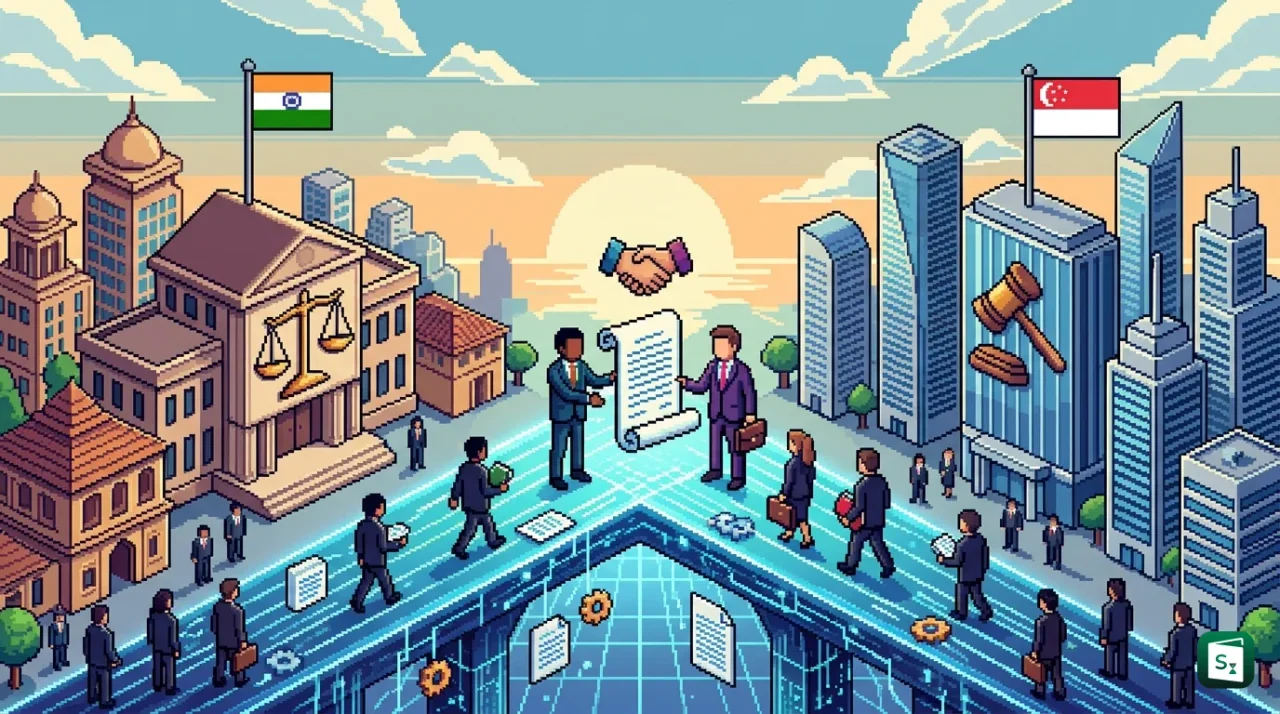
The Singapore Corporate Counsel Association (SCCA) and the General Counsels’ Association of India (GCAI) signed a Memorandum of Understanding (MoU) on 28 August 2026 in Singapore to deepen cross-border cooperation between the in-house legal communities of the two countries. The agreement was signed during GCAI’s event titled India-Singapore Legal Bridge: Enabling Growth, Investment and Effective Dispute Resolution in a Changing Global Economy, held on the sidelines of Singapore Convention Week 2026. It aims to promote knowledge exchange, professional development and talent building at a time when India-Singapore investment and commercial ties are expanding rapidly.
What Is the SCCA-GCAI MoU?
The MoU between SCCA and GCAI was signed on 28 August 2026 in Singapore during a partner event of Singapore Convention Week 2026. The event, India-Singapore Legal Bridge: Enabling Growth, Investment and Effective Dispute Resolution in a Changing Global Economy, was organised by GCAI in association with Drew & Napier LLC, a leading Singapore law firm, and brought together senior legal and business leaders from both countries.
The agreement creates a long term framework for cooperation between the two associations that represent in-house counsel, also called corporate counsel. These are lawyers who work within companies and organisations, advising on transactions, compliance, regulation and dispute management, rather than practising in courts or law firms.
The ceremony was attended by prominent figures including Justice Manmohan of the Supreme Court of India, R. Venkataramani, Attorney General for India, Sudhi Chowdhary, Deputy High Commissioner of India in Singapore, and Jimmy Yim, Chairman of Drew & Napier. SCCA President Daniel Choo and GCAI co-founders Dr Sanjeev Gemawat and Dr Akhil Prasad represented the two associations.
According to both sides, the MoU is intended as the foundation for sustained collaboration, not a one-off event. Further details of joint programmes are expected to be announced as the partnership develops.
Who Are the SCCA and the GCAI?
To understand the significance of this agreement, it helps to know the two bodies involved and what a General Counsel does.
Singapore Corporate Counsel Association
The Singapore Corporate Counsel Association Limited (SCCA) is the national body representing in-house lawyers working for companies and entities based in Singapore. Founded in 2002 and headquartered at Maxwell Chambers Suites, 28 Maxwell Road, Singapore, it is a pioneer non-profit organisation for corporate counsel in the country.
SCCA works to support the professional needs of in-house lawyers through training, networking, career development and law reform. It has helped advance issues such as the recognition of in-house counsel privilege in Singapore. It operates the SCCA Academy, which delivers skills based education, interdisciplinary courses and competency frameworks covering technical knowledge, management skills and professional ethics. The association is also connected to regional and global networks. It was a founding member of the Asia Pacific Corporate Counsel Alliance (APCCA), initiated in 2009, and part of In-House Counsel Worldwide (ICW), formalised in 2014 during the first In-House Counsel World Summit in Singapore.
The current President is Daniel Choo, who also serves as General Counsel and Privacy Responsible for APAC at Bruker. The association is led by a small professional secretariat and an executive committee drawn from senior in-house counsel.
General Counsels’ Association of India and the Role of General Counsel
The General Counsels’ Association of India (GCAI) is a national non-profit body formed, managed and led by General Counsels of leading companies in India. It was launched on 5 March 2021 in Gurugram, with its headquarters in New Delhi. Founding members include Dr Sanjeev Gemawat (then Executive Director, Legal at Dalmia Bharat), Dr Akhil Prasad (Country Counsel, Boeing India), Manjaree Chowdhary (Executive Director and General Counsel, Maruti Suzuki), Tejal Patil (Senior Legal Adviser, OYO), Sameet Gambhir, Sameer Chugh, Manish Lamba and Parvesh Kheterpal, among others. The launch was graced by former Chief Justice of India Justice Ranjan Gogoi.
A General Counsel (GC) is the most senior in-house lawyer in a company, heading its legal department. A Corporate Counsel or in-house counsel is any lawyer employed by a company to handle its legal matters. Unlike external lawyers, they advise on boardroom decisions, mergers and acquisitions, financing, regulatory compliance, technology contracts, competition law, governance and cross-border disputes. In India, GCAI was created to give this stream a distinct professional identity and voice. Its core goals include seeking statutory recognition of General Counsels and in-house counsel as legal practitioners under the Advocates Act, 1961 and Bar Council of India Rules, enhancing awareness of their contributions, upholding ethical standards and strengthening their participation in justice delivery.
GCAI has been active in policy advocacy. In July 2026, it made representations to the Bar Council of India on the proposed Advocates Act Amendment Bill 2026, asking that qualified in-house counsel be recognised as legal practitioners subject to professional and ethical obligations, in line with practice in many global jurisdictions.
What Will the Collaboration Cover?
The MoU outlines cooperation in three broad areas, with a focus on practical outcomes rather than symbolic gestures.
First, knowledge exchange. The associations will share insights on changing laws, regulatory developments, business trends and dispute resolution practices affecting India and Singapore. This includes discussions on investment flows across the India-Singapore-ASEAN corridor, the role of law in supporting growth and how companies manage legal risk when expanding across borders.
Second, professional development and engagement. The two bodies will promote networking and joint learning among in-house counsel in both jurisdictions. They will organise seminars, roundtables and training that bring corporate legal teams closer together.
Third, advancement and alignment of professional standards. SCCA and GCAI will explore ways to strengthen expectations for in-house counsel and promote greater alignment of practices across borders. As companies from both countries increasingly work on joint transactions, regulatory filings and arbitrations, consistency in skills, ethics and competence becomes more important.
Both presidents have framed the partnership in similar terms. Daniel Choo said there is tremendous potential in bringing the two in-house communities closer, given the deep ties between Singapore and India. Sanjeev Gemawat called the MoU a historic beginning that could help build a more integrated legal ecosystem across India, Singapore and the wider region, enabling businesses to invest with confidence and resolve disputes effectively.
Proposed Cross-Border Immersion Programme by SCCA Academy and GCAI
The flagship initiative announced under the MoU is a cross-border immersion programme jointly developed by SCCA Academy and GCAI. It is designed for local and international law students and aims to give them practical exposure to how in-house legal departments actually work.
Key features of the programme include:
| Area Covered | What Students Will Learn |
|---|---|
| Legal Technology and Artificial Intelligence | How corporate legal teams use technology and AI tools for contracts, compliance and research |
| Negotiation | Techniques for commercial negotiation as an in-house counsel representing business interests |
| Forensic Investigations | Methods for handling internal investigations, evidence and risk management |
| Practical In-House Practice | Day to day responsibilities, stakeholder coordination, governance and cross-border problem solving |
The sessions will be led by experienced in-house counsel and industry experts, offering direct mentoring. GCAI co-founder Akhil Prasad has stressed that the next generation of lawyers needs skills beyond traditional legal education, including AI proficiency, negotiation ability and an understanding of complex commercial problem solving. The programme reflects the shared belief that legal talent must be future ready for technology driven and globally connected business.
What Is a Memorandum of Understanding and Is It Legally Binding in India?
A Memorandum of Understanding (MoU), also expanded as Memorandum of Understanding, is a formal document that records a mutual understanding between two or more parties about how they intend to cooperate. It typically sets out objectives, areas of collaboration, roles and a framework for future work.
In India, the title of the document does not decide its legal nature. What matters is whether it satisfies the requirements of a contract under the Indian Contract Act, 1872. Under Section 10, an agreement becomes a contract only when it is made with free consent by parties competent to contract, for lawful consideration and a lawful object, and with the intention to create legal relations. Courts look at substance over form.
| Feature | MoU | Contract or Agreement |
|---|---|---|
| Purpose | Records mutual understanding and proposed cooperation | Creates immediate, enforceable obligations |
| Binding nature | Often non-binding, unless it contains all essentials of a contract | Binding by design |
| Language | May use aspirational terms like intends to or will endeavour | Uses mandatory terms like shall and agrees to |
| Completeness | May leave details to be finalised later | Contains specific deliverables, timelines, payment and dispute clauses |
| Legal remedy | May attract principles such as estoppel if acted upon | Full legal remedies including damages and specific performance |
Indian courts have held that an MoU can be enforceable if it uses precise, mandatory language, identifies clear consideration and contains complete terms, and the parties have acted on it. Examples include Nanak Builders and Investors Pvt Ltd v Vinod Kumar Alag (AIR 1991 Delhi) where the title MoU was held irrelevant, and Supreme Court decisions such as K K Modi v K N Modi (1998) and Reliance Natural Resources Ltd v Reliance Industries Ltd (2010) where family or business MoUs were treated as binding because they were acted upon. Conversely, an MoU that merely records an intention to negotiate and states that a definitive agreement will be signed later is generally treated as non-binding.
The SCCA-GCAI MoU is presented as a framework for cooperation and professional development rather than a commercial contract with payment or delivery obligations. Like many institutional MoUs between professional bodies, its force comes from commitment and collaboration, with specific binding details to be set out in later programme documents where required. Parties usually clarify which parts, if any, are legally binding, add governing law and jurisdiction clauses, and ensure proper stamping under the Indian Stamp Act, 1899 and state stamp laws where obligations are created.
Why India-Singapore Legal Cooperation Matters Now
The timing of the MoU reflects deeper economic and institutional ties.
Economic partnership. The India-Singapore Comprehensive Economic Cooperation Agreement (CECA) was signed in 2005 and entered into force on 1 August 2005. It was Singapore’s first comprehensive economic agreement with a South Asian country and a key part of its network of 28 Free Trade Agreements. CECA eliminated or reduced thousands of tariffs, gave preferential access in services including banking, telecommunications, engineering and real estate, and provided protections and dispute resolution processes for investors. Since then, bilateral trade has grown around five fold and now stands at about $35 billion. Singapore has become India’s largest source of Foreign Direct Investment (FDI) within ASEAN, with cumulative investment stock exceeding $160 billion. More than 9,000 Indian companies now base their regional or global operations in Singapore, using it as a platform to reach the 10 ASEAN member states.
Evolving cooperation pillars. The India-Singapore Ministerial Roundtable (ISMR), one of the most substantive bilateral mechanisms Singapore has with any country, now works across six pillars: advanced manufacturing, connectivity, digitalisation, healthcare and medicine, skills development and sustainability. Recent cooperation has extended to semiconductor ecosystems, the linking of India’s Unified Payments Interface (UPI) with Singapore’s PayNow (the world’s first linkage between two national payment systems), space cooperation between IN-SPACe and the Singapore Space Agency, and capital market links between SGX and Indian exchanges.
Dispute resolution ecosystem. Both countries follow the common law tradition, their arbitration laws are based on the UNCITRAL Model Law, and both are signatories to the New York Convention on recognition of foreign arbitral awards. Singapore is home to the Singapore International Arbitration Centre (SIAC) and hosts Singapore Convention Week, which focuses on mediation and arbitration under the Singapore Convention on Mediation (signed by India in 2019). For companies investing across the corridor, a trusted, neutral dispute resolution forum and predictable enforcement are critical. The panel at the Legal Bridge event stressed the idea of moving from treaty to transaction, where agreements are translated into workable rules, licensing regimes and enforceable dispute mechanisms.
Legal ecosystem gap. As cross-border deals, technology contracts and regulatory matters grow more complex, the role of in-house counsel has expanded from court related work to boardroom strategy, compliance and risk management. A more integrated network of corporate counsels can give businesses greater confidence to invest, structure deals and resolve conflicts efficiently across jurisdictions.
In this context, linking legal education, professional standards and cross-border engagement helps ensure that legal infrastructure keeps pace with commercial integration.
The Way Forward
Both associations describe the MoU as the start of a long term partnership with more initiatives to be announced. The immediate priority is developing the cross-border immersion programme and finalising its curriculum, faculty and selection process for students.
Beyond this, the partnership is expected to explore joint research on legal technology and AI governance, shared competency frameworks for in-house counsel, and regular exchanges to align professional ethics and training standards. It may also facilitate greater use of Singapore’s dispute resolution infrastructure, including SIAC and mediation pathways, for India-Singapore commercial contracts.
At the policy level, the collaboration aligns with broader efforts to strengthen the India-Singapore corridor. These include ongoing work under the MoU on cooperation in law and dispute resolution signed between the two governments in March 2024, the Joint Consultative Committee meeting in August 2025, and discussions on investment protection and ratification of international mediation frameworks. For law students and young lawyers, the initiative signals growing opportunities to build careers that blend domestic legal knowledge with cross-border, technology enabled practice.
If implemented effectively, the bridge between the two in-house communities could make legal cooperation as strong as the economic ties it is meant to support.
Key Takeaways
- The Singapore Corporate Counsel Association (SCCA) and the General Counsels’ Association of India (GCAI) signed an MoU on 28 August 2026 in Singapore during the India-Singapore Legal Bridge event on the sidelines of Singapore Convention Week 2026.
- The MoU aims to strengthen cross-border legal collaboration, knowledge exchange and professional development among in-house counsel and to advance legal talent.
- SCCA, founded in 2002 and based at Maxwell Chambers, Singapore, is the national body for in-house lawyers in Singapore and operates the SCCA Academy.
- GCAI, launched on 5 March 2021 in Gurugram and headquartered in New Delhi, was created by senior General Counsels to give in-house counsel a distinct professional identity and seek recognition under the Advocates Act, 1961.
- The flagship initiative is a cross-border immersion programme by SCCA Academy and GCAI covering legal technology and AI, negotiation and forensic investigations for law students.
- In India, an MoU is not automatically legally binding; its enforceability depends on whether it meets contract essentials under Section 10 of the Indian Contract Act, 1872, including intention to create legal relations.
- The partnership builds on strong India-Singapore ties under CECA (2005), with bilateral trade of about $35 billion and Singapore as India’s largest FDI source in ASEAN with over $160 billion in cumulative stock.