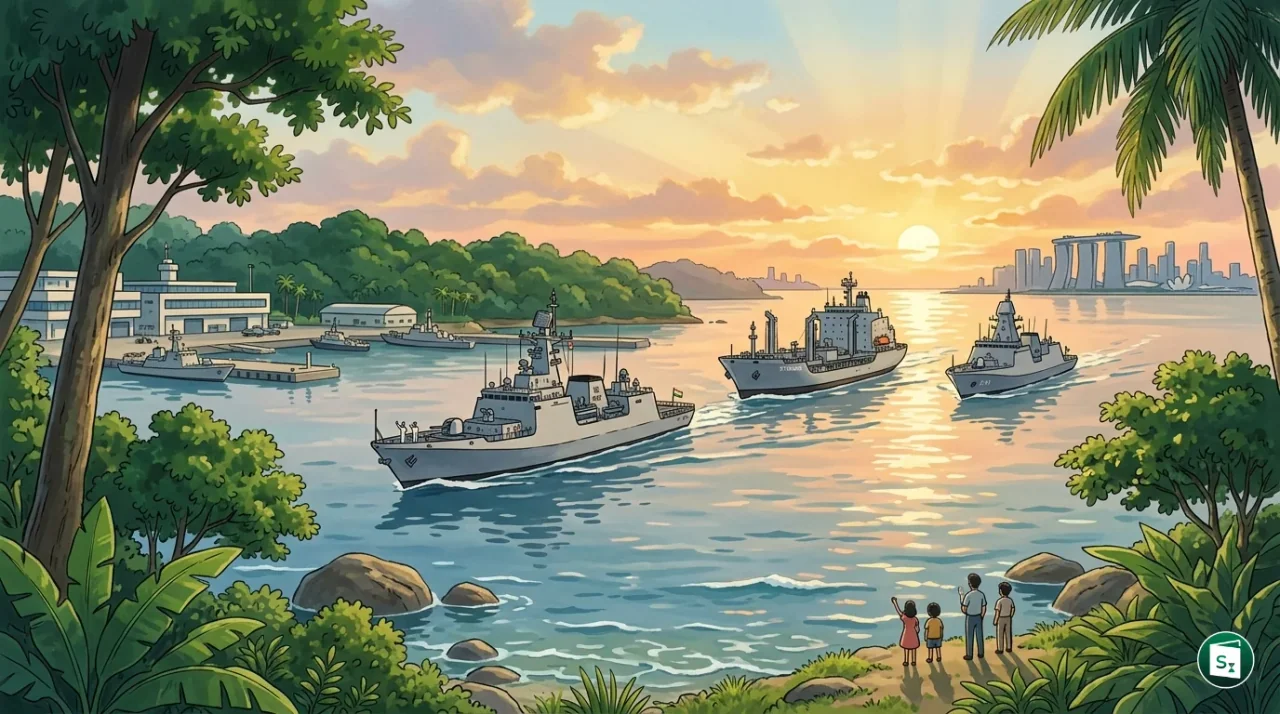
Three Indian Naval Ships of the Eastern Fleet, INS Udaygiri, INS Shakti, and INS Kavaratti, concluded their port call at the Changi Naval Base in Singapore as part of their operational deployment to Southeast Asia. The deployment, led by Rear Admiral Alok Ananda, Flag Officer Commanding Eastern Fleet (FOCEF), coincides with the observance of 2026 as the ASEAN-India Year of Maritime Cooperation. The visit underscores India’s commitment to strengthening maritime partnerships in the region in line with its Act East Policy and Vision MAHASAGAR.
The Eastern Fleet and Its Southeast Asian Deployment
The Eastern Fleet, known as the “Sword Arm” of the Eastern Naval Command, is headquartered at Visakhapatnam, Andhra Pradesh. It is responsible for India’s maritime security along the eastern seaboard and projects Indian naval power into the Bay of Bengal and beyond into Southeast Asia and the Indo-Pacific.
The current deployment of the three ships is part of a broader operational tour that included port calls at Ho Chi Minh City, Vietnam (22 June), Sattahip, Thailand (27-29 June), and finally Singapore (1 July onwards). During the visit to Thailand, the flotilla also conducted a PASSEX (Passing Exercise) with HTMS Chao Phraya of the Royal Thai Navy, enhancing interoperability between the two navies.
The Three Warships: Composition and Capabilities
The flotilla represents a mix of India’s indigenous frontline combatants and a critical logistics enabler, showcasing the Navy’s capability for sustained long-range operations.
INS Udaygiri (F35)
INS Udaygiri is the second ship of the Nilgiri-class stealth guided-missile frigates, also known as Project 17A (P17A) frigates. Built by Mazagon Dock Shipbuilders Limited (MDL) in Mumbai, it was commissioned into the Indian Navy on 26 August 2025 alongside its sister ship INS Himgiri. The ship displaces approximately 6,670 tonnes, measures 149 metres in length, and can reach speeds of 32 knots. It is armed with BrahMos anti-ship cruise missiles, Barak 8 surface-to-air missiles, and an OTO Melara 76 mm naval gun, and is powered by a CODOG propulsion system combining GE LM2500 gas turbines and MAN diesel engines. The P17A frigates feature stealth design with reduced radar cross-section and infrared signature, and are built using integrated modular construction. INS Udaygiri serves as the flagship of the Eastern Fleet flotilla on this deployment.
INS Shakti (A57)
INS Shakti is a Deepak-class fleet replenishment tanker, built by Fincantieri of Italy and commissioned in October 2011. It displaces 27,500 tonnes at full load, measures 175 metres in length, and can carry 17,900 tonnes of cargo including fuel, water, and provisions. As a fleet tanker, Shakti provides at-sea replenishment to warships, significantly extending their operational endurance. Without such logistics support, a naval task force can operate for about seven days at sea; with a tanker, this can be extended to 50 days or more.
INS Kavaratti (P31)
INS Kavaratti is the fourth and final ship of the Kamorta-class anti-submarine warfare (ASW) corvettes, built under Project 28 by Garden Reach Shipbuilders & Engineers (GRSE) in Kolkata. Commissioned on 22 October 2020, it displaces 3,300 tonnes and is 109 metres long. It is armed with an OTO Melara 76 mm gun, AK-630M close-in weapon systems, RBU-6000 anti-submarine rocket launchers, and torpedo tubes capable of firing indigenous Varunastra torpedoes. Notably, 90% of its content is indigenous, and it features a carbon fibre composite superstructure for enhanced stealth. The ship is designed primarily for hunting submarines and provides critical ASW defence for the task group.
India-Singapore Maritime Partnership
India and Singapore share one of the most comprehensive defence partnerships in Southeast Asia. The two navies conduct the Singapore-India Maritime Bilateral Exercise (SIMBEX) annually. First held in 1994, SIMBEX is the Indian Navy’s longest uninterrupted bilateral maritime exercise with any foreign navy. The 32nd edition of SIMBEX was held in July 2025 in Singapore, involving advanced naval drills across anti-submarine warfare, surface firing, and air defence.
Beyond SIMBEX, the defence cooperation includes regular port calls, professional exchanges, and intelligence sharing. During the current visit, the Indian Navy’s P-8I maritime patrol aircraft was also deployed to Singapore’s Paya Lebar Airbase for a Subject Matter Expert Exchange (SMEE) on maritime patrol aircraft operations with the Republic of Singapore Navy.
The High Commission of India in Singapore noted that the port call demonstrates India’s commitment to strengthening maritime partnerships, particularly as 2026 is being celebrated as the ASEAN-India Year of Maritime Cooperation. India’s High Commissioner to Singapore, Shilpak Ambule, visited INS Udaygiri and met Rear Admiral Alok Ananda, receiving a briefing on the capabilities of the indigenous warships.
Rear Admiral Alok Ananda: The Fleet Commander
Rear Admiral Alok Ananda, a Yudh Seva Medal awardee, was commissioned into the Indian Navy on 1 July 1993. He is a specialist in Navigation and Direction and has commanded multiple warships, including the tank landing ship INS Ghorpad and the Shivalik-class frigate INS Satpura. During his tenure as Commanding Officer of INS Satpura, the ship was adjudged the Best Ship of the Eastern Fleet and conducted the successful search and rescue of Commander Abhilash Tomy during Operation Raksham in September 2018. After serving as Assistant Chief of Naval Staff (Policy and Plans) at Naval Headquarters, he assumed command of the Eastern Fleet on 17 October 2025, succeeding Rear Admiral Susheel Menon.
Strategic Significance
The deployment of Eastern Fleet ships to Singapore and other ASEAN nations carries deep strategic significance for India’s maritime posture.
Act East Policy and Vision MAHASAGAR: India’s Act East Policy, launched in 2014, seeks to deepen economic and strategic engagement with Southeast Asian nations. Vision MAHASAGAR (Maritime Heritage, Action, Security and Growth for All in the Region), articulated by Prime Minister Narendra Modi in 2019, outlines India’s vision for a safe, secure, and collaborative maritime domain in the Indian Ocean region. The deployment directly advances both policy frameworks.
ASEAN-India Year of Maritime Cooperation 2026: The year 2026 has been designated as the ASEAN-India Year of Maritime Cooperation, marking a milestone in the ASEAN-India Strategic Partnership, which completed 30 years in 2022. Enhanced naval cooperation is a key pillar of this initiative.
Indo-Pacific Dynamics: The port call comes at a time when the Indo-Pacific region is witnessing increased geopolitical competition, with freedom of navigation and maritime security emerging as critical concerns. India’s sustained naval presence in Southeast Asia signals its role as a net security provider and a reliable partner for regional stability. The Changi Naval Base, one of the most advanced naval facilities in Asia, serves as a strategic hub for multinational naval cooperation.
Key Takeaways
- Indian Naval Ships INS Udaygiri (P17A stealth frigate), INS Shakti (fleet tanker), and INS Kavaratti (ASW corvette) concluded a port call at Singapore’s Changi Naval Base in July 2026.
- The deployment was led by Rear Admiral Alok Ananda, Flag Officer Commanding Eastern Fleet (FOCEF), who was awarded the Yudh Seva Medal in 2016.
- The port call aligns with 2026 being observed as the ASEAN-India Year of Maritime Cooperation and advances India’s Act East Policy and Vision MAHASAGAR.
- INS Udaygiri is a Nilgiri-class (Project 17A) stealth frigate commissioned in August 2025, displacing 6,670 tonnes and armed with BrahMos and Barak 8 missiles.
- The flotilla also conducted a PASSEX with the Royal Thai Navy and visited Vietnam and Thailand during the same deployment.
- India and Singapore hold the annual SIMBEX naval exercise, first held in 1994, making it the Indian Navy’s longest uninterrupted bilateral maritime exercise with any foreign navy.