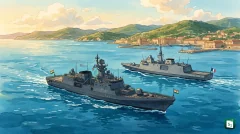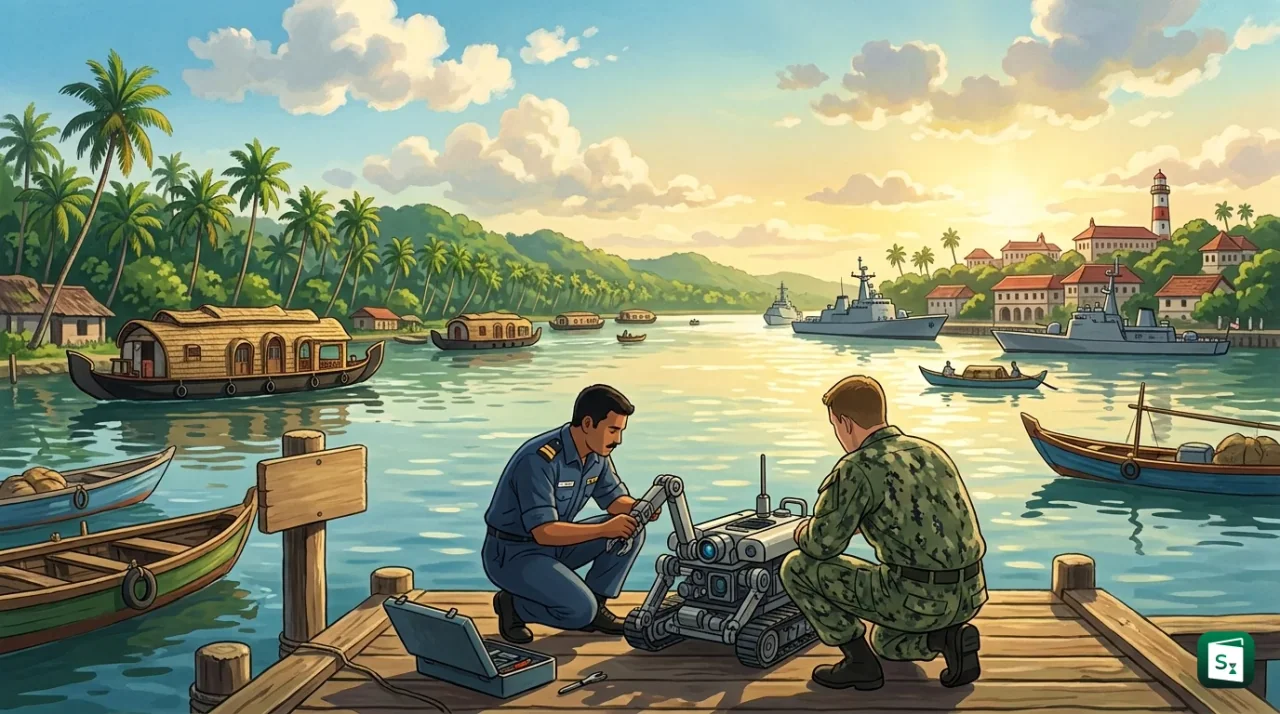
The Indian Navy and the United States Navy began their joint Explosive Ordnance Disposal (EOD) Exercise 2026 at the Southern Naval Command (SNC) in Kochi on 10 August 2026. The five-day bilateral exercise, which runs until 14 August 2026, brings together specialist diving and EOD teams from both navies. It marks the eighth edition of a specialised training relationship that has been running continuously since 2005.
What Is the India-US Navy EOD Exercise?
The EOD Exercise is a bilateral training drill between the Indian Navy (IN) and the United States Navy (USN) focused entirely on one highly specialised field: detecting and safely disposing of explosive devices in and around the sea. This is not a large war game involving warships, aircraft and missiles. Instead, it is a focused professional exchange between the two navies’ specialist diving and bomb disposal teams.
The exercise is officially designed to enhance interoperability, which means the ability of two different militaries to operate together smoothly using shared procedures, communication standards and techniques. It also aims to strengthen professional cooperation between the specialist diving and EOD teams of the two countries.
Each edition of the drill is built around the same core goals. Personnel from both sides refine their operational procedures, build a deeper mutual understanding of each other’s working methods, and sharpen their ability to respond together to complex and constantly evolving EOD challenges in the maritime domain.
What the Five-Day Exercise Includes
The EOD Exercise 2026 is structured around four main activities that take place over the five days:
| Activity | What It Involves |
|---|---|
| Subject Matter Expert Exchanges (SMEEs) | Structured discussions in which specialists from both navies share knowledge on technical topics, including contemporary EOD methodologies, emerging technologies and best practices |
| Cross-training | Divers and EOD operators from one navy train using the equipment, techniques and procedures of the other navy |
| Equipment demonstrations | Both sides display their specialised diving and ordnance disposal equipment, giving each navy a close look at the other’s tools and technology |
| Scenario-based practical exercises | Realistic, hands-on training scenarios covering simulated mine detection and neutralisation, underwater search and recovery, and wreck location and salvage |
The stated aim of this year’s programme is to promote collaborative learning and operational synergy. In plain terms, the two navies want their divers and EOD operators to learn together and work together so smoothly that they act almost as a single team when the situation demands it.
Understanding Explosive Ordnance Disposal and Salvage
Explosive Ordnance Disposal (EOD) is the specialist military field concerned with detecting, identifying, rendering safe and disposing of explosive devices. In simple terms, it is the work of making bombs and mines harmless before they can cause damage.
In a naval context, EOD work extends well beyond land-based bomb disposal. Naval EOD teams handle a wide range of threats, including sea mines, unexploded ordnance (UXO) left behind after conflicts, and improvised explosive devices (IEDs) placed under water by hostile groups. The term ordnance covers all military explosives, munitions and projectiles, whether fired, dropped, planted or abandoned.
Maritime salvage is the related discipline of recovering ships, cargo and equipment from the sea, and carrying out underwater repairs. Salvage operations often go hand in hand with EOD work, because a wrecked or stranded vessel may contain unexploded explosives that must be cleared before the ship itself can be raised or moved.
Analogy · Naval doctors for explosives Expand analogy
Think of naval EOD operators as highly trained surgeons for explosives. A surgeon removes a dangerous tumour without harming the patient; an EOD operator removes or defuses a mine without letting it explode. Both jobs demand precision, steady hands under pressure, and years of specialist training, because the smallest mistake can be fatal.
These two disciplines, EOD and salvage, together form the core of what the Indian Navy and US Navy have been practising jointly since 2005. During the exercises, divers train in skills as diverse as mine detection and neutralisation, wreck location, and underwater salvage, all of which demand elite diving ability and complete control of sophisticated equipment.
Why Kochi Hosts the Exercise
The exercise is being held at the Southern Naval Command, one of the three principal commands of the Indian Navy. The command is headquartered at INS Venduruthy, a large naval establishment located on Willingdon Island in Kochi, Kerala.
The Southern Naval Command is known as the Training Command of the Indian Navy. It is responsible for the professional training of naval officers and sailors, from their basic induction to advanced specialist courses. This makes it the natural home for an exercise that is fundamentally about specialist training.
The command oversees a wide network of training establishments spread across southern India, with most of them concentrated in and around Kochi. Its campus at INS Venduruthy houses several specialist schools, including the Diving School, which is central to EOD training. This school, established in 1972, trains personnel as clearance divers and ship divers, and is regarded as one of the most demanding training programmes in the Indian armed forces.
INS Venduruthy also hosts the Anti-Submarine Warfare School, the Seamanship School, the Signal School and the Navigation and Direction School, making it a complete hub for naval professional education. The Indian Naval Academy (INA) at Ezhimala in Kerala, where all naval officers receive their initial training, also falls under the Southern Naval Command.
A Partnership Dating Back to 2005
The Indian Navy and the US Navy have been conducting joint Salvage and EOD exercises since 2005, and the 2026 edition is the eighth edition of this specialised bilateral training series. In earlier years, the drill was widely known by the name SALVEX, short for Salvage and Explosive Ordnance Disposal Exercise.
The most recent edition before this one was SALVEX 2023, conducted in Kochi from 26 June to 6 July 2023. That edition featured the Indian diving support vessel INS Nireekshak and the US Navy’s rescue and salvage ship USNS Salvor, alongside the specialist diving and EOD teams of both navies. Over ten days, the teams trained together in mine detection and neutralisation, wreck location and salvage operations.
It is worth noting that 2005 was a landmark year for India-US defence ties more broadly. That year, the two countries signed the New Framework for the US-India Defence Relationship, a ten-year agreement that set out priorities for cooperation in defence, counter-terrorism, humanitarian relief and maritime security. The start of the joint salvage and EOD exercises in the same year reflects the wider opening up of defence cooperation between the two countries in that period.
Since then, the relationship has grown considerably. In 2016, the US designated India as a Major Defence Partner. In October 2025, the two countries signed a new ten-year Framework for the US-India Major Defense Partnership, which deepens cooperation in joint exercises, maritime security, technology sharing and defence trade.
The Broader India-US Defence Cooperation
The EOD exercise is just one thread in a much larger web of India-US defence cooperation. The two navies and armed forces take part in several other bilateral and multilateral exercises throughout the year.
The most prominent of these is Exercise Malabar, an annual maritime exercise that began as a bilateral India-US drill in 1992 and has grown into a quadrilateral exercise also involving Japan and Australia, the four members of the Quadrilateral Security Dialogue (Quad). The 2025 edition was held in November at Guam in the western Pacific, with the Indian Navy represented by the Shivalik-class frigate INS Sahyadri.
Other exercises between the two countries include Exercise Yudh Abhyas, a joint army exercise held alternately in India and the US, and Exercise Cope India, a joint air force exercise. Exercise Tiger Triumph, a tri-service humanitarian assistance and disaster relief exercise involving the Indian and US armed forces, was most recently held in Andhra Pradesh.
The 2+2 ministerial dialogue, in which the foreign and defence ministers of both countries meet jointly, provides the top-level political direction for this cooperation. The dialogue has been held regularly since 2018, and the two sides also maintain the India-US COMPACT initiative, which stands for Catalyzing Opportunities for Military Partnership, Accelerated Commerce and Technology, aimed at deepening defence industrial cooperation.
Why Maritime EOD Skills Matter More Than Ever
Maritime EOD expertise has become increasingly critical for India for several connected reasons.
The Indian Ocean is home to some of the busiest sea lanes of communication (SLOCs) in the world. Most of India’s external trade by volume and value moves by sea, and energy imports are particularly dependent on safe sea routes. A single mine or underwater IED laid in a critical chokepoint can disrupt shipping for weeks, push up insurance costs and create panic in global markets.
The strategic importance of these skills was underlined by events in 2026 in the Strait of Hormuz, the narrow waterway between the Persian Gulf and the Gulf of Oman through which a large share of the world’s oil trade passes. During the conflict in the region that year, Iranian forces were reported to have planted naval mines in the strait and threatened commercial shipping. Clearing these mines was a slow, difficult and highly dangerous task, and specialist EOD teams were at the centre of it. Even the mere threat of mines was enough to sharply reduce tanker traffic and raise maritime insurance rates.
These events are a reminder that sea mines remain one of the cheapest and most effective weapons available to a weaker navy or a non-state group. A single moored mine can sink a large warship or disable a port, and hunting mines at sea is far harder than laying them.
For India, this is not an abstract concern. India’s own naval modernisation reflects a growing focus on underwater warfare. In July 2025, the Navy commissioned INS Nistar, the first indigenously designed and constructed Diving Support Vessel (DSV), and in July 2026, it took delivery of the second such vessel, INS Nipun, both built by Hindustan Shipyard Limited in Visakhapatnam. These specialised ships are floating bases for deep-sea diving, salvage and submarine rescue operations, and they strengthen India’s ability to respond to underwater emergencies and to serve as a preferred partner for submarine rescue in the region.
Kochi itself is a major hub of this underwater-focused capability. The city hosts Cochin Shipyard, the largest shipbuilding and maintenance facility in India and the only Indian shipyard capable of building aircraft carriers. The yard is currently building a series of Anti-Submarine Warfare Shallow Water Craft (ASW SWC) for the Indian Navy, vessels designed for underwater surveillance, anti-submarine operations and mine warfare in shallow coastal waters. The Navy’s decision to locate the EOD exercise in Kochi, alongside all these capabilities, underscores the city’s growing role in India’s maritime defence architecture.
Key Takeaways
- The India-US Navy EOD Exercise 2026 was held at the Southern Naval Command, Kochi, from 10 to 14 August 2026.
- The exercise marked the eighth edition of joint Salvage and EOD exercises between the Indian Navy and US Navy, which have been conducted since 2005.
- The drill comprised Subject Matter Expert Exchanges (SMEEs), cross-training, equipment demonstrations and scenario-based practical exercises.
- The Southern Naval Command, headquartered at INS Venduruthy on Willingdon Island, Kochi, is the Training Command of the Indian Navy and houses its elite Diving School.
- The earlier SALVEX 2023 exercise featured the diving support vessel INS Nireekshak and the US Navy’s USNS Salvor.
- The Southern Naval Command is one of the three principal commands of the Indian Navy, the others being the Western Naval Command at Mumbai and the Eastern Naval Command at Visakhapatnam.