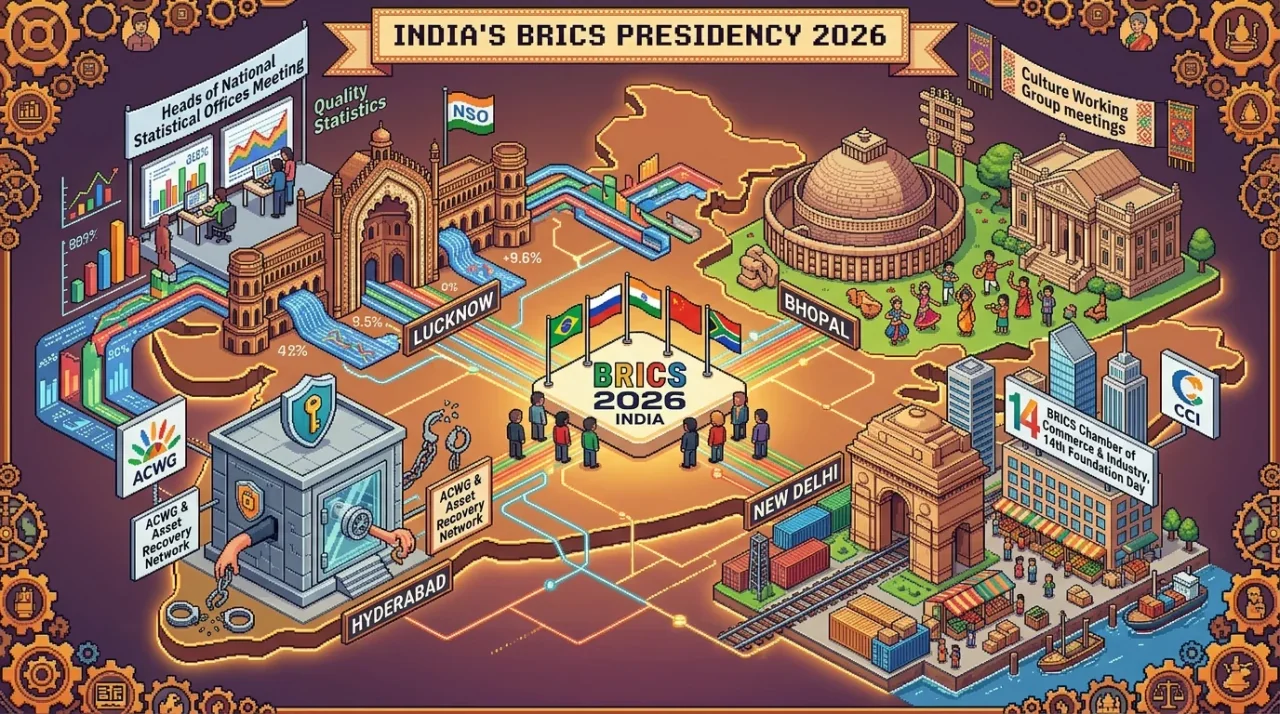
India, in its role as Chair of the BRICS grouping for 2026, has been hosting a series of high-level meetings across the country. The Meeting of Heads of National Statistical Offices (NSOs) was held in Lucknow, while the Anti-Corruption Working Group (ACWG) sessions took place in Hyderabad, and the Culture Working Group (CWG) meetings were conducted in Bhopal. At the same time, the BRICS Chamber of Commerce and Industry (BRICS CCI) marked its 14th foundation day in New Delhi, completing a busy summer of diplomacy spread across four Indian cities.
India’s BRICS Chairship 2026: The Bigger Picture
India formally assumed the BRICS Presidency on 1 January 2026, taking over from Brazil, and will hold the post for the entire year. This is the fourth time India has chaired the grouping, having earlier held the chairship in 2012, 2016 and 2021. The logo of the presidency, unveiled on 13 January 2026, features a lotus whose petals carry the colours of all BRICS members, together with the “Namaste” gesture, symbolising inclusivity, dialogue and shared growth.
The presidency works under the official theme, “Building for Resilience, Innovation, Cooperation and Sustainability”. The theme, and the acronym BRICS it forms, was first outlined by Prime Minister Narendra Modi at the 2025 BRICS Summit in Rio de Janeiro. It continues the people-centric and “Humanity First” approach that India also used during its G20 presidency.
The Four Pillars of the Presidency
The theme rests on four pillars that guide all meetings held during the year:
| Pillar | Focus |
|---|---|
| Resilience | Strengthening economic, social and institutional capacity to handle global shocks, supply chain disruptions, health crises and climate risks |
| Innovation | Promoting digital public infrastructure, emerging technologies, fintech, AI and knowledge sharing for inclusive growth |
| Cooperation | Deepening policy coordination, development finance, trade facilitation and reforms in global governance institutions |
| Sustainability | Accelerating climate action, green finance, energy transitions and sustainable development |
India has said its goal is to redefine BRICS itself around these ideas, giving the grouping a people-centric direction and placing the concerns of the Global South at the centre of its agenda. The meetings in Lucknow, Hyderabad and Bhopal were all organised around these pillars. The 18th BRICS Summit, the centrepiece of the presidency, is scheduled for 12 and 13 September 2026 in New Delhi.
BRICS: An Overview and the Story of Its Growth
BRICS is an intergovernmental grouping of major emerging economies. The acronym was coined in 2001 by economist Jim O’Neill of Goldman Sachs to describe the four fast-growing economies of Brazil, Russia, India and China, then known as BRIC. The grouping was formalised at the first meeting of BRIC foreign ministers on the sidelines of the United Nations General Assembly in New York in 2006, and the first summit was held in Yekaterinburg, Russia, in 2009.
South Africa joined in 2010 and attended the third summit in Sanya in 2011, turning BRIC into BRICS. Today, the grouping brings together eleven major emerging markets and developing countries. Together they account for about 49.5 per cent of the world’s population, roughly 40 per cent of global GDP and around 26 per cent of world trade.
BRICS cooperation is organised around three core pillars: political and security cooperation, economic and financial cooperation, and cultural and people-to-people exchanges. Two key financial institutions emerged from the group, the New Development Bank (NDB), headquartered in Shanghai, and the Contingent Reserve Arrangement (CRA), a mutual financial support pool for members facing balance of payments difficulties. Both were established at the sixth summit in Fortaleza, Brazil, in 2014.
The 2024 and 2025 Expansion
The grouping expanded significantly in recent years. From 1 January 2024, five new countries, Egypt, Ethiopia, Iran, Saudi Arabia and the United Arab Emirates, became full members, and Indonesia followed in January 2025. This took the total membership to eleven.
In 2025, ten more countries joined as BRICS partner countries: Belarus, Bolivia, Cuba, Kazakhstan, Malaysia, Nigeria, Thailand, Uganda, Uzbekistan and Vietnam. The partner country category, created at the 16th BRICS Summit in Kazan, Russia, in October 2024, serves as an on-ramp for countries seeking closer engagement before full membership. The expansion has roughly doubled the grouping’s combined population and economic weight, making it a significant voice in global debates.
Lucknow Meet: Quality Statistics as a Driver of Change
India hosted the Meeting of Heads of National Statistical Offices (NSOs) of BRICS countries in Lucknow, Uttar Pradesh, on 3 and 4 August 2026. The two-day gathering was held under the theme “Quality Statistics as a Driver of Change”, chosen by India for the 2026 BRICS Statistics Track. More than 350 participants took part, including senior statistical officials from BRICS member countries, policymakers, academics, think tanks, civil society organisations and technical experts.
A National Statistical Office is the official government body responsible for collecting, compiling and publishing a country’s official statistics, such as data on population, prices, employment and national income. In India, this role is filled by the National Statistical Office (NSO), which works under the Ministry of Statistics and Programme Implementation (MoSPI). MoSPI Secretary Saurabh Garg chaired the BRICS 2026 Statistics Track.
What the Lucknow Meeting Delivered
The discussions focused on modernising national statistical systems, making greater use of administrative data and digital public infrastructure, and strengthening data governance and privacy standards. Countries stressed that sharing knowledge, harmonising statistical methods and promoting innovation would support informed policymaking, build resilient economies and speed up sustainable development.
The meeting was organised under the long-running BRICS Statistics Track, under which member countries jointly produce statistical publications. A technical meeting of the NSOs had been held earlier, on 16 and 17 April 2026, to prepare the ground. Two side events were also organised in Lucknow, one on the use of administrative data in official statistics and another on AI readiness in the evolving data ecosystem, exploring both the opportunities and the risks that artificial intelligence brings to the field of official statistics.
The BRICS Joint Statistical Publication
A key output of the Lucknow meeting was the release of the draft BRICS Joint Statistical Publication (JSP 2026) and the Snapshot BRICS JSP 2026. The BRICS countries have been jointly publishing the JSP since 2010, providing harmonised statistical data for policymakers, researchers and the public, and the Snapshot version since 2020. The meeting concluded with the adoption of a joint statement reinforcing the members’ commitment to stronger, more transparent and more policy-relevant statistical systems.
Hyderabad Meet: The Anti-Corruption Working Group
India hosted the 2nd Meeting of the BRICS Anti-Corruption Working Group (ACWG) and the 2nd Meeting of the BRICS Expert Network on Asset Recovery in Hyderabad, Telangana, on 4 and 5 August 2026. The two-day event was organised by the Department of Personnel and Training (DoPT), the central government department that also handles vigilance and anti-corruption administration in India. DoPT Secretary Rachna Shah inaugurated the meeting.
The gathering built on the outcomes of the first ACWG meeting, which was held virtually on 2 and 3 June 2026. As the final ACWG meeting under India’s presidency, it was expected to consolidate the progress made during the year and lay the foundation for sustained cooperation among BRICS members.
Key Focus Areas
The deliberations covered strengthening international cooperation for asset recovery, combating cross-border corruption, and enhancing transparency and accountability in governance. The specific agenda included:
- Strengthening informal cooperation to trace fugitives wanted in corruption cases and support extradition proceedings
- Enhancing information sharing and operational cooperation through the BRICS Expert Network on Asset Recovery
- Sharing experiences on preventing corruption risks arising from FinTech, digital assets and emerging digital financial instruments
A dedicated side event titled “Ethical Governance through Innovation and Tech-Driven Systems” was held on 5 August, covering digital public procurement, citizen engagement and the use of technology to improve transparency in government.
The Fugitive Offenders Network
The most significant outcome was the progress made on India’s proposal to establish a BRICS Network of Law Enforcement Practitioners for enhancing international cooperation on fugitive offenders. BRICS members reached an in-principle agreement on the initiative and decided to continue work on a dedicated practitioner-level platform. The network is expected to facilitate informal cooperation, support the tracing of fugitives and complement formal extradition mechanisms.
Members also welcomed the BRICS Repository on Informal Cooperation for tracing fugitive offenders and supporting extradition. This repository will serve as a practical reference for sharing national practices and informal cooperation mechanisms. Speaking at the meeting, Secretary Rachna Shah stressed that no jurisdiction should become a sanctuary for those who profit from crime, and called for stronger cooperation to recover stolen assets and close loopholes that allow offenders and illicit funds to move across borders.
Bhopal Meet: The Culture Working Group
The 3rd BRICS Culture Working Group (CWG) meeting was held in Bhopal, Madhya Pradesh, on 5 and 6 August 2026, organised by the Ministry of Culture in association with the Madhya Pradesh government. It was the third and final CWG meeting of the year under India’s presidency, following the first meeting held virtually on 29 and 30 April 2026 and the second in Varanasi on 4 and 5 June 2026.
Bhopal, often called the “City of Lakes”, was a fitting venue. The deliberations took place at the Kushabhau Thackeray Convention Centre, with more than 100 foreign delegates taking part. Delegations from Brazil, China, South Africa, the UAE, Indonesia, Iran, Russia and Ethiopia attended, while Egypt joined in hybrid mode.
The Sanchi Cultural Connect Declaration
The working group aimed to finalise the Sanchi Cultural Connect Declaration and draft the official statement for the upcoming 11th BRICS Culture Ministers’ Meeting, which was also held in Bhopal on 8 August 2026. The ministerial meeting adopted the Bhopal Declaration, a framework for cultural cooperation covering the creative economy, heritage conservation, museums, libraries, archives, documentary heritage and protection of creators’ rights.
Key proposals discussed by the working group included the formation of BRICS sub-working groups on the creative economy, copyright and artificial intelligence, the creation of a BRICS artist registry and a Heritage Provenance Research Hub, and the establishment of a BRICS Cultural Connect Digital Platform proposed by India for knowledge sharing across member nations. Delegates also discussed institutional cooperation on manuscripts and documentary heritage.
Three special exhibitions were organised to showcase India’s civilisational heritage: Gyan Bharatam, Project Brihattar Bharat and Project Mausam. Project Mausam highlights India’s historical maritime cultural networks across the Indian Ocean region. Delegates also visited the Sanchi Stupa, a UNESCO World Heritage Site about 40 km from Bhopal, home to Buddhist monuments dating back to the 3rd century BCE, built in the time of Emperor Ashoka. A two-day BRICS Culture Festival, themed “Harmony and Peace to All”, was also held in Bhopal on 6 and 7 August.
BRICS CCI Celebrates 14 Years in New Delhi
Alongside these intergovernmental meetings, the BRICS Chamber of Commerce and Industry (BRICS CCI) celebrated its 14th foundation day in New Delhi. The event marked fourteen years of advancing international trade, investment, innovation, entrepreneurship, policy dialogue and people-to-people cooperation across BRICS and BRICS+ nations.
The occasion brought together diplomats from BRICS and partner countries, senior bureaucrats, policymakers, industry leaders and entrepreneurs. A highlight of the evening was the unveiling of the book “Foundation of a Multipolar World”, authored by Dr. BBL Madhukar, Founder and Chairman Emeritus of BRICS CCI, and Dr. Sreekutty Mohandas. The chamber also presented its annual awards and recognition honours for contributions to global trade, innovation and international cooperation.
About BRICS CCI
BRICS CCI is a not-for-profit business chamber established in 2012, with the goal of promoting trade, investment, technology, innovation, entrepreneurship and sustainable development among BRICS and BRICS+ nations. It works as a bridge between governments and industry, and through its network of diplomatic missions, businesses, academic institutions and civil society, it supports economic cooperation and the building of a more equitable multipolar world. Over its fourteen years, the chamber has become one of India’s leading international business institutions, with programmes on women’s leadership and youth engagement as well as trade promotion.
Significance of the 2026 Meetings
The four events together show the breadth of the BRICS agenda during India’s presidency. Statistics, anti-corruption and culture may look like separate fields, but each connects to the presidency’s larger goals. Reliable statistics support better policymaking in all member economies, cooperation on asset recovery and fugitive offenders protects the integrity of financial systems, and cultural exchanges deepen people-to-people ties that sustain long-term political and economic relationships.
For India, hosting these meetings across different cities has strategic value. It projects India’s institutional strengths, its statistical infrastructure, its law enforcement cooperation, and its civilisational heritage, to a large group of emerging economies. It also reinforces India’s role as a bridge within the grouping and a voice for the Global South in debates on global governance.
The meetings also laid groundwork for the 18th BRICS Summit in New Delhi in September 2026. The in-principle agreement on the fugitive offenders network, the joint statement on statistical cooperation and the Bhopal Declaration on culture are all concrete deliverables that India can point to as evidence of an action-oriented presidency. With the grouping now covering roughly half the world’s population and 40 per cent of global GDP, the outcomes of these working-level meetings carry weight well beyond the rooms in which they were held.
Key Takeaways
- India is chairing BRICS in 2026 for the fourth time, under the theme “Building for Resilience, Innovation, Cooperation and Sustainability”, and will host the 18th BRICS Summit in New Delhi on 12 and 13 September 2026.
- The Meeting of Heads of National Statistical Offices was held in Lucknow on 3 and 4 August 2026 under the theme “Quality Statistics as a Driver of Change”, with over 350 participants.
- The 2nd BRICS Anti-Corruption Working Group Meeting and the 2nd Meeting of the BRICS Expert Network on Asset Recovery were held in Hyderabad on 4 and 5 August 2026, organised by the Department of Personnel and Training (DoPT).
- Members reached an in-principle agreement on India’s proposal for a BRICS Network of Law Enforcement Practitioners to strengthen cooperation on fugitive offenders and extradition.
- The 3rd BRICS Culture Working Group Meeting was held in Bhopal on 5 and 6 August 2026, and the 11th BRICS Culture Ministers’ Meeting adopted the Bhopal Declaration.
- The BRICS Chamber of Commerce and Industry (BRICS CCI), established in 2012, celebrated its 14th foundation day in New Delhi.