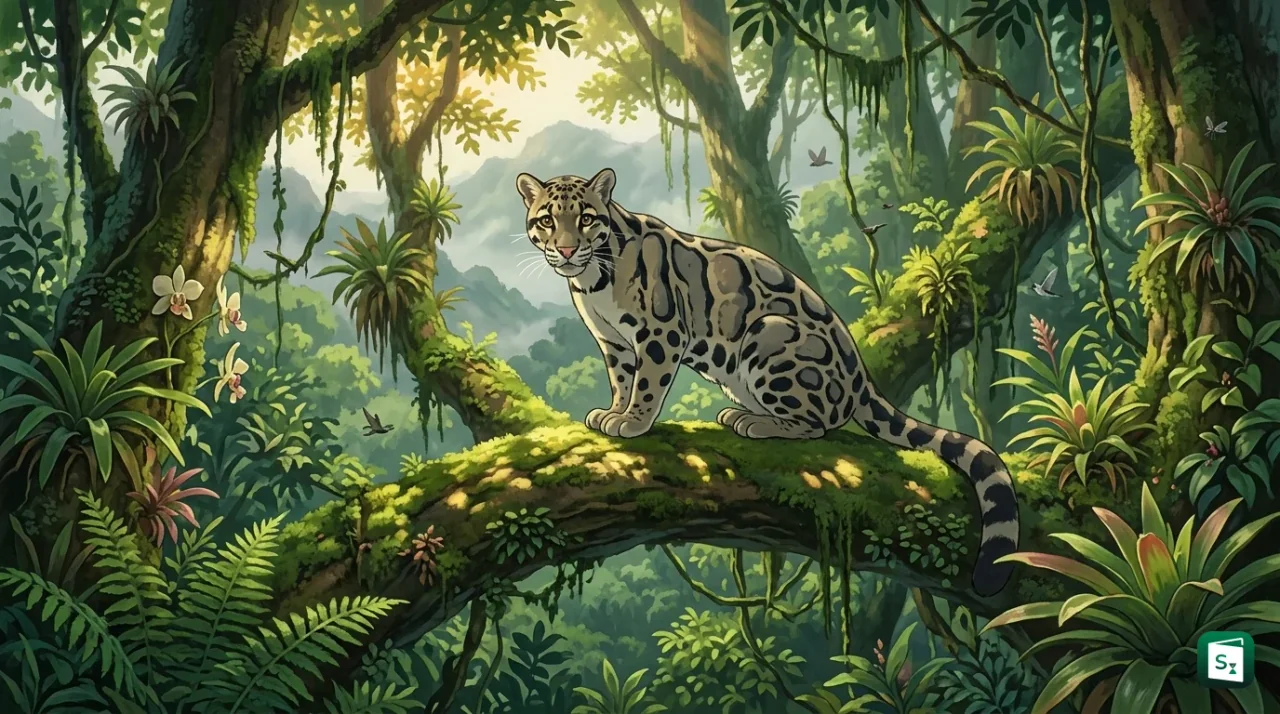
International Clouded Leopard Day is observed every year on August 4 to raise awareness about one of Asia’s most secretive and fascinating wild cats. The day was founded in 2018 by keepers Lauren Amos and Dan Kemp at Howletts Wild Animal Park in Kent, United Kingdom, in partnership with The Aspinall Foundation. The date shines a light on the threats facing this vulnerable feline and highlights the conservation work needed to protect it, both in the wild and in captivity.
About International Clouded Leopard Day
The first International Clouded Leopard Day was held in 2018 at Howletts Wild Animal Park, a conservation-focused wildlife park near Canterbury in the United Kingdom. Howletts and its sister park, Port Lympne Reserve, are managed by The Aspinall Foundation, a charity founded in 1984 that works to breed endangered animals in captivity and return them to protected wilderness areas in their native habitats.
The two parks together claim the title of the most successful breeders of clouded leopards in the world, with 146 births recorded, more than any other breeding programme. The keepers who founded the day chose August 4 deliberately, hoping that a dedicated awareness day would draw global attention to a cat that most people have never seen or even heard of.
Since its launch, the observance has gone global. Zoos such as the Cincinnati Zoo, conservation organisations and schools across the world now host keeper talks, guided nocturnal walks, workshops and fundraising drives on the day. People are encouraged to share facts and images on social media using the hashtags #InternationalCloudedLeopardDay and #CloudedLeopardDay. In 2026, the day carried added significance for India, because the Ministry of Environment, Forest and Climate Change released the country’s first dedicated Clouded Leopard Conservation Action Plan to coincide with the observance.
The Clouded Leopard: A Unique Wild Cat
Despite its name, the clouded leopard is not a leopard. It belongs to its own genus, Neofelis, and sits in an evolutionary middle ground between the big cats of the Panthera genus, such as tigers and lions, and the smaller wild cats. Genetic studies suggest the species branched off from the big cat lineage more than 6 million years ago, making it one of the oldest living feline lineages.
Its name comes from its coat, which carries large, irregular blotches and patches edged in black that resemble storm clouds. The fur is a pale yellowish-brown to grey, and the cloud-like markings give the animal excellent camouflage in the dappled light of the forest canopy.
The clouded leopard is famous for its teeth. It has the longest canine teeth relative to its skull size of any living cat, with canines measuring around 5 centimetres. Because of these sabre-like fangs, it is often nicknamed the “modern-day sabre-tooth”. Its head-and-body length ranges from roughly 69 to 108 centimetres, while its thick, black-ringed tail can be almost as long as its body and is used for balance high in the trees.
Two Species, One Name
Scientists now recognise two separate species of clouded leopard. They were long treated as a single species, but genetic and anatomical studies carried out in 2006 confirmed that they are distinct.
| Species | Scientific Name | Where It Lives |
|---|---|---|
| Mainland clouded leopard | Neofelis nebulosa | Himalayan foothills, Northeast India, mainland Southeast Asia, southern China |
| Sunda clouded leopard | Neofelis diardi | Islands of Borneo and Sumatra |
The mainland species is the one found in India. The Sunda clouded leopard, named after the Sunda Islands, is restricted to Borneo and Sumatra. The Formosan clouded leopard, which once lived on the island of Taiwan, is now considered extinct.
Built for Life in the Trees
The clouded leopard is one of the most accomplished climbers in the cat family. Short, powerful legs, large paws, strong curved claws and flexible ankle joints allow it to move through the canopy with ease. Uniquely among big cats, it can climb down a tree trunk head-first and even hang from a branch by its hind feet.
It preys on monkeys, squirrels, deer, wild pigs and other forest animals, which it catches both in the trees and on the ground. It is shy, secretive and largely active at night, which is why so few people have ever seen one in the wild.
Distribution and Habitat in India
The mainland clouded leopard is found from the Himalayan foothills of Nepal, Bhutan and India, through Myanmar, Thailand, Malaysia and Indochina, to southern China. In India, the species is restricted almost entirely to the northeastern states and the eastern Himalayas, living in dense subtropical and tropical evergreen forests.
Its presence has been recorded in Meghalaya, Mizoram, Tripura, Assam, Arunachal Pradesh, Nagaland, Manipur, Sikkim and the northern parts of West Bengal. Some sightings have also been reported as far west as the Valmiki Tiger Reserve in Bihar. Camera traps have confirmed its presence in reserves such as Pakke Tiger Reserve in Arunachal Pradesh, Manas National Park in Assam, Namdapha National Park in Arunachal Pradesh and the Nongkhyllem Wildlife Sanctuary in Meghalaya.
The clouded leopard is the state animal of Meghalaya, a recognition of the cat’s importance to the region. Researchers have even documented surprisingly high-altitude sightings in the Khangchendzonga Biosphere Reserve in Sikkim, at elevations of up to 3,700 metres. The Dampa Tiger Reserve in Mizoram is regarded as having one of the highest population densities of clouded leopards in South and Southeast Asia, with surveys estimating around 5 individuals per 100 square kilometres.
Why the Clouded Leopard Needs Protection
The clouded leopard is listed as Vulnerable on the IUCN Red List of Threatened Species, the global list of species at risk of extinction. Global population estimates are uncertain because the cat is so hard to observe, but the IUCN estimates there are roughly 3,700 to 5,580 mature individuals of the mainland species left in the wild, and fewer than 10,000 clouded leopards of both species combined. Population numbers have declined by more than 30 per cent over the past two decades.
The biggest threat is habitat loss and fragmentation. Southeast Asia’s forests are being cleared at one of the fastest rates in the world for timber, agriculture, roads and expanding settlements. One widely cited estimate suggests that more than 30 per cent of the mainland clouded leopard’s habitat was lost between 2000 and 2018. When forests are cut into small, isolated patches, breeding populations become cut off from each other, which weakens the species over time.
Poaching and the illegal wildlife trade are the second major threat. The clouded leopard is hunted for its beautiful coat, while its bones, claws and teeth are used in traditional medicine. The species also dies in snares set for other animals, and faces retaliatory killing by villagers when it preys on livestock. Its listing in Appendix I of CITES, the international treaty that regulates trade in endangered species, provides protection at the global level, while in India the cat is listed in Schedule I of the Wildlife (Protection) Act, 1972, which grants it the highest level of legal protection.
| Threat | How It Harms the Species |
|---|---|
| Deforestation and habitat fragmentation | Destroys forest canopy and cuts off breeding populations |
| Poaching and illegal wildlife trade | Fur, bones and teeth sold for money and traditional medicine |
| Accidental snaring | Clouded leopards get trapped in snares meant for other animals |
| Human-wildlife conflict | Retaliatory killings after attacks on livestock |
India’s Conservation Efforts
The Clouded Leopard Conservation Action Plan
On the occasion of International Clouded Leopard Day in 2026, India’s Ministry of Environment, Forest and Climate Change launched the country’s first dedicated Clouded Leopard Conservation Action Plan (CAP). The plan was prepared under a joint Government of India, Global Environment Facility (GEF) and United Nations Development Programme (UNDP) initiative, and was finalised during the 91st meeting of the Standing Committee of the National Board for Wildlife in Coimbatore in July 2026.
The action plan identifies 14 priority conservation landscapes across Northeast India for habitat protection and restoration. It also emphasises restoring wildlife corridors, the forest pathways that allow animals to move between isolated patches of forest and keep populations connected. Scientific monitoring is a core pillar, using camera traps, occupancy surveys, genetic analysis and environmental DNA (eDNA) to establish a reliable population baseline for a species whose numbers in India are not yet known with confidence.
The plan promotes community-based conservation, recognising that much of Northeast India’s forest lies outside formal protected areas and is managed under community and customary land systems. It also strengthens anti-poaching efforts, equipping frontline forest staff with the M-STrIPES smart application, a mobile tool originally built for tiger monitoring, and supports transboundary cooperation with neighbouring countries such as Bhutan, Myanmar and Nepal. The species has also been brought under the Species Recovery Programme of the Integrated Development of Wildlife Habitats (IDWH) scheme, a centrally sponsored programme that provides technical and financial assistance for protecting wildlife habitats.
Dedicated Protected Areas
India has taken a special interest in this species for nearly two decades. In 2007, the country established the Clouded Leopard National Park within the Sepahijala Wildlife Sanctuary in Tripura, making it India’s first dedicated park for the clouded leopard. The park covers about 5.08 square kilometres and also protects other rare species such as the hoolock gibbon and the Phayre’s leaf monkey.
The clouded leopard is also protected under several other legal and policy frameworks. As a Schedule I species under the Wildlife (Protection) Act, 1972, it enjoys absolute protection from hunting, trade and possession. India’s long-running Project Tiger, now more than half a century old, and the International Big Cat Alliance (IBCA), launched by India in April 2023, provide broader institutional backing for the conservation of large cats across the country.
The Way Forward
Conserving the clouded leopard is really about conserving the forests of Northeast India. Because the species depends on dense, connected forest canopy, protecting it automatically protects the wider ecosystem, making it an umbrella species whose conservation benefits countless other plants and animals in the region.
The newly launched action plan marks the first time this little-studied cat has received dedicated, landscape-level planning in India. Its success will depend on reliable population surveys, real protection of forest corridors and the active participation of local communities, who manage much of the forest land. International cooperation with neighbouring range countries is equally important, since clouded leopards do not respect national borders.
As the world marked International Clouded Leopard Day in August 2026, the central message remained simple: this ancient, tree-dwelling cat is running out of forest, and its future depends on whether those forests are protected and reconnected before it is too late.
Key Takeaways
- International Clouded Leopard Day is observed every year on August 4, and it was founded in 2018 by keepers at Howletts Wild Animal Park in the United Kingdom.
- The mainland clouded leopard (Neofelis nebulosa) and the Sunda clouded leopard (Neofelis diardi) were recognised as separate species in 2006.
- The clouded leopard has the longest canine teeth relative to its skull size of any living cat, and it can climb down a tree trunk head-first.
- The clouded leopard is listed as Vulnerable on the IUCN Red List, is included in Appendix I of CITES, and is in Schedule I of the Wildlife (Protection) Act, 1972 in India.
- In India, the clouded leopard is found mainly in Northeast India and is the state animal of Meghalaya; the Dampa Tiger Reserve in Mizoram has one of the highest densities of the species in South and Southeast Asia.
- In 2026, India launched the Clouded Leopard Conservation Action Plan, identifying 14 priority conservation landscapes across Northeast India.