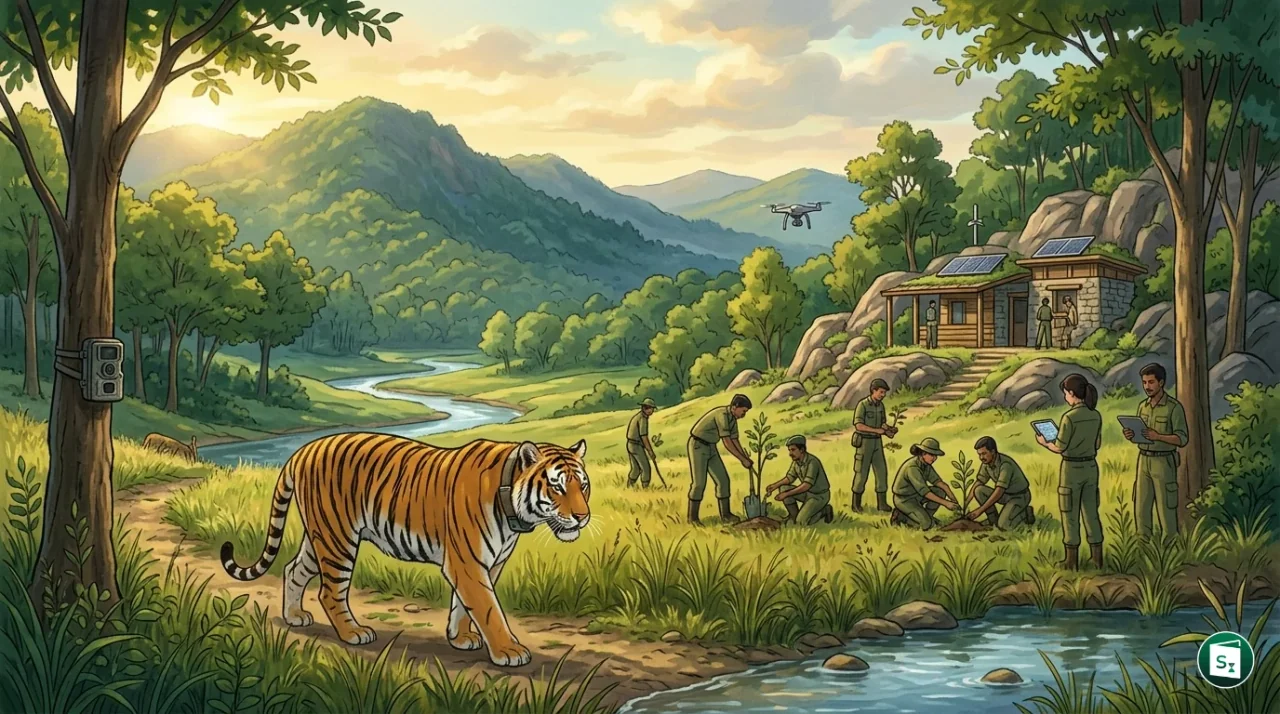
The Union Ministry of Environment, Forest and Climate Change has identified 25 of India’s 58 tiger reserves as potential recipient sites for priority recovery through science-led interventions. The decision follows two reports released by Union Minister Bhupender Yadav at a national workshop in Alwar, Rajasthan, marking 18 years of tiger reintroduction in the Sariska Tiger Reserve. With India’s tiger population growing at an annual rate of 6% and now estimated at 3,682, the new roadmap shifts focus from counting numbers to actively restoring reserves where tiger occupancy, prey abundance or habitat quality remains critically low.
What Is the New Tiger Conservation Roadmap?
The two reports were released on June 28, 2026, at the National Workshop on “Tiger Re-introduction: Opportunities and Challenges” organised by the National Tiger Conservation Authority (NTCA) in collaboration with the Government of Rajasthan. The NTCA was constituted in 2006 under an amendment to the Wildlife (Protection) Act, 1972, following the recommendations of the Tiger Task Force. It is the statutory body responsible for overseeing India’s tiger conservation efforts and ensuring implementation of Project Tiger, India’s flagship conservation programme launched in 1973.
The “Road Map on Active Management of Tigers in India” is the flagship document. It provides a framework for managing tiger populations by evaluating every tiger reserve on three key parameters: habitat quality, prey abundance, and tiger occupancy. Reserves are classified as either source populations, where all three factors are strong and tigers breed in healthy numbers, or sink populations, where one or more of these factors is under stress and tiger populations are absent, critically low or declining.
The second document, “Tiger Reintroduction: Field Learnings and Case Studies”, presents the first comprehensive assessment of India’s experience in restoring locally extinct, depleted or genetically isolated tiger populations across 12 reserves. It was developed by the NTCA in collaboration with the Wildlife Institute of India (WII), headquartered in Dehradun, which serves as the premier research body guiding India’s wildlife conservation science.
Alongside these two reports, the Minister also released the Annual Report of Project Cheetah (September 2024 to December 2025), documenting progress in India’s cheetah reintroduction programme.
Source and Sink: The Science Behind the Strategy
The roadmap introduces a source-sink framework that marks a significant shift in India’s conservation approach. Rather than treating all reserves equally, it categorises them based on ecological conditions. Source reserves are those where habitat, prey and tiger numbers are all healthy. These reserves produce surplus tigers that naturally disperse into surrounding areas. The report identifies 13 such high-performing reserves, including Corbett, Bandipur, Kanha, Kaziranga and Ranthambore. Corbett alone holds around 260 tigers, one of the highest densities in India.
On the other hand, sink reserves are areas where tiger populations are absent, critically low or in decline due to poor habitat quality, low prey density or habitat fragmentation. The roadmap has identified 25 reserves as sink populations needing targeted, science-led intervention.
The framework is built on three assessment parameters:
| Parameter | What It Measures |
|---|---|
| Habitat Quality | Forest cover, water availability, degree of anthropogenic disturbance |
| Prey Abundance | Density of herbivore species such as chital, sambar, nilgai and wild pig |
| Tiger Occupancy | Presence or absence of breeding tigers and population trends |
The roadmap also emphasises that conservation can no longer be limited to the boundaries of protected areas. It advocates a landscape-scale model that includes maintaining wildlife corridors, securing dispersal habitats and promoting coexistence between humans and tigers across shared landscapes. This is critical because many sink reserves are isolated from source populations by fragmented forests, roads and human settlements, cutting them off from the dispersing tigers that would otherwise repopulate them naturally.
The 25 Priority Reserves: Where Intervention Is Needed
The 25 reserves identified for priority recovery span multiple landscapes across India. Some of them have zero tigers, while others have critically low populations that are not viable in the long term. The reasons for decline vary by region, revealing distinct ecological and human-induced challenges.
Reserves such as Satkosia (Odisha), Kawal (Telangana), Dampa (Mizoram), Kamlang (Arunachal Pradesh) and Buxa (West Bengal) currently have no tigers at all. Low prey abundance is a recurring problem cited for nearly every reserve on the list. Without adequate populations of herbivores such as chital, sambar and nilgai, tigers cannot establish breeding populations even if habitat conditions are otherwise suitable.
Fragmented landscape connectivity compounds the problem in reserves like Ranipur (Uttar Pradesh), Achanakmar (Chhattisgarh), Kali (Karnataka) and Mukundara Hills (Rajasthan). These reserves are isolated from source populations, preventing natural tiger dispersal that would otherwise help repopulate them.
In the Chhattisgarh-Jharkhand belt, reserves such as Indravati, Udanti-Sitanadi, Guru Ghasidas-Tamor Pingla and Palamau have suffered from Left Wing Extremism (LWE) related disruptions that severely compromised protection efforts for years. Poaching, habitat degradation and encroachment worsened during periods of weak enforcement.
The Northeastern reserves, including Dampa, Kamlang and Namdapha, face naturally low prey densities combined with rugged terrain and historical hunting pressure. However, these reserves also have extensive forest cover, giving them strong recovery potential if prey, protection and connectivity are improved.
The Central Indian and Eastern Ghats landscape has the largest number of reserves flagged for priority intervention, highlighting the uneven distribution of tigers within India’s overall successful conservation story.
Sariska: A Success Story That Shaped the Strategy
The Sariska Tiger Reserve in the Alwar district of Rajasthan holds a unique place in India’s conservation history. In the mid-2000s, the reserve lost all its tigers to poaching and habitat degradation, becoming a symbol of conservation failure. The last tiger in Sariska died in 2005, but park authorities continued to report misleading population figures for years, exposing deep flaws in monitoring systems. A Tiger Task Force appointed by the central government submitted a damning report titled “Joining the Dots” in 2005, which recommended sweeping reforms in tiger conservation.
In July 2008, the first tiger, named ST-1, was translocated from Ranthambore Tiger Reserve to Sariska. This was the world’s first successful scientific reintroduction of tigers into a landscape where the species had become locally extinct. The first breeding success came in 2012 when tigress ST-2 gave birth to two cubs. By 2022, the population had grown to 19, and it has now reached 56 tigers as of 2026.
The national workshop in Alwar was timed to mark 18 years since this historic reintroduction. The success of Sariska, along with Panna Tiger Reserve in Madhya Pradesh, provided the foundational experience that shaped the new roadmap. Panna lost all its tigers to poaching in 2008-2009 and was repopulated through a similar reintroduction programme, reaching over 40 individuals within nine years.
Both reserves demonstrated that tiger recovery is possible even after complete local extinction, provided habitat and prey base are intact and communities support conservation. The lessons from these successes are now being applied to the 25 priority reserves identified under the new roadmap.
Lessons from Tiger Reintroduction Across India
Since 2008, India has undertaken scientifically designed tiger recovery interventions across 12 reserves. The experiences have been mixed, offering valuable insights into what works and what does not in tiger conservation.
Some reserves have shown remarkable recovery through strategic supplementation adding tigers to existing but depleted populations. Sanjay Dubri Tiger Reserve in Madhya Pradesh increased its tiger count from 8 to 24. Veerangana Durgavati Tiger Reserve, also in Madhya Pradesh, now supports 30 tigers and has emerged as a key conservation landscape in central India. Navegaon-Nagzira Tiger Reserve in Maharashtra expanded from 8 to 23 tigers. Ramgarh Vishdhari Tiger Reserve in Rajasthan has recorded 8 tigers, strengthening connectivity across eastern Rajasthan.
However, not all attempts succeeded. The reintroduction at Satkosia Tiger Reserve in Odisha failed due to lack of community support. Tigers translocated to Satkosia faced conflict with local populations, and the resistance from communities proved insurmountable. This failure highlighted a critical lesson: ecological science alone is not enough. Community acceptance and socio-economic realities ultimately determine whether tigers can return to a landscape.
The roadmap makes clear that reintroduction is strictly a last resort, to be attempted only after rigorous scientific assessment of habitat suitability including forest cover, water availability and terrain, prey density or the presence of adequate herbivore populations, protection measures or the capacity to prevent poaching, and socio-economic conditions including local community attitudes and livelihood dependencies.
The report also stresses that prey base recovery must precede any tiger release. Without adequate populations of prey species like sambar, chital and nilgai, relocated tigers tend to move toward livestock, increasing human-wildlife conflict. Similarly, habitat corridors must be secured to ensure that reintroduced populations can exchange genes naturally rather than remain trapped as isolated genetic islands.
The Bigger Picture: India’s Tiger Conservation Journey
India’s tiger conservation story is one of the world’s most significant wildlife recovery efforts. When Project Tiger was launched in 1973, the country had just 1,411 tigers across nine reserves. Today, India has 58 tiger reserves covering over 85,000 sq km and an estimated 3,682 tigers, accounting for nearly 70% of the global wild tiger population. India achieved the St. Petersburg Declaration target of doubling its wild tiger population by 2022, four years ahead of the global deadline.
The number of tiger reserves has grown from 46 to 58 in the last decade alone, reflecting the government’s expanding commitment to conservation. The new roadmap builds on this foundation by acknowledging that the next phase of conservation must move beyond headline numbers. With some reserves overcrowded and many others empty or underpopulated, the strategy shifts to habitat quality, prey recovery and landscape connectivity as the pillars of long-term tiger conservation.
The roadmap also aligns with the broader vision outlined in Amrit Kaal Ka Tiger Vision Tiger@2047, released during Project Tiger’s Golden Jubilee in 2023. This 25-year vision aims to position the tiger as a symbol of India’s natural heritage and ecological well-being, guiding conservation efforts toward a greener, more balanced and biodiversity-rich future by the time India marks 100 years of Independence in 2047.
Key Takeaways
- The Union Ministry of Environment, Forest and Climate Change has identified 25 of India’s 58 tiger reserves for priority recovery based on two reports released on June 28, 2026.
- The Road Map on Active Management of Tigers in India classifies reserves into source (13 high-performing) and sink (25 needing intervention) populations based on habitat quality, prey abundance and tiger occupancy.
- Sariska Tiger Reserve recovered from complete local extinction in 2005 to 56 tigers in 2026, marking the world’s first successful scientific tiger reintroduction programme.
- The National Tiger Conservation Authority (NTCA), constituted in 2006 under the Wildlife (Protection) Act, 1972, is the nodal agency implementing the roadmap, in collaboration with the Wildlife Institute of India (WII) in Dehradun.
- India’s tiger population is estimated at 3,682 (2022 cycle), growing at 6% annually, accounting for nearly 70% of the world’s wild tigers.
- Project Tiger, launched in 1973, has expanded India’s tiger reserves from 9 to 58 over five decades, and India met the St. Petersburg Declaration target of doubling tiger numbers by 2022.