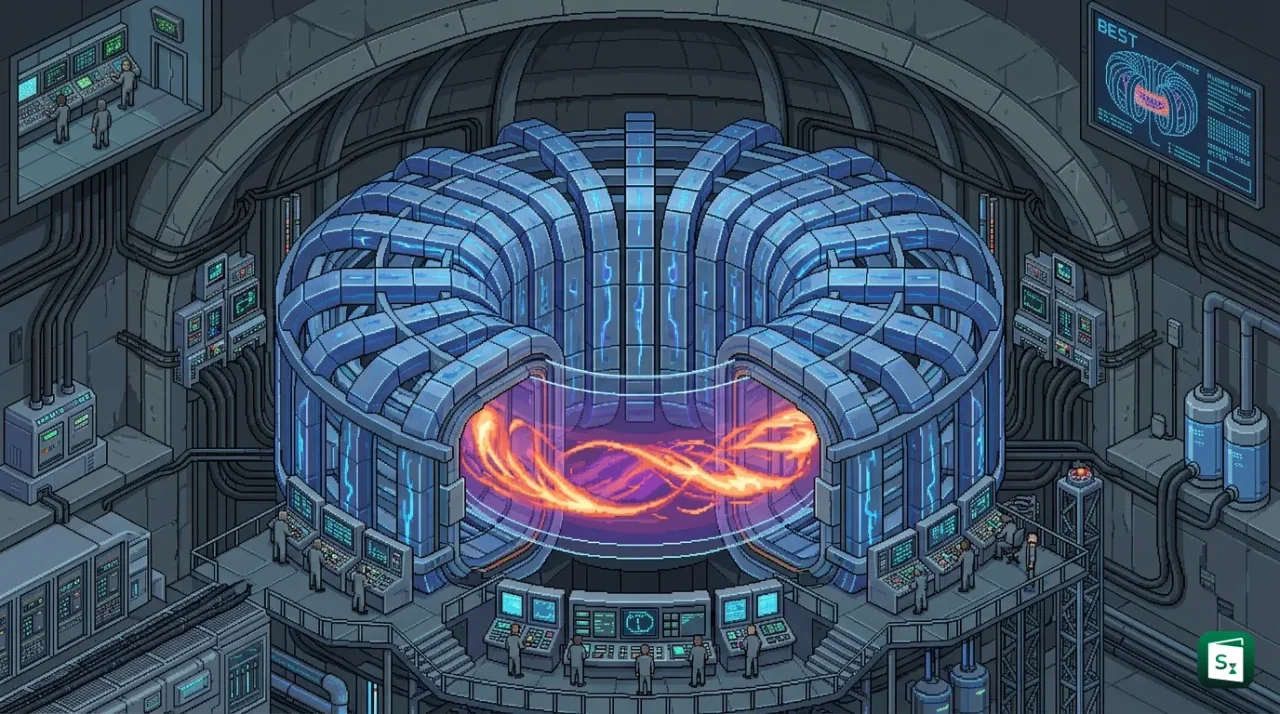
China has completed full-parameter testing of the world’s largest superconducting magnet built for a fusion reactor, a 582-ton Toroidal Field magnet developed in Hefei, Anhui province on 27 June 2026. The D-shaped magnet will act as an invisible magnetic cage to confine plasma hotter than 100 million degrees Celsius inside the Burning Plasma Experimental Superconducting Tokamak (BEST). Alongside it, China also tested a high-temperature superconducting Central Solenoid coil at record performance, clearing a key hurdle for its next-generation burning plasma mission.
What Was Achieved in Hefei
On 27 June 2026, the Institute of Plasma Physics, Chinese Academy of Sciences (ASIPP) at the Hefei Institutes of Physical Science announced that two core superconducting magnet systems for fusion reactors had passed final acceptance and full-parameter testing in Hefei, Anhui province. An expert panel carried out a comprehensive review and cleared the magnets for integration into the next-generation fusion programme.
Both systems were built with 100 percent domestically developed core technologies. This means special stainless steel, insulation materials and superconducting wires were all produced inside China, ending dependence on imported magnet technology. The project took six years of design, research and testing, and resulted in 47 authorized patents and 14 industry standards.
The two systems are part of the Comprehensive Research Facility for Fusion Technology (CRAFT), a large national science facility constructed since 20 September 2019 on a 40-hectare campus near Hefei. CRAFT hosts around 20 specialized test platforms for superconducting magnets, heating systems, breeding blankets and tritium technology, and its goal is to master and industrialize the key technologies needed for future reactors. The magnets tested at CRAFT are meant to be directly used in the assembly of the Burning Plasma Experimental Superconducting Tokamak (BEST), whose construction began on 30 June 2023.
Why Fusion Needs Powerful Magnets
Nuclear fusion is the process that powers the Sun. Light nuclei, usually deuterium and tritium, which are forms of hydrogen, fuse to form a heavier nucleus and release huge amounts of energy. On Earth, this requires heating the fuel to more than 100 million degrees Celsius, and in advanced devices up to 150 million degrees. At that temperature the fuel becomes plasma, a charged gas where electrons are stripped from atoms. No solid material can touch or contain such heat, it would instantly melt.
How a Tokamak Works
A tokamak is a doughnut-shaped vacuum chamber that uses magnetic fields to confine plasma without touching the walls. It was first developed in Russia in 1958, with the first device called T-1. A tokamak uses three main magnetic systems. Toroidal Field (TF) coils produce a field along the long way around the doughnut, Poloidal Field coils create a field along the short way, and a Central Solenoid acts like the primary winding of a transformer to induce and drive current inside the plasma. Together they create a twisted, helical magnetic field that keeps charged particles moving in closed loops and holds the hot plasma in the centre.
Why Superconductivity Is Essential
Normal copper coils waste energy as heat due to electrical resistance and cannot sustain strong fields for long periods. For a commercial power plant, this energy loss would be unaffordable. Superconductors are materials that, when cooled to very low temperatures, lose all electrical resistance and can carry huge currents with almost no energy loss.
Fusion magnets are therefore made superconducting and cooled with supercritical helium at about 4 Kelvin, or minus 269 degrees Celsius. They can produce fields above 10 Tesla, while consuming far less power. ITER, for example, notes that its copper equivalent would need an 800 MW power station just to run the magnets, while its superconducting system needs only about 20 MW for the cryogenic plant. This is why powerful superconducting magnets are considered the enabling technology for long, steady-state fusion operation.
Inside the Two Breakthrough Magnets
Researchers described the two tested magnets as the magnetic cage and the igniter of the future reactor. Both passed full-condition parameter testing, but their roles and records are very different.
Toroidal Field Magnet: The Invisible Cage
The Toroidal Field (TF) superconducting magnet is the largest fusion magnet ever built. Its key specifications underline its scale:
| Parameter | Detail |
|---|---|
| Weight | 582 tons |
| Dimensions | 21 metres long, 12 metres wide, 3.3 metres high |
| Shape | D-shaped |
| Operating current | 98 kiloamperes (kA), with design current of 100 kA per coil in final assembly |
| Stored energy | 120 gigajoules (GJ) |
| Design life | 60 years under extreme conditions |
The magnet has 1.3 times the volume and three times the energy storage of the equivalent TF magnet built for the International Thermonuclear Experimental Reactor (ITER) in southern France. Each ITER TF coil weighs about 330 tons and stores about 41 GJ, with 18 such coils planned for a total stored energy of about 51 GJ. The Chinese magnet alone stores 120 GJ, the highest capacity of its type in the world.
Its function is to generate a stable, powerful magnetic field that acts like a sealed, reinforced cage. The plasma, heated to over 100 million degrees, is forced to stay inside the vacuum chamber without striking the steel walls. Without this confinement, the plasma would disperse instantly and fusion would stop. In the final BEST device, 16 identical TF magnets will be assembled in a ring to create a complete toroidal field, producing a field strength of 6.5 Tesla at the centre.
Central Solenoid Coil: The Ignition Engine
The second magnet is the high-temperature superconducting Central Solenoid (CS) coil. While the TF magnet is the cage, the CS coil is the starter and controller.
It sits in the centre of the tokamak and has the most complex operating conditions of any fusion magnet. Its jobs are to induce and drive plasma current, initiate the discharge, and dynamically adjust the shape and stability of the plasma.
During testing, the coil exceeded its design target:
| Parameter | Detail |
|---|---|
| Rated design current | 46.5 kA |
| Tested stable current | 60 kA |
| Energy storage | 6.03 megajoules (MJ) |
| Joint resistance | 0.87 nano-ohms (ultra-low) |
| Performance level | Six times that of the current EAST tokamak |
Joint resistance measures how much energy is lost at the connections between superconducting segments. A value as low as 0.87 nano-ohms means almost no loss and very high stability. The team overcame more than ten key bottlenecks in design, conductor fabrication and quench protection. A quench is the dangerous event when a superconductor suddenly loses its superconducting state and turns resistive, releasing stored energy as heat. Good quench detection is essential for safety.
The successful tests of both magnets validate the two most critical components required to sustain a burning plasma. Together they form the backbone and the cage of the reactor.
What Is the BEST Tokamak
The Burning Plasma Experimental Superconducting Tokamak (BEST) is a new compact, high-field tokamak under construction in Hefei by ASIPP. It is designed specifically to study burning plasma, a state where the energy released by fusion produced alpha particles itself provides most of the heating needed to keep the reaction going, rather than relying on external heating.
| Feature | Detail |
|---|---|
| Location | Next to CRAFT campus, Hefei, Anhui province |
| Type | Superconducting tokamak with full-tungsten first wall and divertor |
| Major radius | 3.6 metres |
| Minor radius | 1.1 metres |
| Plasma volume | About 140 cubic metres |
| Central magnetic field | 6.15 Tesla |
| Plasma current | Up to 7 megaamperes (MA) |
| Auxiliary heating power | 50 megawatts (MW) |
| Expected fusion power | More than 50 MW initially, up to 250 MW design |
| Fusion gain target | Q greater than 1 in first phase, aiming for Q greater than 5 |
Q is the fusion gain factor, the ratio of fusion power output to heating power input. Q greater than 1 means scientific breakeven, where output exceeds input. BEST aims to produce more than three times the historic 59 megajoules record set by the Joint European Torus (JET) in the United Kingdom in 2021.
According to the joint ASIPP and EUROfusion Research Plan released in November 2025, construction of BEST is scheduled to finish in the second half of 2027, with first plasma expected in late 2027. The first campaigns will use hydrogen and deuterium at half magnetic field for commissioning, followed by full-field deuterium and then deuterium-tritium operations. Initial deuterium-tritium plasmas at 3 to 4 MA will aim for Q greater than 1, before scaling to 6 to 7 MA and long-pulse operation exceeding 1000 seconds.
Once operating, BEST will be the world’s largest operating deuterium-tritium tokamak before ITER, positioned between JET and ITER in size but with a higher magnetic field, allowing high performance in a smaller footprint. A major upgrade to the existing Experimental Advanced Superconducting Tokamak (EAST), launched in 2025, will support BEST by testing scenarios, divertors and heating systems.
China’s Fusion Roadmap: From EAST to BEST to CFETR
The magnet success is not an isolated achievement. It is part of a step-by-step national strategy led by ASIPP to move from physics experiments to a demonstration power plant.
EAST: The Physics Platform The Experimental Advanced Superconducting Tokamak (EAST), nicknamed the Artificial Sun, is the world’s first fully superconducting tokamak with both upper and lower divertors. Operating since 2006 in Hefei, it studies long-pulse, steady-state operation. In January 2025, EAST set a world record by maintaining high-confinement plasma for 1,066 seconds at temperatures near 70 million degrees Celsius, far beyond its previous 403-second record in 2023. In January 2026, EAST also demonstrated stable operation at plasma densities 1.3 to 1.65 times the empirical Greenwald limit, entering a theorized density-free regime. This is important because fusion power scales with the square of density, so higher density helps reach ignition more easily.
CRAFT: The Technology Bridge CRAFT does not generate fusion itself. It provides extreme testing environments of particle beams, magnetism, heat and force to prove that components like magnets and divertors survive real reactor conditions. Construction started in 2019 with more than 300 scientists and engineers involved. CRAFT directly feeds its validated designs into BEST.
BEST: The Burning Plasma Testbed As an intermediate step, BEST will demonstrate burning plasma physics and tritium self-sufficiency technology. Its mission has two parts, to prepare the science and materials for the next step, and to provide timely deuterium-tritium data to help optimize future ITER operations, which are now expected to start deuterium-tritium experiments only in the early 2040s.
CFETR: The Power Plant Demonstration The final goal is the China Fusion Engineering Test Reactor (CFETR), and its demonstration successor CFEDR (China Fusion Engineering Demonstration Reactor). The engineering design of CFETR was completed in 2020 with a design major radius of 7.2 metres and minor radius of 2.2 metres. CFETR aims for 100 to 200 MW of fusion power in Phase I and up to 1 gigawatt in Phase II in the 2040s. It targets a tritium breeding ratio greater than 1 and steady-state operation with a duty factor of 0.3 to 0.5, and ultimately net electricity generation. Full-scale construction is expected in the late 2020s, with a goal to deliver electricity to the grid by about 2035, and a prototype power plant by around 2060.
On 1 October 2025, BEST achieved another milestone when its Dewar base, a 400-ton, 18-metre diameter vacuum insulation vessel weighing as the heaviest single component and acting like a giant thermos to keep magnets at minus 269 degrees, was successfully installed. This shows that both magnets and large structural components are now moving toward final assembly.
Global Context and Significance
Fusion is pursued globally as a source of clean, abundant energy with no carbon emissions during operation and very little long-lived radioactive waste. Its fuel, deuterium from seawater, is virtually limitless.
The global benchmark for large superconducting magnets is ITER in Cadarache, southern France, a collaboration of 35 nations including the European Union, China, India, Japan, South Korea, Russia and the United States. ITER’s magnet system, when finished, will have a combined stored energy of 51 GJ and a toroidal field of 11.8 Tesla with a central solenoid peak field of 13 Tesla. In May 2026, ITER began operating its Magnet Cold Test Facility, cooling its first 330-ton TF coil to 4 Kelvin over 12 days for testing at 68 kA. In June 2026, ITER also completed stacking the six modules of its 1,000-ton central solenoid, now the world’s largest pulsed superconducting magnet at 18 metres tall.
China’s new achievement is notable because it exceeds ITER’s scale while achieving full domestic localization. The TF magnet’s 120 GJ single-magnet storage and the CS coil’s 60 kA performance surpass current international levels. Unlike ITER, which relies on internationally procured components, all materials and manufacturing for these Chinese magnets were indigenous.
International interest in high-field magnets has also accelerated elsewhere. In September 2021, the MIT and Commonwealth Fusion Systems team tested a 20 Tesla high-temperature superconducting magnet at 20 Kelvin using Rare-Earth Barium Copper Oxide (REBCO) tape, showing that smaller, higher-field compact tokamaks like SPARC could be viable. China’s advance complements this trend but uses large-scale, low-temperature superconducting cable-in-conduit technology proven for reactor-scale devices.
For India, which contributes in-kind hardware to ITER and operates the SST-1 tokamak at the Institute for Plasma Research in Gandhinagar, these developments offer lessons on magnet manufacturing, cryogenic technology and long-pulse operation. For the world, BEST’s upcoming deuterium-tritium campaigns before 2030 could fill a critical data gap before ITER’s own burning plasma experiments in the 2040s, accelerating learning on alpha-particle physics, tungsten divertor handling and tritium breeding.
The successful testing does not mean fusion electricity is immediate. Challenges of materials damage from neutron flux, tritium production and continuous heat exhaust remain. But by proving the magnetic cage and the igniter at full parameters, China has removed one of the hardest engineering barriers on the path to a fusion power plant.
Key Takeaways
- The world’s largest fusion Toroidal Field superconducting magnet, weighing 582 tons and measuring 21 metres by 12 metres, passed full-parameter testing in Hefei on 27 June 2026 at ASIPP.
- The magnet stores 120 GJ of energy and has 1.3 times the volume and three times the energy of the ITER TF magnet, and will form part of a 16-magnet ring producing 6.5 Tesla at the centre of BEST.
- The companion high-temperature superconducting Central Solenoid coil achieved 60 kA, above its 46.5 kA design rating, with 6.03 MJ storage and 0.87 nano-ohm joint resistance, six times the performance of EAST.
- The BEST tokamak, with major radius 3.6 metres and central field 6.15 Tesla, is scheduled for first plasma in late 2027 and aims for Q greater than 1 before 2030, becoming the largest operating deuterium-tritium tokamak before ITER.
- Both magnets were built with 100 percent domestic technology after six years of work, yielding 47 patents and 14 standards, under the CRAFT facility started in September 2019 to support CFETR, which targets 100 to 200 MW initially and grid electricity by about 2035.