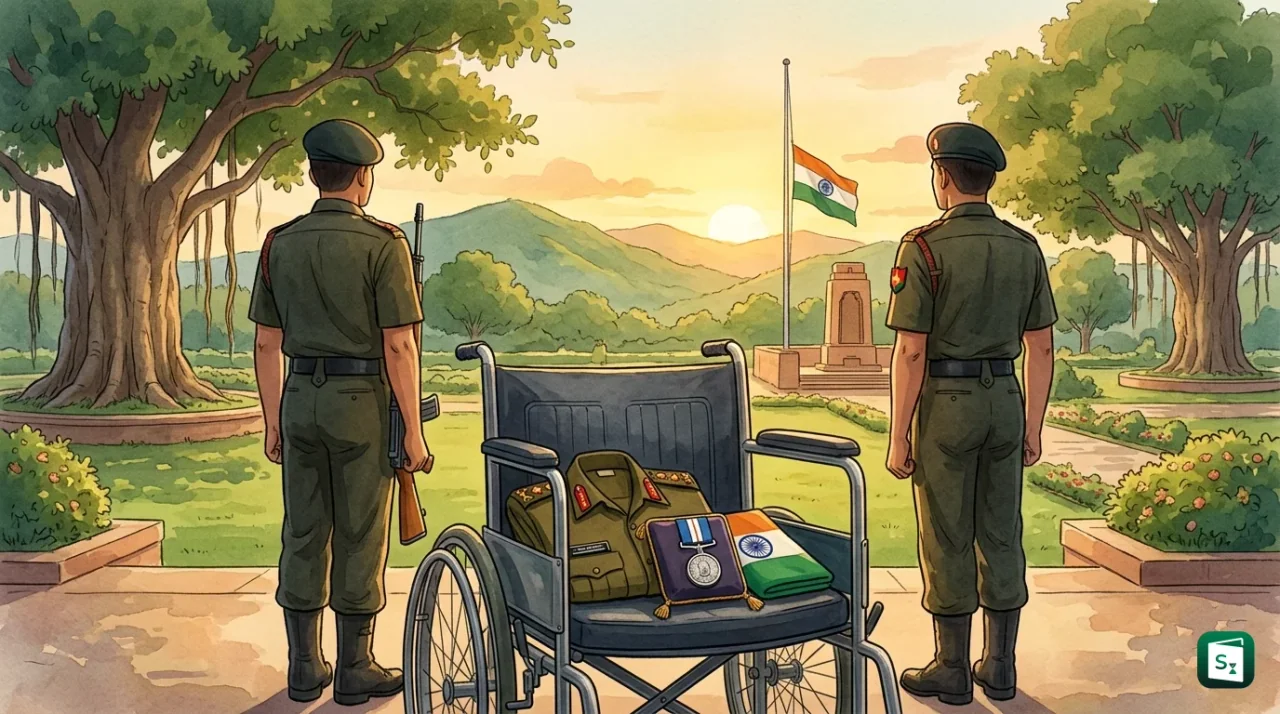
Major General Sunil Kumar Razdan (Retd), Kirti Chakra and Vishisht Seva Medal, passed away on 13 August 2026 at the age of 71. He was the Indian Army’s first wheelchair-borne General, a distinction he earned after overcoming catastrophic spinal injuries sustained during a daring hostage rescue operation in Jammu and Kashmir in 1994. His life remains one of the most extraordinary stories of courage, sacrifice, and indomitable human spirit in the history of the Indian armed forces.
Early Life and Military Background
Major General Sunil Kumar Razdan was born on 8 October 1954 in Happy Valley, Shillong, Meghalaya. He belonged to a distinguished Kashmiri Pandit military family originally from Purshyar, Habakadal in Srinagar. Military service ran through generations of his family. His grandfather had served in the British Indian Army during the Burma Campaign of the Second World War, and his father also served in the Army. For the Razdans, the armed forces were not merely a profession but a tradition of service.
From his youth, Razdan was known for his exceptional physical endurance. A keen long-distance runner, he possessed the stamina and determination that would later become hallmarks of his military career. His comrades gave him the affectionate nickname “Greyhound”, a name that would remain associated with his remarkable spirit throughout his life. He was also known for his passion for motorcycles and embodied the physically demanding and adventurous spirit associated with the Parachute Regiment.
Razdan was commissioned into the 7th Battalion, The Parachute Regiment (7 PARA SF), one of the most elite units of the Indian Army. The Parachute Regiment, established in 1952, is the main airborne and special forces regiment of the Indian Army. Its motto is “Shatrujeet” (Conqueror of Enemies), and its war cry is “Balidan Param Dharma” (Sacrifice is Supreme Duty). The regiment consists of fifteen regular Special Forces battalions, one Rashtriya Rifles battalion, and two Territorial Army battalions. PARA SF units specialise in counter-insurgency, counter-terrorism, direct action, hostage rescue, special reconnaissance, and unconventional warfare.
The 1994 Hostage Rescue Operation
The defining episode of Major General Razdan’s military career unfolded on the night of 8 October 1994, coincidentally his 40th birthday, during a counter-terrorism operation at Damal Hanzipur in the Naugam area of South Kashmir. Then Lieutenant Colonel Razdan received intelligence that a group of Lashkar-e-Toiba militants had abducted 14 young Kashmiri Muslim women, aged between 14 and 30, and were holding them captive inside a four-storey building.
Razdan set out with a small team of approximately 20 soldiers. After an arduous 12-hour march, they reached the building where the women were being held hostage. Displaying extraordinary tactical courage and leadership, Razdan and his men succeeded in getting the hostages out through a kitchen window. But the operation was far from over.
During the fierce exchange of fire that followed, a terrorist fired at Razdan from point-blank range. The bullets tore through his abdomen and caused devastating damage to his spine. Razdan was left paralysed below the waist. Yet the injury that permanently changed his physical life could not break his spirit. Despite catastrophic injuries, he continued fighting, neutralised another militant, and ensured all the women were safely rescued.
Displaying extraordinary composure under extreme pain, he reportedly administered intravenous fluids to himself while continuing to direct the operation. The engagement lasted for several hours as his troops fought to secure the building. By the end, nine militants were neutralised, and a large cache of weapons was seized. Even after suffering wounds that would eventually leave him permanently paraplegic, Razdan refused to withdraw from the operation. He remained steadfast until the mission concluded.
Kirti Chakra: India’s Second-Highest Peacetime Gallantry Award
For his extraordinary bravery, leadership, and refusal to abandon the mission despite suffering grievous injuries, Razdan was awarded the Kirti Chakra in 1996. The Kirti Chakra is India’s second-highest peacetime gallantry award, ranking after the Ashoka Chakra and before the Shaurya Chakra. It is the peacetime equivalent of the Maha Vir Chakra.
The award was originally established as “Ashoka Chakra, Class II” by the President of India on 4 January 1952, with effect from 15 August 1947. The statutes were revised and the decoration renamed as Kirti Chakra on 27 January 1967. The award is conferred for conspicuous gallantry otherwise than in the face of the enemy. It may be awarded to military personnel, civilians, and members of police forces including Central Para-Military Forces.
The Kirti Chakra medal is circular in shape, made of standard silver, one and three-eighth inches in diameter. On the obverse, the Ashoka Chakra is embossed in the centre, surrounded by a lotus wreath. The ribbon is 30 mm dark green with two 2 mm saffron stripes. As of 2024, a total of 487 individuals have received the Kirti Chakra.
Razdan was also awarded the Vishisht Seva Medal (VSM) in recognition of his distinguished service. The Vishisht Seva Medal was instituted on 26 January 1960 to recognise “distinguished service of a high order” to all ranks of the Indian Armed Forces. It was originally established as “Vishisht Seva Medal, Class III” and renamed on 27 January 1967.
Overcoming Disability: The First Wheelchair-Borne General
For many soldiers, the injuries Razdan sustained could have marked the end of an active military career. For him, however, it became the beginning of another extraordinary chapter of service. Despite paraplegia, persistent neural pain, and the enormous physical challenges associated with his injuries, he continued serving the Indian Army and took on demanding staff and institutional responsibilities.
Razdan subsequently underwent multiple surgeries and spent nearly a year undergoing treatment and rehabilitation. His spinal injuries permanently deprived him of the use of his lower body, leaving him dependent on a wheelchair for the remainder of his life. Yet he refused to let his physical condition end his military career.
Through sheer perseverance, professional competence, and an indomitable will, he continued to rise through the ranks. His professional ability, operational experience, and intellectual approach enabled him to remain an important contributor to higher defence planning.
In October 2010, he achieved another historic milestone when he was promoted to the rank of Major General. He became the first wheelchair-bound officer in the history of the Indian Army to attain the two-star rank. The Army had in the past promoted amputee officers to General-officer rank, but this was the first time a wheelchair-bound officer had become a Major General. His promotion was a landmark moment in the history of the service.
As he once said, “It is a challenge, as I have to prove my mettle. Else, people will think I have become a general on sympathy vote. Mental capabilities are far more important than brawn. One can overcome physical handicap with cerebral capital.”
Service at HQ Integrated Defence Staff
As a Major General, Razdan served as Assistant Chief of the Integrated Defence Staff (ACIDS) at Headquarters Integrated Defence Staff (HQ IDS). He contributed significantly to areas including joint warfare, operations, logistics, and institutional military thinking. His work associated with higher defence organisations and the Centre for Joint Warfare Studies further reflected his continued contribution to the development of military thought and jointness within the Indian Armed Forces.
HQ IDS was established on 1 October 2001, following the recommendations of the Group of Ministers report after the Kargil conflict of 1999. It represents one of the major structural reforms in India’s higher defence organisation since independence. The headquarters functions as the secretariat to the Chief of Defence Staff (CDS) and the Chiefs of Staff Committee (COSC). It is staffed by officers and personnel from the three services, along with officials from the Ministry of External Affairs, Defence Accounts Department, and the Defence Research and Development Organisation (DRDO).
The HQ IDS is responsible for coordinating long-range plans, five-year plans, and annual budgetary proposals for the three services. It formulates the Long Term Integrated Perspective Plan (LTIPP) and the Five Year Defence Plan based on the anticipated threat perception, force structures, modernisation, and equipment development. The headquarters also steers capital procurement of the three services and has been instrumental in promoting indigenous defence production under the Atmanirbharta initiative.
Razdan’s service at HQ IDS demonstrated that leadership, courage, and commitment are not diminished by physical limitations. His intellectual approach to military strategy and joint warfare concepts earned him the respect of colleagues and superiors alike.
Legacy and Inspiration
Major General Sunil Kumar Razdan’s story is not simply one of battlefield bravery. It is a story of resilience. The bullets that struck him on his 40th birthday altered his life forever. They left him confined to a wheelchair, but they could not confine his ambition, his sense of duty, or his commitment to the Army.
His journey from a paratrooper and gallantry awardee to a Major General in a wheelchair stands as a powerful reminder that courage is not merely the absence of fear or injury. It is the determination to continue one’s journey despite them. He belonged to a generation of soldiers for whom duty came before self.
His life exemplified the ethos traditionally associated with the Parachute Regiment: “Men apart, every man an emperor.” Few careers demonstrated that spirit as powerfully as his. He had entered battle as a physically formidable Paratrooper, suffered injuries that permanently changed his life, and nevertheless continued his journey until he wore the rank of Major General.
His family played a crucial role in his journey. His wife, Manju, provided unwavering support throughout his years of rehabilitation and continued service. His son, Ishan, followed in his father’s footsteps by joining the Parachute Regiment, while his other son, Paarth, pursued a career in medicine.
Even after retirement, he remained actively engaged with the military community, sharing insights about leadership and resilience through various platforms. His promotion would inspire officers and jawans who have lost their limbs in counter-insurgency operations, proving that physical disability need not be the end of a meaningful military career.
As India remembers Major General Sunil Kumar Razdan, it remembers not only the brave officer who risked his life to rescue 14 young women, but also the extraordinary human being who refused to surrender to the consequences of his sacrifice. The Greyhound may have lost the ability to run, but he never stopped moving forward.
Key Takeaways
- Major General Sunil Kumar Razdan (Retd) passed away on 13 August 2026 at the age of 71.
- He was the first wheelchair-borne General in the history of the Indian Army, achieving the rank of Major General in October 2010.
- He was awarded the Kirti Chakra, India’s second-highest peacetime gallantry award, for his extraordinary bravery during a 1994 hostage rescue operation in South Kashmir.
- During the operation at Damal Hanzipur on his 40th birthday, he led a team of 20 soldiers to rescue 14 young Kashmiri women held hostage by Lashkar-e-Toiba militants.
- Despite sustaining multiple gunshot wounds to the abdomen that severely damaged his spine and left him paralysed below the waist, he refused evacuation and continued fighting until the mission was completed.
- He was commissioned into the 7th Battalion, The Parachute Regiment (7 PARA SF), one of the most elite units of the Indian Army.
- The Kirti Chakra was originally established as “Ashoka Chakra, Class II” on 4 January 1952 and renamed on 27 January 1967.
- He served as Assistant Chief of the Integrated Defence Staff (HQ IDS), contributing to joint warfare concepts and strategic research.
- He was also awarded the Vishisht Seva Medal (VSM) for his distinguished service to the Indian Armed Forces.