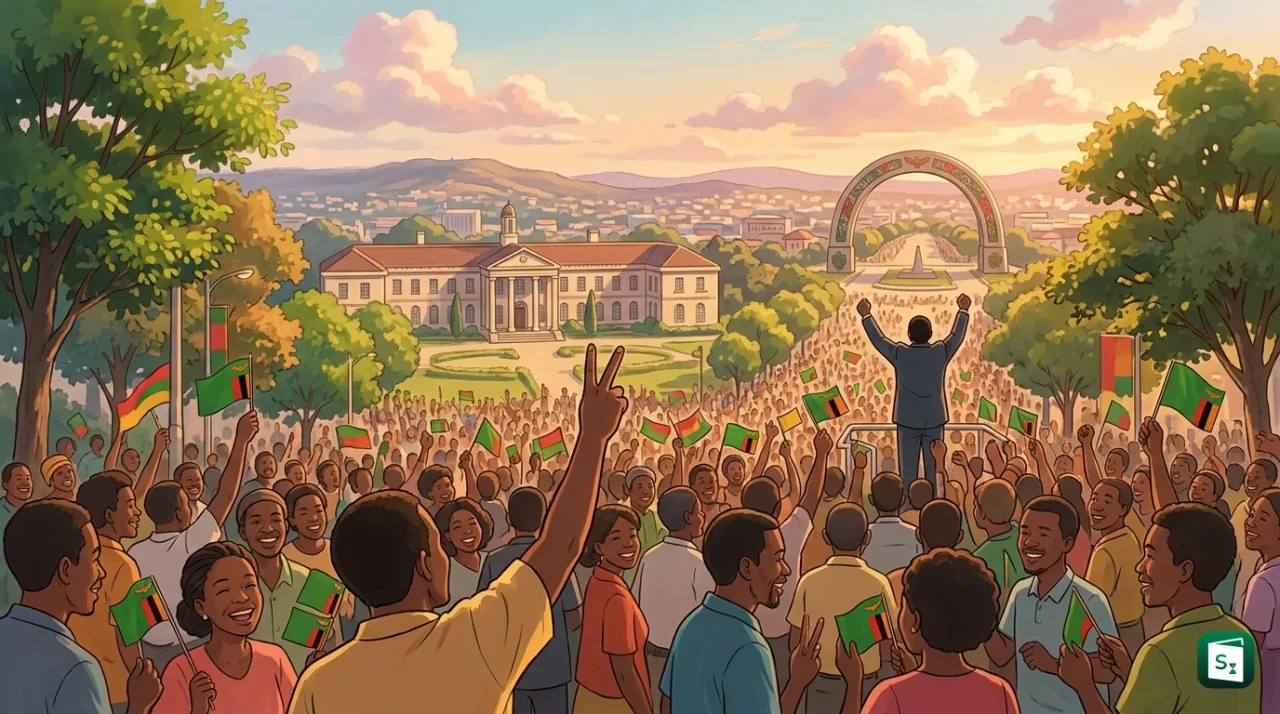
Hakainde Hichilema, the leader of the United Party for National Development (UPND), has been re-elected as the President of Zambia for a second consecutive five-year term (2026-2031). The Electoral Commission of Zambia declared him president-elect on 18 August 2026 after all 226 constituencies reported results. Hichilema secured 60.49% of the valid votes, comfortably clearing the 50%-plus-one threshold required to avoid a run-off, and defeating his main challenger Brian Mundubile of the National Reconciliation Party for Unity and Prosperity (NRPUP), who received 37.87%.
Who Is Hakainde Hichilema?
Born on 4 June 1962 in Monze district in southern Zambia, Hichilema is a businessman, farmer, and politician who has spent over two decades in opposition before finally winning power in 2021. Often referred to as “HH” or by his nickname “Bally,” he studied business administration at the University of Zambia and later at the University of Birmingham in the United Kingdom. Before entering politics, he built a reputation as a successful financial consultant, property developer, and cattle rancher, becoming one of Zambia’s wealthiest individuals.
Hichilema’s political journey has been long and marked by repeated setbacks. He contested the presidency six times before finally winning in 2021. He ran in 2006, 2008, 2011, 2015, and 2016, losing each time. In 2017, he was arrested and charged with treason after his convoy allegedly failed to give way to then-President Edgar Lungu’s motorcade. The charges were later dropped, but the episode galvanised his support base and strengthened his image as a political opponent persecuted under the previous government.
He has led the UPND since 2006, following the death of the party’s founder Anderson Mazoka. Under his leadership, the UPND transformed from a regional party concentrated in the Southern, Western, and North-Western provinces into a national political force capable of winning power in urban centres such as Lusaka and the Copperbelt.
The 2026 Election Result
The 2026 Zambian general election was held on 13 August 2026, with voters casting ballots for a president, members of the National Assembly, councillors, and council chairs. Fourteen candidates were nominated for the presidency, though the contest was essentially a two-horse race between Hichilema and Mundubile. The remaining twelve candidates, including Harry Kalaba of Citizens First (CF), Fred M’membe of the Socialist Party, and Kelvin Bwalya of Zambians Must Prosper (ZMP), each polled below 1%.
The Electoral Commission of Zambia (ECZ) declared Hichilema president-elect on 18 August 2026 after all 226 constituencies were counted. He received 2,965,326 votes, or 60.49% of the 4,902,050 valid votes cast. Mundubile polled 1,856,217 votes, or 37.87%. A total of 126,556 ballots were rejected, accounting for 2.52% of the 5,028,606 total votes cast. Voter turnout stood at 57.23% of the 8,786,300 registered voters.
Hichilema’s strongest support came from the traditional UPND heartlands of the Southern (96%), Western (96.4%), and North-Western (95.8%) provinces. He also maintained his 2021 breakthrough in the Copperbelt (49.3%) and Lusaka (48.3%), though his margins were tighter in these urban provinces compared to the rural strongholds. Mundubile dominated in the northern provinces of Luapula (68.2%), Muchinga (67%), Northern (63.3%), and Eastern (63.8%), which have historically backed the Patriotic Front and its successor formations.
The election was not without controversy. On 14 August, the ECZ suspended the nationwide count for several hours, citing violence targeting polling staff and the theft of marked ballot papers. The suspension was lifted the same evening, but it raised concerns about the transparency of the tabulation process. The European Union Election Observation Mission (EU EOM) noted that the overall conduct of tabulation “deteriorated significantly” after the suspension. Mundubile’s party alleged voting irregularities and announced plans for a legal challenge. Regional observers from the Southern African Development Community (SADC) and the African Union described election day as largely peaceful but raised concerns about restrictions on opposition campaigning in the lead-up to the vote.
First Term Economic Record
Hichilema took office in August 2021 inheriting one of the most difficult economic situations in Zambia’s history. The country had become the first African sovereign to default on its debt during the COVID-19 pandemic in November 2020, with external obligations of approximately $16 billion. Inflation was running high, the Zambian kwacha was under severe pressure, and investor confidence had collapsed. The government treasury was, as Hichilema himself described it, “literally empty.”
His administration’s most significant achievement was securing a comprehensive debt restructuring under the G20 Common Framework. Zambia restructured approximately $13 billion in external debt, bringing its debt-to-GDP ratio down from about 133% in 2023 to a projected 90.7% by the end of 2025. The government completed an International Monetary Fund (IMF)-supported programme, which helped restore macroeconomic stability. Inflation fell from 24% to around 9%, and the kwacha currency strengthened considerably.
On social spending, Hichilema introduced free secondary education, bringing an estimated 2.3 million children back into classrooms. He expanded social cash transfer programmes and increased funding for community projects through the Constituency Development Fund (CDF), raising allocations from K1.6 million to K25.7 million per constituency. The government also pursued public-private partnerships in infrastructure, including the Lusaka-Ndola dual carriageway worth $577 million and the Itimpi Solar Project contributing 60 megawatts to the energy grid.
Despite these gains, challenges persisted. More than 70% of Zambia’s 22 million people continued to live on less than $3 a day, according to World Bank data. Youth unemployment remained high, food prices stayed elevated, and recurring droughts in 2024 caused severe electricity shortages, with load-shedding lasting up to twelve hours a day in some areas. These pressures formed the core of the opposition’s campaign against Hichilema.
Copper Economy and Future Promises
Copper is the backbone of Zambia’s economy, and Hichilema’s second-term agenda is built around expanding the country’s position as Africa’s second-largest copper producer after the Democratic Republic of Congo. Zambia produced approximately 890,346 tonnes of copper in 2025, an 8% increase from the previous year and the strongest output in over a decade, though still short of the government’s one-million-tonne target. The long-term aspiration under the 8th National Development Plan is to reach 3 million tonnes per year by 2031.
Hichilema has promised to double the size of Zambia’s economy during his second term. Central to this vision is the Lobito Corridor, a multimodal logistics project backed by the United States and European Union. The corridor runs from Zambia through the Democratic Republic of Congo to Angola’s Atlantic coast at Lobito Port. A $753 million financial close for the railway project was achieved in July 2026, and the rail extension through Zambia is expected to be completed by 2029. The project is designed to reduce Zambia’s dependence on Chinese-controlled logistics networks and provide a direct export route for copper and other critical minerals to Western markets.
Zambia also signed a $491 million grant agreement with the Millennium Challenge Corporation (MCC), a US foreign aid agency, to expand support from agriculture to critical minerals infrastructure. The government has simultaneously begun discussions with the IMF on a new growth-focused programme, distinct from the earlier stabilisation-oriented arrangement.
However, the gap between investment promises and production reality remains. Copper output in the first quarter of 2026 fell by 4.27% to 208,992 tonnes, driven by declines in small-scale operations. Structural constraints persist, including unreliable electricity supply (roughly 85% of Zambia’s power is hydro-dependent and vulnerable to drought), inadequate rail and corridor capacity, and bureaucratic delays in mining licence approvals. Whether the copper boom translates into jobs, supplier development, and public revenue depends on policy execution over the coming decade.
Concerns Over Democratic Space
While Hichilema’s economic record earned him re-election, his first term drew significant criticism over the shrinking space for political dissent. The Zambia Catholic Bishops Conference expressed concern in November 2024 that the government was using law enforcement agencies to stifle opposition, the same tactics that had been used against Hichilema when he was in opposition. A UN special rapporteur reported in 2025 that there was “increasing concern” about the criminal justice system being “weaponised to silence legitimate expression” and called for legal reforms.
Opposition figures faced a pattern of arrests and prosecutions. Raphael Nakacinda, the secretary general of the Patriotic Front, was sentenced in May 2024 to six months in prison for defaming the president, under a law that Hichilema himself had repealed in 2022. Journalists covering opposition events also faced harassment, with 60% of surveyed journalists and bloggers reporting increased intimidation under the Hichilema government, according to the Media Institute of Southern Africa (MISA).
The 2021 Cyber Security and Cyber Crimes Act was invoked against online critics, raising concerns about the misuse of security tools for political purposes. The government passed a new cyber law in 2025 that rights groups described as vaguely worded, allowing authorities to intercept electronic communications. Freedom House rated Zambia as “partly free” in its 2025 report, with a score of 53 out of 100, citing selective restrictions on opposition activities.
Hichilema has rejected these allegations, telling parliament that “arresting and prosecuting lawbreakers is not equivalent to loss of democratic space and human rights.” His supporters argue that the political environment is more open than it was before 2021, when the Patriotic Front government routinely banned opposition rallies and detained critics. Nevertheless, the EU EOM noted that restrictions on the opposition during the campaign period may have contributed to an “uneven contest” in the 2026 election.
Looking Ahead
Hichilema now faces the task of converting macroeconomic gains into tangible improvements in the lives of ordinary Zambians. His second-term agenda centres on three priorities: doubling the economy, creating jobs for the large youth population, and expanding social opportunities for households. The success of these goals will depend on the completion of the Lobito Corridor railway, the expansion of copper production toward the one-million-tonne target, and the continued management of Zambia’s debt obligations under the G20 Common Framework.
The political landscape will also be shaped by the opposition’s legal challenge to the election results. Under Zambia’s electoral law, a petition against the declaration must be filed with the Constitutional Court within seven days, and the court has fourteen days to decide. Whether this challenge proceeds and how it is adjudicated will test the resilience of Zambia’s democratic institutions, which have facilitated peaceful transfers of power since the return to multiparty politics in 1991.
Zambia’s strategic importance continues to grow in the context of the global energy transition. Copper demand is projected to rise by more than 40% between now and 2040, driven by electric vehicles, grid-scale energy storage, and data centre infrastructure. Zambia sits at the heart of this shift, and its ability to leverage its mineral wealth while maintaining democratic governance will be closely watched by the international community.
Key Takeaways
- Hakainde Hichilema was re-elected as President of Zambia on 18 August 2026 with 60.49% of the valid votes, defeating Brian Mundubile who received 37.87%.
- The Electoral Commission of Zambia declared the result after all 226 constituencies were counted, with total valid votes of 4,902,050 and voter turnout of 57.23%.
- Hichilema’s key first-term achievement was completing a comprehensive debt restructuring under the G20 Common Framework, bringing Zambia’s debt-to-GDP ratio down from 133% to a projected 90.7%.
- Zambia produced approximately 890,346 tonnes of copper in 2025, making it Africa’s second-largest producer, with a target of 1 million tonnes per year under the 8th National Development Plan.
- The Lobito Corridor railway project, backed by the US and EU, achieved financial close of $753 million in July 2026 and is expected to provide a direct export route for Zambian copper to Atlantic markets by 2029.
- International and regional observers, including the EU EOM and SADC, raised concerns about restrictions on opposition campaigning and a deterioration in the transparency of vote tabulation after a brief nationwide suspension of counting on 14 August.
- Zambia has maintained a record of peaceful transfers of power since the return to multiparty democracy in 1991, with four different parties having governed since then.