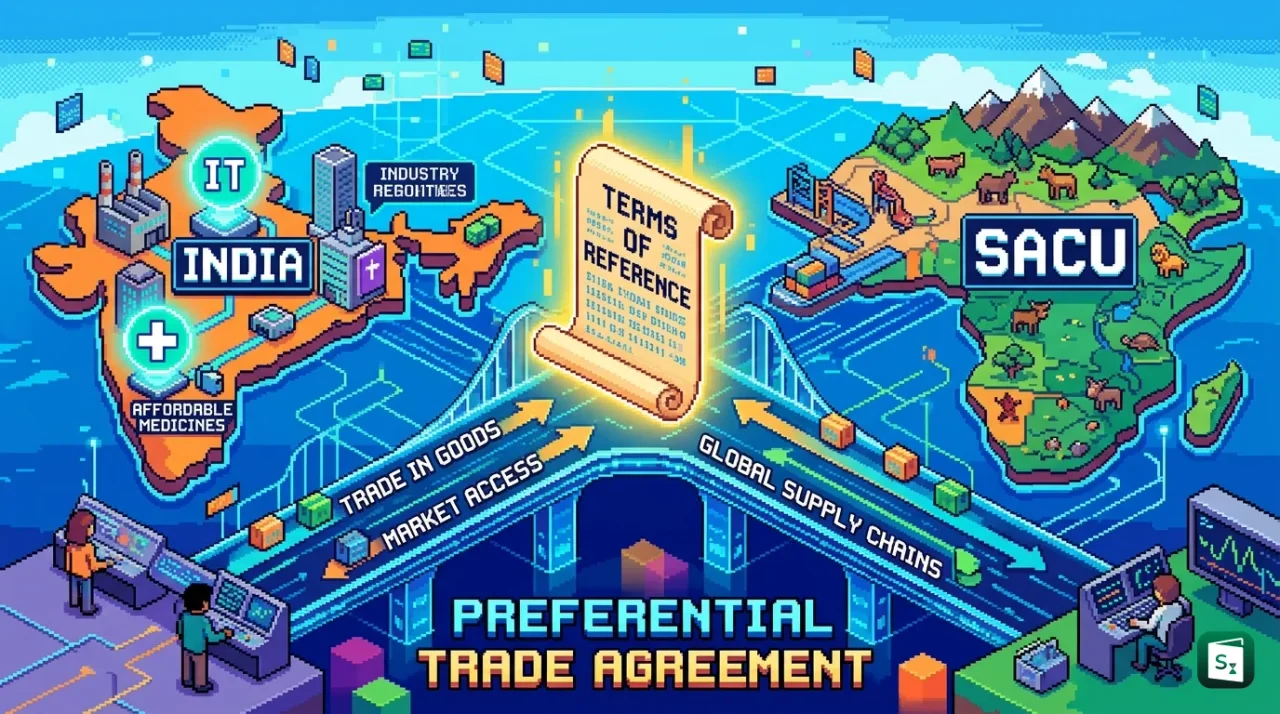
India and the five-member Southern African Customs Union (SACU) signed the Terms of Reference (ToR) on August 12, 2026, at Vanijya Bhawan in New Delhi, formally launching negotiations for a Preferential Trade Agreement (PTA). The signing revives trade talks that first began over two decades ago, with the Union Cabinet having approved the commencement of PTA negotiations with SACU as far back as 2006. This marks the first time India has signed ToRs for a trade agreement with an African regional bloc.
What Is the Southern African Customs Union?
The Southern African Customs Union (SACU) is the oldest functioning customs union in the world, established in 1910. It comprises five member states: South Africa, Botswana, Namibia, Lesotho, and Eswatini. Its headquarters are in Windhoek, Namibia.
A customs union means that member states trade goods duty-free among themselves while maintaining a common external tariff (CET) on imports from outside the bloc. SACU also operates a common revenue pool, where all customs and excise duties collected by member states are pooled and distributed according to a fixed formula. South Africa, as the largest economy in the union, contributes the most to this pool and receives the largest share.
The five SACU members have a combined population of approximately 65 million people. While South Africa dominates the bloc economically, the smaller member states (Botswana, Namibia, Lesotho, and Eswatini) depend heavily on SACU revenue payments, which form a significant portion of their government budgets.
SACU is also a member of the World Trade Organisation (WTO) and the Southern African Development Community (SADC). It has existing trade agreements with the European Union, the European Free Trade Association (EFTA), and the Common Market of the South (MERCOSUR).
A 20-Year Journey: How India-SACU Talks Revived
The idea of an India-SACU trade agreement traces back to a meeting between the trade ministers of India and South Africa in New Delhi in 2000. The two countries agreed to negotiate a Preferential Trade Agreement to deepen bilateral trade and investment ties, and in 2002, they signed a framework agreement to this effect. However, under the renegotiated 2002 SACU Agreement, all SACU member states were required to negotiate trade pacts with third parties as a bloc. This meant South Africa could not proceed bilaterally with India, and the other four SACU members were brought into the process.
The Union Cabinet of India approved the commencement of PTA negotiations with SACU in 2006. A Memorandum of Understanding (MoU) was signed between India and SACU in November 2008 to facilitate the negotiations. Between 2007 and 2010, five rounds of technical discussions were held across Pretoria, Walvis Bay, and New Delhi. The first round took place in Pretoria in October 2007, followed by a second round in Walvis Bay, Namibia in February 2008, and a third round in New Delhi in November 2008.
Despite these early rounds, the negotiations stalled by 2010 over disagreements on sensitive products and market access. For over a decade, the process remained dormant. Commerce Secretary Rajesh Agrawal noted that this ToR signing is India’s first with any African region, underscoring the significance of the revival.
Commerce and Industry Minister Piyush Goyal called for a “balanced, fair and equitable” agreement and emphasised that India would not touch issues that SACU may deem sensitive, while expecting reciprocity on India’s own sensitive sectors. The two sides have set a target to begin formal negotiations within one month and conclude them within one year.
What Does the ToR Cover? The Eight Chapters
The Terms of Reference establish the negotiating framework for the proposed PTA. The agreement will cover eight chapters, defining the scope and rules for trade between India and the five SACU member states:
| Chapter | What It Covers |
|---|---|
| Trade in Goods | The core chapter, determining which products will be traded under preferential terms |
| Market Access for Goods | Tariff concessions and reduction schedules for specific products |
| Rules of Origin | Criteria to determine where a product was manufactured, essential for preventing third-party goods from gaining preferential access |
| Customs Procedures | Streamlining customs clearance, documentation, and border processes |
| Sanitary and Phytosanitary (SPS) Measures | Food safety, animal health, and plant health standards for agricultural products |
| Technical Barriers to Trade (TBT) | Product standards, labelling, and certification requirements |
| Trade Remedies | Safeguards, anti-dumping duties, and countervailing measures to protect domestic industries |
| Dispute Settlement | Mechanisms to resolve disagreements over the interpretation or application of the agreement |
Both sides have agreed that these chapters can be further expanded if the negotiations demand it. The PTA will initially focus on goods only, with services potentially included in later stages.
Goyal stated that the agreement should focus on “low-hanging fruits” where India and SACU can complement each other, rather than attempting deep, across-the-board market access from the start.
India-SACU Trade: Key Numbers
India’s trade relationship with SACU is already substantial, even without a preferential agreement in place. Understanding the current trade profile highlights why both sides are motivated to revive these negotiations.
India’s bilateral trade with SACU stood at $16.81 billion in the financial year 2025-26. India exported $7.55 billion worth of goods to SACU countries, while importing $9.2 billion. South Africa is India’s largest trading partner within the bloc.
| Category | Value (FY 2025-26) |
|---|---|
| India’s Exports to SACU | $7.55 billion |
| India’s Imports from SACU | $9.2 billion |
| Total Bilateral Trade | $16.81 billion |
India’s Top Exports to SACU
Petroleum products are India’s largest export category to SACU. Automobiles and auto parts rank as the second-largest export, with shipments worth $1.7 billion in FY26. Other significant exports include pharmaceuticals, industrial machinery, electrical equipment, chemicals, textiles, and agricultural products. India is already a major supplier of affordable medicines to the SACU region, with South Africa being among the top buyers of Indian pharmaceutical products globally.
India’s Imports from SACU
India imports critical minerals from SACU, including platinum-group metals, manganese, and copper. These minerals are essential for manufacturing, batteries, and clean energy technologies. New Delhi is seeking more reliable and preferential access to these supplies through the proposed PTA, which would support India’s ambitions in electric vehicle manufacturing and renewable energy.
What India and SACU Stand to Gain
The proposed PTA is built on strong complementarities between India and the SACU region. India is a major supplier of manufactured goods, pharmaceuticals, and IT services, while SACU countries are rich in natural resources and minerals. A preferential trade agreement would formalise and expand this existing commercial relationship.
For India
Indian exporters stand to gain tariff concessions in key sectors. Automobiles and auto parts ($1.7 billion in exports), pharmaceuticals, industrial machinery, electrical equipment, chemicals, and textiles are the primary sectors where India expects better market access. The agreement would give Indian companies a competitive advantage over suppliers from countries that do not have preferential access to SACU markets, which collectively represent a consumer base of 65 million people.
Beyond goods, the PTA framework could open doors for Indian IT talent and services to support digital transformation in the SACU region. Indian pharmaceutical companies already supply affordable medicines across Africa, and preferential terms could further strengthen this position.
For SACU
SACU countries benefit from access to India, one of the world’s fastest-growing major economies. A PTA would help SACU members diversify their export markets beyond traditional partners like the European Union and China. It would also give SACU nations access to India’s vast manufacturing ecosystem and technology capabilities at competitive prices.
Namibia’s Executive Director at the Ministry of International Relations and Trade, Ndiitah Nghipondoka Robiati, described the ToR as establishing a framework for a “balanced, mutually beneficial and development-oriented agreement.”
India’s Broader Africa Trade Strategy
The India-SACU PTA does not exist in isolation. It is part of India’s wider strategy to deepen trade and economic engagement with the African continent. India is currently Africa’s fourth-largest trading partner, with bilateral trade reaching approximately $82 billion in 2024-25. India’s cumulative investment across Africa is estimated at over $75 billion.
At the 20th CII India-Africa Business Conclave held in New Delhi in August 2025, Commerce Minister Goyal announced a target to double India-Africa bilateral trade to $164 billion by 2030. The India-SACU PTA is a critical building block in achieving that goal, given that SACU alone accounts for over $16 billion of India’s trade with Africa.
India has also hosted the India-Africa Forum Summit (IAFS), with the fourth edition (IAFS-IV) taking place in May 2025, eleven years after the previous summit in 2014. The forum has been a platform for India to strengthen ties with African nations across trade, investment, capacity building, and development cooperation.
Notably, India has adopted a deliberate strategy of pursuing Preferential Trade Agreements (PTAs) rather than full Free Trade Agreements (FTAs) with developing economies like South Africa. A PTA involves reducing tariffs on a positive list of selected products, whereas an FTA typically eliminates tariffs across most goods using a negative list approach. This calibrated approach allows both sides to protect sensitive industries while opening up specific sectors of mutual strength.
The Significance for India-Africa Relations
The India-SACU PTA, once concluded, would be India’s first major trade agreement with an African regional bloc. It would set a precedent for future negotiations with other African economic communities, including the African Continental Free Trade Area (AfCFTA), which aims to create a single continental market for goods and services across 54 African countries. The AfCFTA, which came into force in 2021, has the potential to boost intra-African trade by 52% by 2022, according to the United Nations Economic Commission for Africa. A bilateral PTA with SACU would position India advantageously within this evolving African trade architecture.
Key Takeaways
- India and SACU signed the Terms of Reference (ToR) on August 12, 2026, at Vanijya Bhawan in New Delhi, formally launching negotiations for a Preferential Trade Agreement (PTA).
- SACU, established in 1910, is the oldest functioning customs union in the world, comprising South Africa, Botswana, Namibia, Lesotho, and Eswatini, with its headquarters in Windhoek, Namibia.
- The PTA negotiations cover eight chapters: trade in goods, market access, rules of origin, customs procedures, SPS measures, TBT, trade remedies, and dispute settlement.
- India’s bilateral trade with SACU stood at $16.81 billion in FY 2025-26, with India exporting $7.55 billion and importing $9.2 billion.
- Automobiles and auto parts were India’s second-largest export to SACU at $1.7 billion in FY26, after petroleum products.
- This is the first time India has signed ToRs for a trade agreement with an African regional bloc, with negotiations expected to begin within one month and conclude within one year.
- India is Africa’s fourth-largest trading partner, with bilateral trade reaching approximately $82 billion in 2024-25 and cumulative investment exceeding $75 billion.