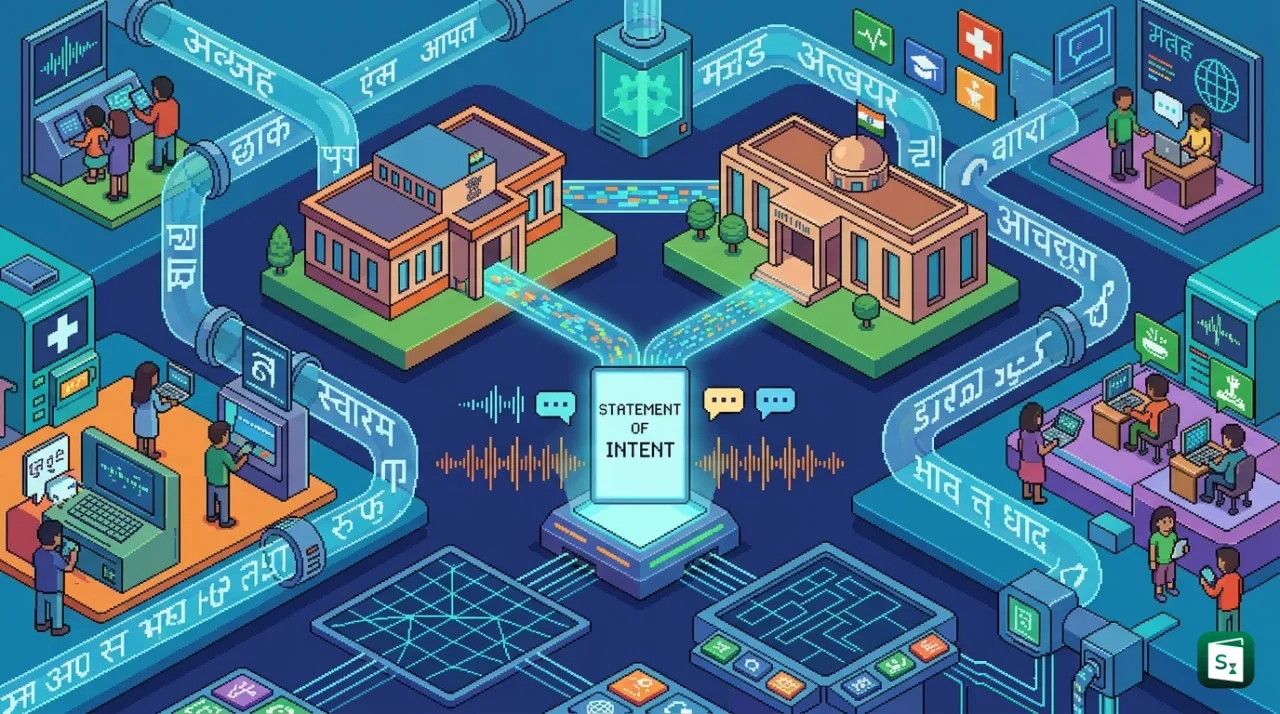
The Digital India BHASHINI Division (DIBD) and NITI Aayog signed a Statement of Intent (SoI) on 12 August 2026 in New Delhi to jointly advance multilingual, voice-first Artificial Intelligence (AI) solutions across government services. The agreement, signed under the BHASHINI for Seva/Sanchalan initiative, aims to ensure that citizens can access digital information and public services in the Indian languages they are most comfortable using. This partnership brings together India’s national language technology platform and its apex policy think tank to make inclusive, language-aware governance a reality at scale.
What Is BHASHINI?
BHASHINI, short for Bhasha Interface for India, is the country’s national language technology mission. It was launched by Prime Minister Narendra Modi in July 2022 during the Digital India Week in Gandhinagar, Gujarat, as part of the National Language Translation Mission (NLTM). The platform uses AI and Natural Language Processing (NLP) to provide translation, speech recognition, text-to-speech, and optical character recognition services across Indian languages.
The platform is implemented by the Digital India BHASHINI Division (DIBD), an Independent Business Division operating under the Digital India Corporation (DIC), a Section 8 company under the Ministry of Electronics and Information Technology (MeitY). As of 2026, BHASHINI supports 36 Indian text languages, 23 Indian voice languages, and 35 international languages. It powers over 800 government websites and processes more than 24 million AI inferences daily, with over 9 billion cumulative inferences completed since its launch.
The platform hosts more than 300 pre-trained AI models available to ecosystem partners through open APIs. India’s Eighth Schedule of the Constitution officially recognises 22 languages, and BHASHINI aims to bridge the digital divide caused by linguistic diversity by making government services, digital content, and the internet accessible to every citizen in their mother tongue.
What the Statement of Intent Envisions
The SoI was signed by Amitabh Nag, Chief Executive Officer of DIBD, and Shoyabahmed Kalal, Director at NITI Aayog. Under this agreement, BHASHINI’s language AI ecosystem will be connected with NITI Aayog’s digital platforms and programmes to make governance more linguistically inclusive. The partnership covers five flagship sub-programmes, each addressing a distinct layer of the multilingual governance puzzle.
BHASHINI Udyat
This sub-programme enables multilingual access to NITI Aayog’s services through BHASHINI’s translation APIs and reference applications. Citizens will be able to interact with government systems in their preferred Indian language rather than depending primarily on English or a limited selection of languages.
BHASHINI Mitra
BHASHINI Mitra supports the building and continuous improvement of translation models used across NITI Aayog’s platforms. It focuses on refining accuracy and contextual relevance of translations for specialised government terminology.
BHASHINI AppMitra
This component helps integrate language technologies directly into digital platforms, document management systems, and communication workflows. It also supports the development of sector-specific voice bots that allow voice-based interaction with government services.
BHASHINI Sahayogi
Under BHASHINI Sahayogi, the partnership will leverage BhashaDaan, a crowdsourcing initiative, to collect, curate, and share linguistic data. NITI Aayog officials and citizens will be encouraged to contribute text, audio, and video samples to strengthen AI models across languages, dialects, and specialised domains.
BHASHINI Pravakta
BHASHINI Pravakta focuses on spreading awareness and adoption of these multilingual tools across districts through training, technical assistance, and other resources. It is especially relevant for users with different levels of digital literacy, since multilingual technology only becomes useful in public services when people can comfortably understand and operate the systems built around it.
SMRITI and NITI TARA: AI Meets Grassroots Governance
A particularly significant component of the partnership is SMRITI (System for Meeting Recording, Information and Transcription Interface), developed in collaboration with BHASHINI. SMRITI automates the preparation of meeting minutes while supporting multilingual translation. This reduces the manual effort involved in documenting official discussions and makes meeting information easier to use across languages, bringing language technology directly into administrative workflows rather than treating it as a separate layer added only to citizen-facing websites.
The collaboration also connects with NITI TARA (Toolkit for Analysis, Review and Action), an integrated digital platform designed to help government officials turn data into practical decisions at the district and block levels. NITI TARA uses multi-sector dashboards, visualisations, and collaborative planning tools to simplify reviews and improve coordination between departments. More than 200 capacity-building sessions have already been conducted across India, reaching over 4,000 district and block officials trained to use data-driven insights for evidence-based decision-making.
By combining BHASHINI’s voice bots, translation APIs, and improved language models with NITI TARA’s data infrastructure, the partnership aims to make multilingual capabilities a natural part of everyday governance at the grassroots level.
Why This Partnership Matters
India’s linguistic diversity is both a cultural strength and a governance challenge. While the Constitution recognises 22 scheduled languages under the Eighth Schedule, the vast majority of government digital infrastructure, policy documents, and citizen services have historically been available primarily in English or Hindi. This creates a barrier for hundreds of millions of citizens whose mother tongues are neither of these two languages.
The BHASHINI-NITI Aayog partnership addresses this gap by embedding multilingual AI directly into the policy and governance ecosystem. NITI Aayog serves as the Government of India’s premier policy think tank, providing directional and strategic inputs across sectors. By integrating BHASHINI’s language technologies into NITI Aayog’s platforms, the collaboration ensures that multilingual access is not limited to citizen-facing websites alone but extends into policy dashboards, administrative workflows, and inter-departmental communication.
The partnership also fits within a broader pattern of BHASHINI expanding its institutional footprint. In February 2026, DIBD signed an MoU with the Reserve Bank of India (RBI) to launch Banking BHASHINI, a multilingual AI framework for banking and financial services. In June 2026, a similar agreement was signed with the Department for Promotion of Industry and Internal Trade (DPIIT) for multilingual access across India’s investment ecosystem. In July 2026, the National Forensic Sciences University (NFSU) partnered with BHASHINI for multilingual AI solutions in forensic science and public services. The NITI Aayog agreement represents the latest in a series of institutional collaborations that are steadily weaving multilingual AI into the fabric of Indian governance.
For citizens, the practical impact is straightforward. A farmer in rural Maharashtra seeking information about a NITI Aayog development programme will eventually be able to do so in Marathi rather than navigating an English-language portal. A district official in Assam reviewing dashboards on NITI TARA will be able to read meeting transcriptions translated into Assamese. The vision is a governance ecosystem where language is no longer a barrier to participation.
The Way Forward
The BHASHINI-NITI Aayog partnership is expected to support two-way communication between citizens and government while widening access to public information across Indian languages. The immediate focus will be on integrating BHASHINI’s translation APIs into NITI Aayog’s existing digital platforms, followed by the development of sector-specific voice bots and the deployment of SMRITI for multilingual meeting documentation.
Over the longer term, the collaboration aims to create a governance environment where multilingual capabilities become a standard feature rather than an add-on. This aligns with the broader vision of the Digital India programme, which seeks to transform the country into a digitally empowered society and knowledge economy. As BHASHINI continues to scale through partnerships across banking, industry, forensics, and now policy governance, India is building a population-scale language infrastructure that could serve as a model for multilingual democracies worldwide.
Key Takeaways
- The Digital India BHASHINI Division (DIBD) and NITI Aayog signed a Statement of Intent on 12 August 2026 under the BHASHINI for Seva/Sanchalan initiative.
- The SoI was signed by Amitabh Nag (CEO, DIBD) and Shoyabahmed Kalal (Director, NITI Aayog).
- The partnership covers five sub-programmes: BHASHINI Udyat, BHASHINI Mitra, BHASHINI AppMitra, BHASHINI Sahayogi, and BHASHINI Pravakta.
- SMRITI (System for Meeting Recording, Information and Transcription Interface), developed with BHASHINI, automates meeting minutes with multilingual translation support.
- NITI TARA (Toolkit for Analysis, Review and Action) has conducted over 200 capacity-building sessions, training more than 4,000 district and block officials.
- BHASHINI was launched in July 2022 under the National Language Translation Mission (NLTM) and currently supports 36 Indian text languages and 23 Indian voice languages.