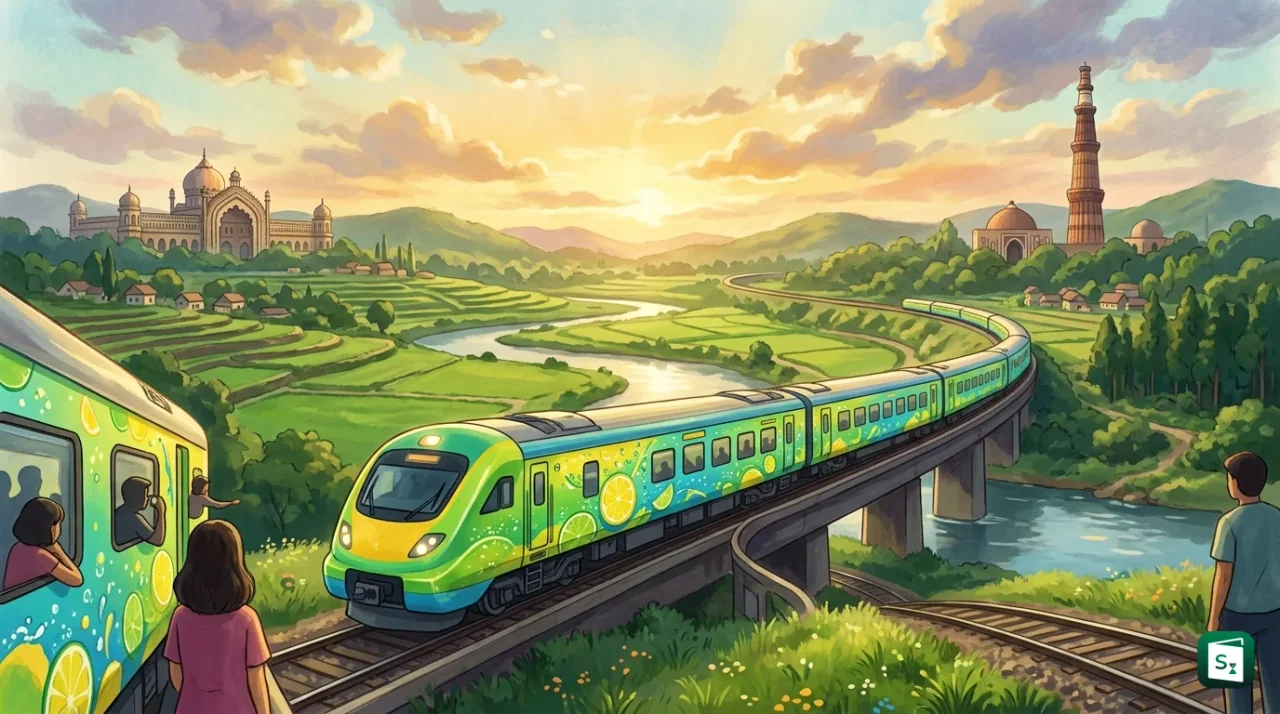
The Lucknow-Delhi-Lucknow Tejas Express, operated by the Indian Railway Catering and Tourism Corporation (IRCTC), will be renamed the Sprite Tejas Express from August 19, 2026. This makes it the first train in India to carry a commercial brand name under an advertising arrangement. The branding, awarded to beverage company Sprite for a six-month period, marks a new chapter in the commercialisation of India\u2019s privately operated passenger train services.
What Is the Sprite Tejas Express?
The Sprite Tejas Express is the temporary brand name assigned to the Lucknow-Delhi-Lucknow Tejas Express (train numbers 82501 and 82502) after IRCTC awarded advertisement rights through train branding to beverage company Sprite. Under this arrangement, the train will be announced as the Sprite Tejas Express at the originating station, all en-route stations, and the destination station in both directions.
The branding will be in effect from August 19 to November 11, 2026. The advertisement rights were awarded through a Letter of Acceptance, a formal instrument used by IRCTC to grant commercial rights. This is the first time in Indian railway history that a train has been named after a commercial brand.
It is important to note that this is distinct from exterior advertisement wraps that are already permitted on regular trains operated by Indian Railways. Under those arrangements, private companies can display their brands on train exteriors as an income-generating measure. The Sprite Tejas Express arrangement goes a step further, with the brand name itself becoming part of the train\u2019s official announcement at every station along the route.
Background: Tejas Express and Private Operation in India
The Tejas Express is a semi-high-speed, fully air-conditioned train service introduced by Indian Railways. The first Tejas Express in the country ran between Chhatrapati Shivaji Terminus (CSMT) in Mumbai and Karmali in Goa, covering 552 km in 8 hours and 30 minutes on its inaugural run on May 24, 2017. The coaches for this route were manufactured at the Rail Coach Factory in Kapurthala, Punjab.
The Lucknow-Delhi Tejas Express, the one now branded as the Sprite Tejas Express, was inaugurated on October 4, 2019, on the occasion of Navratris. It was later re-flagged by Uttar Pradesh Chief Minister Yogi Adityanath on December 3, 2021. This train covers a distance of approximately 512 km between Lucknow Junction and New Delhi, with intermediate stops at Kanpur Central, Tundla Junction, and Ghaziabad. The train runs six days a week, except on Tuesdays, taking roughly 6 hours and 25 minutes to complete the journey.
The Bibek Debroy Committee and the Push for Private Trains
The experiment of allowing IRCTC to operate the Tejas Express as a private service traces its origins to the recommendations of the Bibek Debroy Committee, set up in September 2014 under the chairmanship of NITI Aayog member and economist Bibek Debroy. The committee submitted its report in 2015 and recommended, among other reforms, that private entry into running both freight and passenger trains should be allowed to encourage competition and growth within the railway sector.
The idea was not full-scale privatisation but rather liberalisation through competition. The committee recommended the establishment of an independent Railway Regulatory Authority of India (RRAI) to mediate disputes between track-owning associations, train administrators, and competitors. Based on these recommendations, Indian Railways identified 109 origin-destination pairs of routes using 151 modern trains for potential operation by private players through a public-private partnership (PPP) model. The Lucknow-Delhi Tejas Express was the first concrete outcome of this policy direction.
While IRCTC manages the train\u2019s operations, including ticket booking, onboard catering, and crew, it pays haulage charges to Indian Railways for the use of its infrastructure, including tracks, stations, and signalling systems. The loco pilots and guards remain Indian Railways employees. This model allows IRCTC to function as a private operator while Indian Railways retains control over the physical network.
How Train Branding Works
The Sprite Tejas Express branding arrangement represents a new commercial model for Indian Railways. Under this framework, private companies can purchase advertising rights that extend beyond the standard exterior wraps already seen on regular trains. The key distinction is that the brand name becomes part of the train\u2019s official identity during the branding period.
The advertising rights were granted through a Letter of Acceptance, a formal document used by IRCTC to award commercial contracts. Under this arrangement, the Sprite brand will be prominently displayed on the train\u2019s exterior and interior spaces. The train will also be officially announced as the Sprite Tejas Express at the originating and en-route stations on both sides of the journey, according to instructions issued to the North Eastern Railway.
This is different from exterior advertisement wraps that Indian Railways already permits on its regular trains. Those wraps allow companies to showcase their brand on train coaches but do not change the train\u2019s official name or announcements. The Sprite arrangement goes a step further, making the brand name a part of the train\u2019s operational identity.
The arrangement is expected to generate additional revenue for IRCTC and Indian Railways, adding a new commercial dimension to the private train model. It also opens the door for future branding partnerships on other IRCTC-operated Tejas Express services and potentially other premium train categories.
Key Features of the Lucknow-Delhi Tejas Express
The Lucknow-Delhi Tejas Express is equipped with a range of modern amenities designed to offer a premium travel experience. Passengers have access to onboard Wi-Fi, personalised LCD screens at every seat, automatic doors, CCTV surveillance, personal reading lights, and snack trays. The coaches also feature modular bio-toilets and fire and smoke detection systems.
The train offers two classes of travel: Executive Chair Car with 56 seats and AC Chair Car with 78 seats per coach. Group bookings are permitted, allowing passengers travelling for corporate meetings, weddings, or social events to book an entire AC Chair Car coach. IRCTC also provides a free travel insurance of up to ₹10 lakh to every passenger, with an additional compensation of up to ₹1 lakh in case of theft or robbery.
A unique feature of this service is its delay compensation policy. If the train is delayed by more than one hour, passengers receive a compensation of ₹100, and for delays exceeding two hours, the compensation increases to ₹250. The payments are processed automatically by IRCTC without passengers needing to file a Ticket Deposit Receipt (TDR).
The train follows a dynamic pricing model, similar to Rajdhani and Shatabdi services, where fares vary based on demand and season. Advance reservation is available 60 days in advance, shorter than the standard 120-day window for regular Indian Railways trains. Tickets are available exclusively through the IRCTC website and mobile app.
The Way Forward
The Sprite Tejas Express branding experiment is likely to serve as a template for future commercial partnerships on India\u2019s premium train services. If the six-month arrangement proves commercially viable, it could encourage IRCTC and Indian Railways to explore similar branding deals on other Tejas Express routes, such as the Mumbai-Ahmedabad service inaugurated on January 17, 2020.
The broader policy context remains focused on expanding private participation in Indian Railways. The government has been gradually opening up passenger train operations through the PPP model, with the Tejas Express serving as the flagship project. The train branding model adds a new revenue stream that does not require the government to bear the full cost of premium services while ensuring passengers receive world-class amenities.
The success of this experiment will also depend on how the branding is received by passengers and whether it creates a positive association with the service. For Sprite, the arrangement provides an unmatched platform for brand visibility, with the train\u2019s daily operations across the Lucknow-Delhi corridor offering sustained exposure to a large and diverse passenger base. The coming months will reveal whether this new model of commercial partnership reshapes how India\u2019s premium trains are marketed and operated.
Key Takeaways
- The Lucknow-Delhi Tejas Express will be branded as the Sprite Tejas Express from August 19 to November 11, 2026, making it the first train in India to carry a commercial brand name.
- The branding was awarded by IRCTC through a Letter of Acceptance to beverage company Sprite for a six-month period.
- The Lucknow-Delhi Tejas Express (train numbers 82501 and 82502) was inaugurated on October 4, 2019 and covers approximately 512 km in about 6 hours and 25 minutes.
- The experiment traces its origins to the Bibek Debroy Committee (2015), which recommended allowing private operators to run passenger trains to encourage competition.
- IRCTC operates the train by paying haulage charges to Indian Railways for using its infrastructure, including tracks, stations, and signalling systems.
- Passengers receive free travel insurance of up to ₹10 lakh and automatic delay compensation of ₹100 for delays over one hour and ₹250 for delays over two hours.