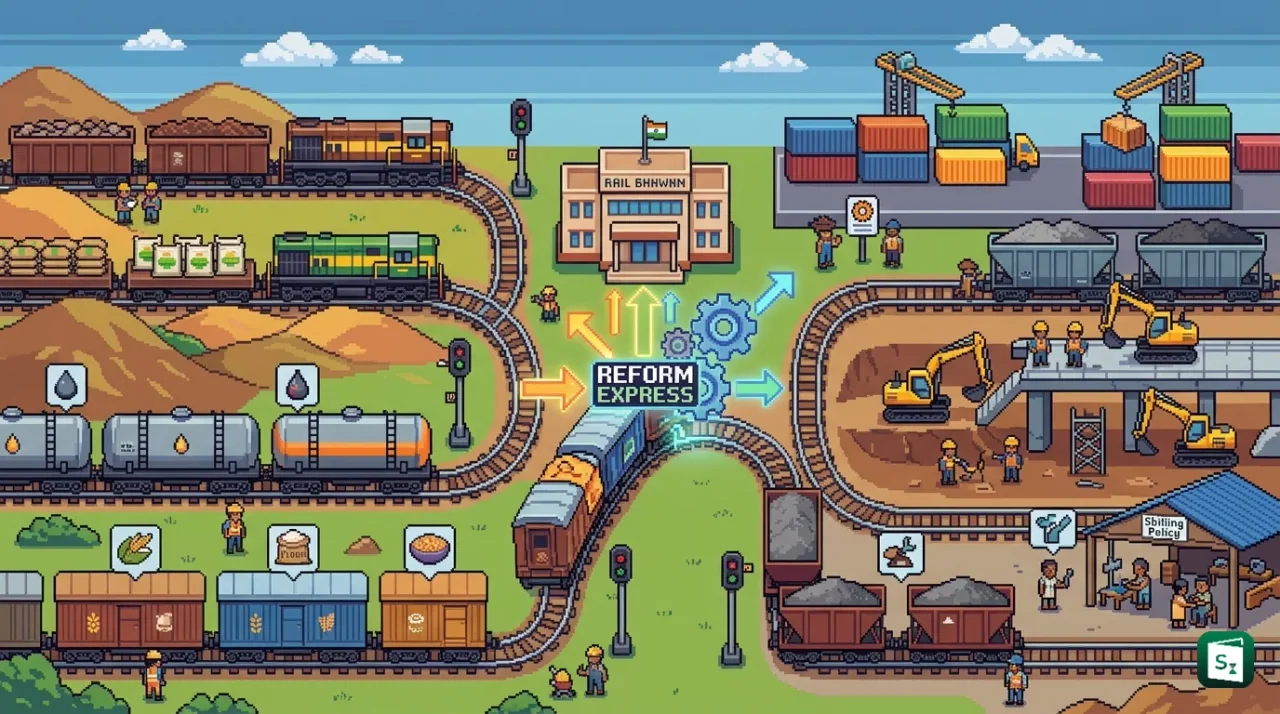
Union Railway Minister Ashwini Vaishnaw announced eight new structural reforms under the ongoing Reform Express initiative at Rail Bhawan in New Delhi, taking the total number of reforms implemented in 2026 to 17. The reforms cover fly ash transportation, container sector licensing, fertilizer and foodgrain logistics, petroleum products movement, construction project execution, artisan skilling, and wagon design. Together, they form the latest installment of the ministry’s target to execute 52 reforms within 52 weeks this year.
What Is the Reform Express Initiative?
The Reform Express initiative was launched by the Ministry of Railways in January 2026 as a structured, time-bound transformation agenda. Under this, the ministry committed to implementing 52 structural reforms over 52 weeks, covering passenger services, freight operations, construction quality, technology adoption, and ease of doing business.
Before the latest round, the ministry had already implemented nine reforms. The first set focused on continuous on-board train cleaning, expansion of Gati Shakti Cargo Terminals, the RailTech policy and portal, and digitisation of the Railway Claims Tribunal. The second tranche (reforms five to nine) introduced specialised containers for salt and automobile transportation, seven construction-quality changes, simplified ticket cancellation and refund rules, and digital change of boarding point.
The reforms are being driven by Union Minister Ashwini Vaishnaw, who also holds the portfolios of Information and Broadcasting and Electronics and Information Technology. The initiative builds on Indian Railways’ broader modernisation push, which includes record capital expenditure, completion of the Dedicated Freight Corridors (DFCs), rapid network electrification, and station redevelopment under the Amrit Bharat Station Scheme.
Transforming Freight Through Containerisation
Three of the eight new reforms directly promote containerisation of commodities that have traditionally moved in open wagons or through non-containerised modes. Containerisation allows cargo to move seamlessly between rail and road, reduces handling losses, protects goods from weather damage, and enables flexible storage and distribution. The shift is central to Indian Railways’ strategy to diversify its freight basket beyond traditional bulk commodities such as coal, iron ore, and cement.
Fly Ash Transportation
India generates approximately 340 million tonnes of fly ash every year as a by-product of thermal power generation. Of this, the cement industry utilises nearly 96 million tonnes, but Indian Railways transported only about 13 million tonnes of fly ash during FY 2025-26, which is roughly four per cent of the country’s total generation.
Fly ash has historically been moved in open wagons, leading to dust pollution during loading, transit, and unloading. It also poses serious environmental challenges when stored in large ash ponds at thermal power plants.
Under the new reform, Indian Railways has introduced containerised transportation of fly ash using specially designed ISO-standard closed containers. These containers can be top-loaded directly at power plants and unloaded using side-discharge or pneumatic systems without releasing dust into the environment. The closed-container system enables pollution-free movement, allows safe storage within cement plants, and improves logistics efficiency. Containers can be handled using reach stackers, enabling seamless end-to-end movement from power plants to cement plants. The reform is expected to increase rail’s share of fly ash movement, reduce dependence on road transport, and turn an environmental challenge into an economically productive resource.
Fertilizer Transportation
Indian Railways currently moves approximately 85 per cent of the country’s fertiliser, making it a critical link in the agricultural supply chain. The existing freight tariff structure was spread across nearly 50 slabs, creating complexity and inefficiency.
Reform 12 simplifies this by replacing the multi-slab structure with a per-tonne-per-kilometre model using a flat-tapering-flat approach with three variations. The reform also permits containerised movement of fertilisers, allowing individual containers to be unloaded according to demand instead of detaining an entire rake. This gives distributors greater operational flexibility, improves wagon turnaround, and protects fertilisers from weather damage during transit and storage.
Foodgrains, Flour, and Pulses
Reform 17 introduces containerised transportation for foodgrains, flour, and pulses with simplified freight charges. The new policy permits sealed containers to be stored at the premises of sellers or buyers and distributed as per demand, without detaining an entire rake. Since containers remain sealed during transit, the risk of contamination is significantly reduced, improving food safety and quality while enhancing logistics efficiency.
Encouraging Private Participation in Freight
Three of the new reforms are designed to attract private investment and encourage industry-led innovation in railway freight operations.
Unified Container Train Operator Licence
Reform 11 replaces the existing four-category licensing system for Container Train Operators (CTOs) with a single Pan-India unified licence. Earlier, operators had to navigate separate licence categories with varying registration fees and operational restrictions depending on the route. The new framework allows operators to run container trains anywhere on the Indian Railways network under one licence.
The registration fee has been fixed at a uniform ₹25 crore, which is valid for 20 years, with automatic extension and no renewal fees thereafter. The reform is expected to reduce regulatory complexity, encourage greater private sector participation, increase container traffic, and help diversify railway freight beyond bulk commodities.
Policy for Wagon Design Approval
Reform 15 revises the wagon design approval framework to allow private manufacturers and designers to propose customised freight wagons for specific industrial requirements. Previously, wagon design within Indian Railways largely followed standardised templates developed by the Research Designs and Standards Organisation (RDSO), which is headquartered in Lucknow and serves as the technical authority on rolling stock design.
Under the new policy, industry participants can develop specialised wagons tailored to sectors such as steel, petroleum, chemicals, milk, and plastics. Proposed designs will undergo technical evaluation, prototype testing, field trials, and safety certification before commercial induction. This shift from centralised design control to innovation-led industrial participation is aimed at improving freight efficiency across diverse industrial sectors while creating new opportunities for domestic manufacturing.
Petroleum Products Transportation
Reform 16 addresses the movement of petroleum, oil, and lubricant (POL) products. Until now, specialised tank wagons were largely owned and operated by Indian Railways. The new policy removes ownership restrictions, permitting oil companies to procure or lease specialised tank wagons directly for rail movement.
This reform offers oil companies greater flexibility in logistics planning and is expected to reduce transportation costs, minimise product losses, increase rail’s share of petroleum movement, and lower the risks associated with long-distance road transport of hazardous materials.
Reforms for Project Execution and Quality
Two reforms focus on improving the quality, timeliness, and safety of railway infrastructure projects.
Construction Reforms
Reform 14 introduces several measures to address long-standing issues of project delays, contractual disputes, and inconsistent construction quality in railway projects. Performance security of 10 per cent will now be collected upfront at contract commencement, ensuring that only financially serious contractors participate. Contractors involved in litigation exceeding 50 per cent of their net worth will be ineligible to bid for railway tenders.
The ministry has made Contractor’s All Risk Insurance and Professional Indemnity Insurance mandatory to strengthen risk management during project execution. A defined land handover mechanism has been introduced to minimise disputes between Railways and executing agencies.
These reforms are supported by Rail Bhoomi, a web-based platform developed by the Centre for Railway Information Systems (CRIS). The platform integrates multiple railway digital systems to enable online processing of land acquisition workflows, real-time monitoring of acquisition stages, and seamless project management. The ministry estimates that Rail Bhoomi could reduce land acquisition timelines by 30 to 40 per cent, depending on the state.
Policy for Skilling Artisans
Reform 13 introduces a nationwide Skill Certification Framework for workers engaged in railway projects. Artisans in specialised trades such as welding, masonry, plumbing, concrete testing, and fitting will undergo structured practical and oral assessments before receiving QR code-enabled digital certificates linked to an online verification database.
The certification programme will initially focus on technically demanding projects such as bridges and tunnels before being expanded across the entire railway network within 24 months. Only certified artisans and supervisors will handle safety-sensitive and precision railway works. The policy aims to standardise skill levels, improve workmanship quality, and complement the government’s broader Skill India mission.
Lowering Logistics Costs and Building a Future-Ready Railway
The eight reforms together reflect a strategic shift in Indian Railways’ approach from passenger-centric improvements to logistics efficiency, private sector participation, and supply chain optimisation. The ministry has emphasised that rail transport generates nearly 90 per cent lower carbon emissions than road transport, making the modal shift from road to rail an important component of India’s climate commitments.
The government has set a target to reduce India’s logistics cost as a percentage of GDP from the current estimated level of around 13 to 14 per cent to below 10 per cent, in line with global benchmarks. Greater use of railways for freight movement, combined with containerisation, simplified licensing, and digital project management, is central to achieving this goal.
Earlier reforms under the Reform Express have already shown results. Cement transportation recorded a 170 per cent increase within four months of introducing bulk cement tank containers and a dedicated terminal policy in late 2025. The ministry expects similar outcomes from the latest reforms, particularly in fly ash, fertiliser, and foodgrain logistics.
Key Takeaways
- The Reform Express initiative targets 52 reforms in 52 weeks for 2026, with 17 reforms implemented so far.
- India generates about 340 million tonnes of fly ash annually, but Railways currently transports only 13 million tonnes; the new containerised system aims to increase this share.
- The Container Train Operator (CTO) licensing regime has been unified into a single Pan-India licence with a ₹25 crore registration fee valid for 20 years.
- Rail Bhoomi, a CRIS-developed platform, is expected to reduce land acquisition timelines for railway projects by 30 to 40 per cent.
- The wagon design approval policy now allows private manufacturers to propose customised wagons for sectors like steel, petroleum, and chemicals.
- The Skill Certification Framework for railway artisans will be expanded across the network within 24 months, with QR code-enabled digital certificates.
- Rail transport generates nearly 90 per cent lower carbon emissions than road transport, supporting India’s climate goals.