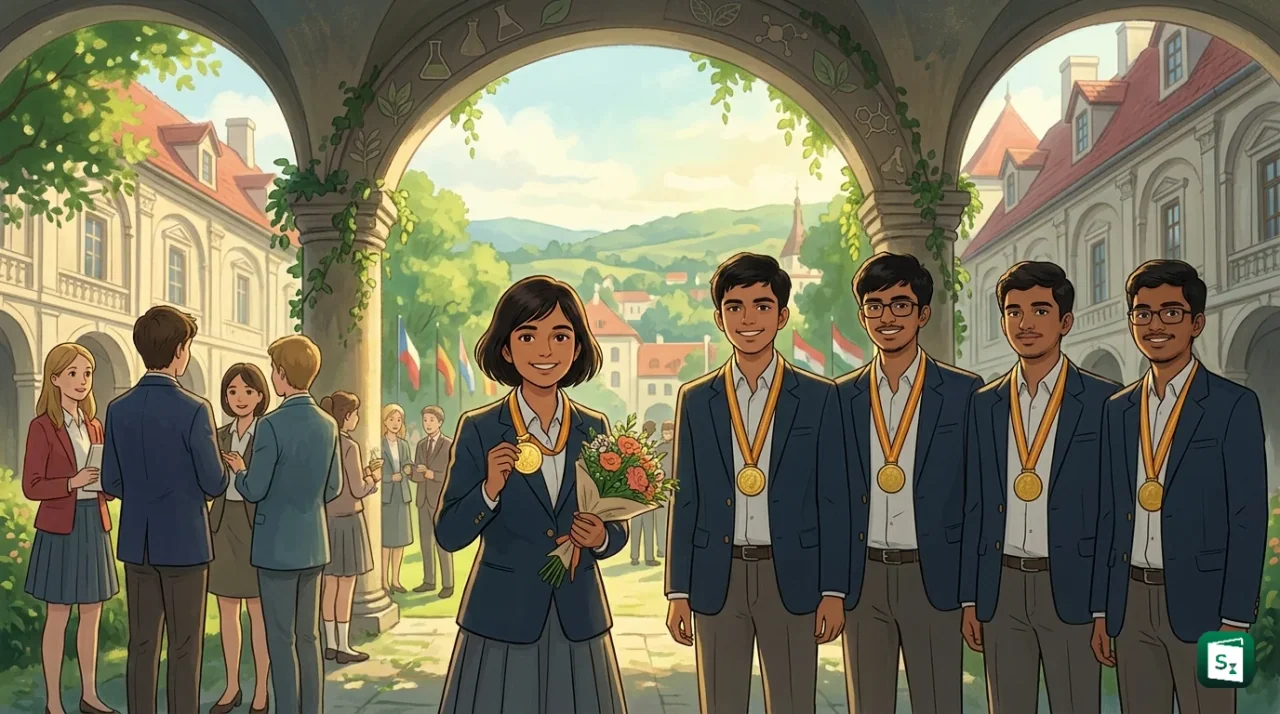
India’s young scientists delivered a brilliant performance at two of the world’s most prestigious science competitions in July 2026, with all four members of its chemistry team winning gold medals at the 58th International Chemistry Olympiad (IChO) in Tashkent, Uzbekistan, and the biology team securing one gold and three silver medals at the 37th International Biology Olympiad (IBO) in Vilnius, Lithuania. The all-gold haul at the chemistry olympiad was India’s first such achievement in its 27-year history at the competition. These results continue a strong run for India at international science olympiads, following similarly impressive performances earlier this year in physics and other subjects.
IChO 2026: India’s First All-Gold Sweep
The 58th International Chemistry Olympiad was held in Tashkent, Uzbekistan, from July 10 to 19, 2026, with 363 students from 93 countries participating, making it the largest edition of the competition to date. India’s four-member team returned with gold medals for all four students, a first in the country’s 27 appearances at the IChO.
The gold medallists are Debadatta Priyadarshi from Bhubaneswar, Odisha; Harshit Singla from Mandi Gobindgarh, Punjab; Kabeer Chillar from Delhi; and Sandeep Kuchi from Hyderabad, Telangana. Kabeer Chillar had earlier secured All India Rank 2 in JEE Advanced 2026, scoring 329 out of 360 marks. For Sandeep Kuchi and Debadatta Priyadarshi, this was their second medal at the IChO. Kuchi had won gold at the 2025 edition in Dubai, while Priyadarshi had won silver that year.
India finished joint first in the overall standings alongside China, Vietnam, and an individual participant from Russia. The competition tested students through a rigorous five-hour theoretical examination and a five-hour practical laboratory exam, covering advanced topics in organic, inorganic, physical, and analytical chemistry.
IBO 2026: Consistent Excellence in Biology
At the 37th International Biology Olympiad, held in Vilnius, Lithuania, from July 12 to 19, 2026, India won one gold and three silver medals. The competition featured 307 students from 78 countries, with a total of 31 gold, 61 silver, and 91 bronze medals awarded.
Bhavyaa Gunwal from Mahendragarh, Haryana, won the gold medal for India. The three silver medallists are Soumil Maity from Howrah, West Bengal; Nishit Kalani from Pali, Rajasthan; and Anmol Kumar from Mansa, Punjab.
The IBO examination consists of a six-hour theory paper and a six-hour practical component. The practical segment this year covered four areas: Molecular Biology and Biochemistry, Animal Physiology, Animal Morphology and Systematics, and Plant Computational Biology. This was India’s 26th appearance at the IBO. Since its debut in the competition, 104 Indian students have represented the country, winning 17 gold medals, 69 silver medals, 17 bronze medals, and one honourable mention. Over the past decade, India’s strike rate at the IBO has been 25 per cent gold and 68 per cent silver.
The Science Olympiad Ecosystem in India
India’s participation in all International Science Olympiads, including the IChO and IBO, is coordinated by the Homi Bhabha Centre for Science Education (HBCSE), a constituent unit of the Tata Institute of Fundamental Research (TIFR) based in Mumbai. HBCSE has been the nodal agency for India’s olympiad programmes since the country’s first participation in these competitions.
The selection process for both olympiads follows a rigorous multi-stage pipeline. It begins with the National Standard Examination (NSE) conducted by the Indian Association of Physics Teachers (IAPT), followed by the Indian National Olympiad (INO) examination, and culminates in an Orientation-cum-Selection Camp (OCSC) at HBCSE where the final four-member teams are chosen after intensive theory and practical training.
The International Chemistry Olympiad was first held in 1968 in Prague, Czechoslovakia, and is the world’s oldest and most prestigious chemistry competition for secondary school students. India first participated in the IChO in 1999 and hosted the 33rd edition in Mumbai in 2001. Over the years, Indian students have maintained a strike rate of 32 per cent gold, 51 per cent silver, and 17 per cent bronze at the competition.
The International Biology Olympiad began in 1990 in Olomouc, Czechoslovakia, and has since grown to include over 75 countries. India has participated since 2000 and hosted the 19th IBO in Mumbai in 2008. The IBO is regarded as one of the most challenging of the science olympiads due to its heavy emphasis on both theoretical depth and practical laboratory skills.
Prime Minister Narendra Modi congratulated all the medal winners, describing their achievements as a testament to India’s growing prowess in science and technology. In a post on X, he said that successes like these inspire countless young minds to pursue excellence in science.
Key Takeaways
- India won 4 gold medals at the 58th International Chemistry Olympiad (IChO) 2026 in Tashkent, Uzbekistan, marking its first all-gold haul and joint first position with China and Vietnam.
- The IChO 2026 gold medallists are Debadatta Priyadarshi (Odisha), Harshit Singla (Punjab), Kabeer Chillar (Delhi), and Sandeep Kuchi (Telangana).
- India won 1 gold and 3 silver medals at the 37th International Biology Olympiad (IBO) 2026 in Vilnius, Lithuania, with Bhavyaa Gunwal (Haryana) winning the gold.
- The International Chemistry Olympiad was first held in 1968 in Prague, and India first participated in 1999.
- The International Biology Olympiad began in 1990 in Czechoslovakia, and India has participated since 2000.
- India’s olympiad programmes are coordinated by the Homi Bhabha Centre for Science Education (HBCSE) at the Tata Institute of Fundamental Research (TIFR), Mumbai.