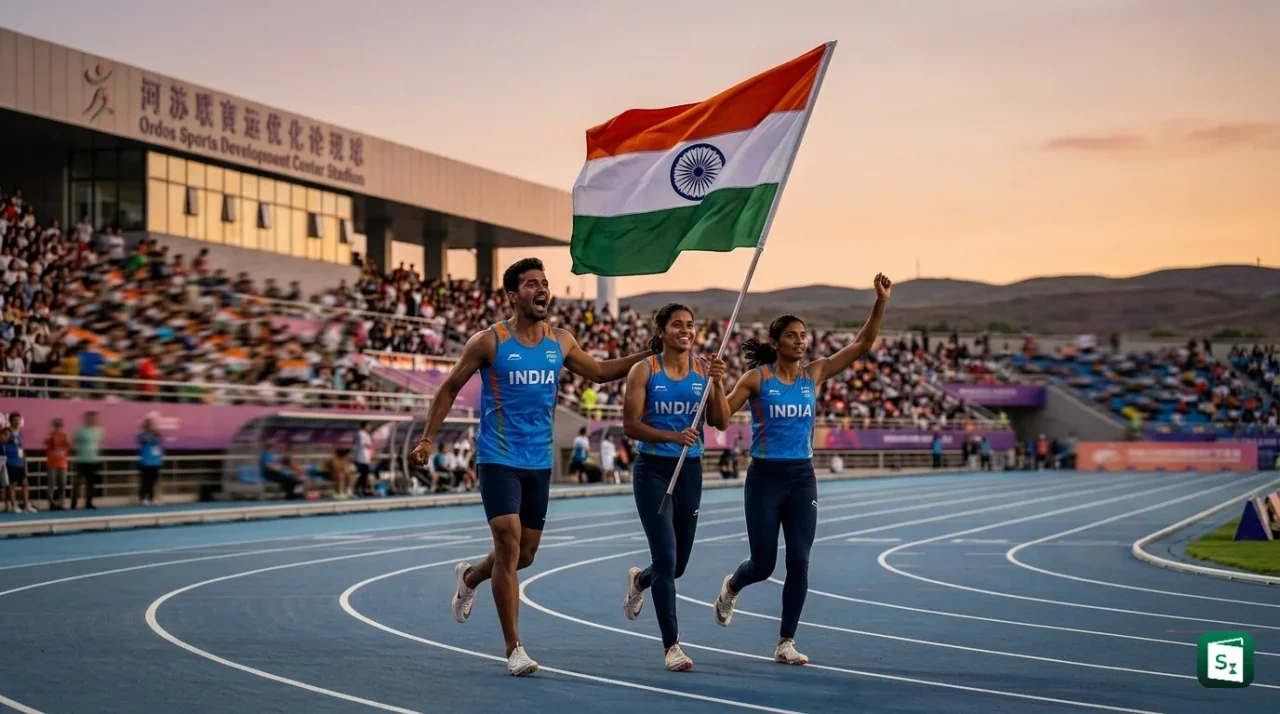
India finished fourth in the medal standings at the inaugural Asian Under-23 Athletics Championships, held from July 9 to 12 at the Ordos Sports Development Center Stadium in Ordos, China, with a total of 16 medals (3 gold, 4 silver, 9 bronze). The Indian contingent of nearly 50 athletes competed across track and field events, with relay teams and javelin thrower Anand Singh leading the gold medal charge. Host nation China dominated the competition with 52 medals (23 gold), followed by Japan and Uzbekistan at second and third places respectively.
India at the Inaugural Asian U23 Athletics Championships
The Asian U23 Athletics Championships is the newest addition to the continental calendar, introduced by Asian Athletics (formerly the Asian Athletics Association) to create a dedicated platform for athletes aged under 23. The governing body, headquartered in Pathum Thani, Thailand, was established in 1973 and serves as the continental arm of World Athletics. This inaugural edition featured 45 events (22 men’s, 22 women’s and one mixed) with athletes born between 2004 and 2006 eligible to compete.
India sent a 54-member squad selected by the Athletics Federation of India (AFI), though several leading U23 athletes including long jumper Shaili Singh, pole vaulter Dev Kumar Meena and Kuldeep Kumar opted out of the championships. They chose instead to focus on preparing for the Commonwealth Games and Asian Games, both scheduled later in 2026. This meant the Ordos contingent largely comprised emerging athletes gaining their first significant international exposure.
The Three Gold Medals
Mixed 4x400m Relay
India opened its campaign in style on the very first day, July 9, when the mixed 4x400m relay quartet of Astik Pradhan, Sandramol Sabu, Setu Mishra and Shravani Sachin Sangle clinched gold in a thrilling finish. The team clocked 3:18.64 seconds, edging out hosts China (3:18.74) by just 0.10 seconds. The Philippines took bronze with 3:25.28. Shravani Sangle, running the anchor leg, produced a brilliant finish to pip China’s Yingying Huang at the line.
Women’s 4x400m Relay
India’s third gold came on the final day, July 12, when the women’s 4x400m relay team dominated the field to finish first. The quartet of Shravani Sachin Sangle, Sandramol Sabu, Pravallika Narimalla and Nofisa Khatun clocked 3:33.62 seconds, well ahead of China (3:35.14) who took silver and Kazakhstan (3:37.65) who settled for bronze. This victory made Shravani Sangle the most successful Indian athlete at the championships, with three medals in total.
Anand Singh’s Javelin Gold
On the final day, Anand Singh, a 22-year-old from Uttar Pradesh, delivered a career-defining performance in the men’s javelin throw. On his international debut, he unleashed a massive 80.57m throw on his final attempt. This was a personal best, improving his previous mark of 77.68m by nearly 3 metres, and marked his first time breaching the elite 80m barrier. India made it a double podium finish in the event as Shivam Lohakare won the bronze medal with a throw of 77.70m, while China’s Wang Xiaobo took silver (79.41m).
Anand had entered the championships with a personal best of 77.68m, set at the National Inter-State Senior Athletics Championships in Bhubaneswar on June 28, where he finished fourth. His rapid improvement within two weeks signals growing depth in India’s javelin programme, which has gained global attention since Neeraj Chopra’s Olympic success.
Silver and Bronze Performances
India added four silver medals. Shivaji Parashuram was the standout performer in distance events, winning silver in both the men’s 5000m (14:08.19) and men’s 10,000m (29:33.54, a personal best). He was the only Indian athlete to win multiple individual medals. The men’s 4x400m relay team of Astik Pradhan, Sharan Megavarnam, Setu Mishra and Aman Choudhary clocked 3:04.24 seconds to finish behind China (3:03.46) for silver. The women’s 4x100m relay team of Sanjana, Akshaya Saravanan, Sudheeksha V and Shreeya Rajesh also won silver with a time of 44.68 seconds, again behind China (43.75).
The bronze medals came from nine events, showcasing India’s breadth across disciplines. In track events, Vinod Singh won bronze in the men’s 5000m (14:23.67), Shakeel in the men’s 800m (1:48.78), Abhay Singh in the men’s 200m (20.96), Huidrom Bhumeshwory Devi in the women’s 800m (2:10.20), Shravani Sangle in the women’s 400m hurdles (58.09) and Prachi Devkar in the women’s 3000m steeplechase (10:32.69). In field events, Bhartpreet Singh won bronze in men’s discus throw (52.91m), Priya in women’s discus throw (50.44m) and Shivam Lohakare in men’s javelin throw (77.70m).
Final Medal Tally
| Rank | Country | Gold | Silver | Bronze | Total |
|---|---|---|---|---|---|
| 1 | China | 23 | 17 | 12 | 52 |
| 2 | Japan | 7 | 8 | 7 | 22 |
| 3 | Uzbekistan | 5 | 4 | 1 | 10 |
| 4 | India | 3 | 4 | 9 | 16 |
| 5 | Qatar | 3 | 2 | 3 | 8 |
| 6 | Chinese Taipei | 3 | 1 | 1 | 5 |
| 7 | Malaysia | 1 | 0 | 1 | 2 |
| 8 | Kazakhstan | 0 | 2 | 4 | 6 |
| 9 | Vietnam | 0 | 2 | 3 | 5 |
| 10 | Philippines | 0 | 2 | 1 | 3 |
China’s dominance was comprehensive, winning nearly half of all gold medals on offer. Japan’s second place underscored its consistent athletic development system, while Uzbekistan’s five gold medals from only 10 total medals demonstrated a sharp focus on converting participation into top finishes. India’s 16 medals were the third highest in total count, but a lower gold conversion rate compared to Uzbekistan pushed it to fourth.
Beyond the Medal Count
India’s performance in Ordos is noteworthy given the context of a packed 2026 calendar. Several of the country’s top U23 prospects were absent, conserving energy for the Commonwealth Games and Asian Games later in the year. The championships therefore served as a valuable testing ground for the next tier of Indian athletes, giving them experience of international competition and exposure to continental rivals.
The relay programme emerged as a clear strength, contributing four medals including two golds. India’s depth in the 4x400m distances, across both men’s and women’s categories, bodes well for future senior championships. The double podium in men’s javelin throw, with Anand Singh’s gold and Shivam Lohakare’s bronze, also points to a promising pipeline beyond established stars.
However, the absence of medals in jump events (long jump, triple jump, high jump and pole vault) highlighted a gap that Indian athletics will need to address. The next edition of the championships is expected to be held in 2028, providing a biennial platform for Asia’s under-23 talent to shine.
Key Takeaways
- India finished 4th in the medal tally at the inaugural Asian U23 Athletics Championships 2026 in Ordos, China, with 16 medals (3 gold, 4 silver, 9 bronze).
- The three gold medals came from the Mixed 4x400m Relay, the Women’s 4x400m Relay, and Anand Singh in the Men’s Javelin Throw (80.57m, personal best).
- Shravani Sachin Sangle was India’s most decorated athlete with three medals: gold in the mixed and women’s 4x400m relays and bronze in the 400m hurdles.
- Shivaji Parashuram won two silver medals in the men’s 5000m and 10,000m events.
- China topped the table with 52 medals (23 gold), followed by Japan (22 medals) and Uzbekistan (10 medals).
- The championships were organized by Asian Athletics, the continental governing body for athletics in Asia, established in 1973 and headquartered in Pathum Thani, Thailand.