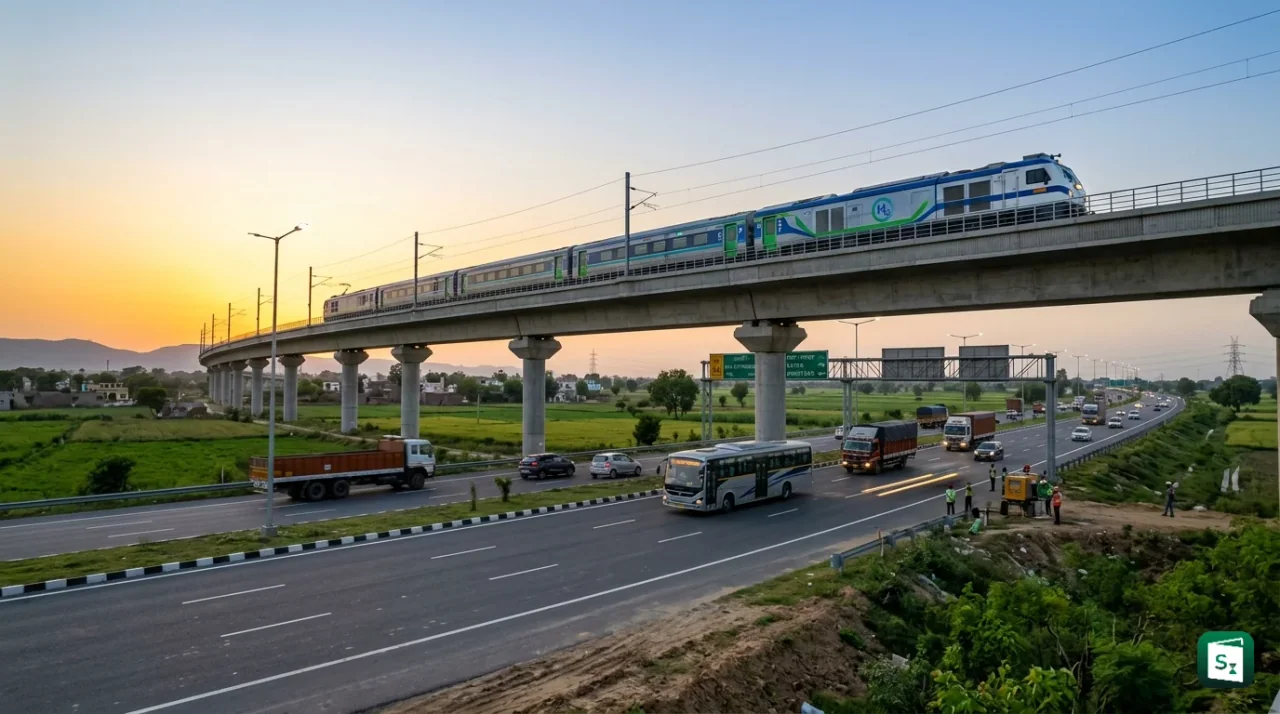
Prime Minister Narendra Modi dedicated development projects worth ₹14,700 crore to the nation during a visit to Jind, Haryana, on July 17, 2026, spanning railways, highways, healthcare and cultural infrastructure. The highlight of the event was the flagging off of India’s first hydrogen-powered train between Jind and Sonipat, making India one of only a handful of countries to operate a hydrogen fuel cell train. The Prime Minister also inaugurated the first 157.92 km stretch of the Delhi-Amritsar-Katra Expressway, built at a cost of ₹9,680 crore, a flagship project under the Bharatmala Pariyojana that promises to halve travel times between the national capital and key cities in Punjab and Jammu and Kashmir.
India’s First Hydrogen-Powered Train
The Prime Minister flagged off the NaMo Green Rail, India’s first hydrogen-powered train, from Jind railway station at 11:22 am on July 17. The train will operate on the 89 km Jind-Sonipat section under Northern Railway, covering the distance in about two hours with halts at 14 stations. With an operational speed of 75 kmph and a design speed of 110 kmph, the train can carry up to 2,600 passengers across its 10 coaches, making it the longest hydrogen-powered passenger train currently in operation globally.
The train is also the world’s most powerful hydrogen train, generating 3,200 HP of propulsion power. It comprises two Hydrogen Driving Power Cars and eight Trailer Coaches. Each Driving Power Car houses fuel cells, lithium iron phosphate batteries and hydrogen storage cylinders, together generating 2,400 kW of power.
How Hydrogen Fuel Cell Technology Works
The train uses a Proton Exchange Membrane Fuel Cell (PEMFC) as its primary energy source. This technology generates electricity onboard through a chemical reaction between hydrogen and oxygen, producing only water vapour as a by-product. Hydrogen carries an energy density of 120 MJ/kg, nearly three times that of diesel at 43 MJ/kg, making it among the cleanest propulsion technologies available for rail transport. The process results in zero carbon emissions during operation.
Indigenous Development and Safety
The trainset was designed, engineered and integrated in India using indigenous technology. The Research Designs and Standards Organisation (RDSO), headquartered in Lucknow and established in 1957, formulated the technical specifications and led the design approval. Medha Servo Drives integrated the trainset, while the Integral Coach Factory (ICF) in Chennai, established in 1955, contributed to the exterior design. The project underwent a third-party safety assessment by TUV SUD, Germany before commissioning.
The system uses layered safety measures, including hydrogen leak and flame detectors at production, storage and dispensing points, continuous ventilation, and automatic shut-off if heat, flame or smoke is detected. The loco pilot’s cabin has a special emergency mode to move the train to safety, along with a real-time system health display.
Hydrogen Ecosystem at Jind
Indian Railways has set up the country’s largest railway hydrogen storage and refuelling facility at Jind, capable of holding nearly 3,000 kg of hydrogen at a time. The Petroleum and Explosives Safety Organisation (PESO) has licensed the site for storage and dispensing of compressed hydrogen gas. The facility includes a hydrogen compression system and a standby compressor to ensure uninterrupted refuelling. A maintenance facility at Shakurbasti in Delhi has also been readied to support the train’s operations.
With this launch, India joins a select group of countries, including Germany, Japan, China and the United States, that are exploring hydrogen-powered rail transport. The project is a pilot initiative aligned with the National Green Hydrogen Mission, approved by the Union Cabinet in January 2023 with an outlay of ₹19,744 crore. The mission aims to make India a global hub for production, usage and export of green hydrogen and targets production of 5 million metric tonnes per annum of green hydrogen by 2030.
Delhi-Amritsar-Katra Expressway
The Prime Minister inaugurated Packages 1 to 5 of the Delhi-Amritsar-Katra Greenfield Expressway, a 157.92 km four-lane, fully access-controlled section built at a cost of around ₹9,680 crore. Later in the day, he also inaugurated the 30.9 km Package 6 in Jalandhar, Punjab, bringing a total of over 188 km of the expressway into operation.
The expressway is part of the larger Delhi-Amritsar-Katra Expressway, a 667 km corridor being developed at an estimated cost of approximately ₹38,905 crore. It is being implemented by the National Highways Authority of India (NHAI), which was established through the NHAI Act of 1988 and began operations in 1995. The project has been divided into 21 construction packages across two phases to speed up execution. Designed as a four-lane highway, it can be expanded to eight lanes as traffic demand increases.
Travel Time and Connectivity Impact
Once the full corridor is completed, travel time between Delhi and Katra is expected to drop from nearly 14 hours to about 6 hours, while the Delhi-Amritsar journey will reduce from approximately 8 hours to 4 hours. The total distance between Delhi and Katra will also shrink from 727 km to 588 km.
The expressway will significantly decongest the busy NH-44 (GT Road), boost pilgrim traffic to Shri Mata Vaishno Devi shrine, and catalyse industrial and logistics development along the corridor. The route passes through Delhi, Haryana, Punjab and Jammu and Kashmir, with a spur connecting Nakodar to Sri Guru Ram Das Ji International Airport in Amritsar. The full corridor is scheduled for completion by March 2027.
Other Development Projects in Haryana
Road Infrastructure
Beyond the expressway, the Prime Minister inaugurated and laid the foundation stone for multiple highway projects worth over ₹12,470 crore in Haryana. The Ambala-Kala Amb Highway, a 33.81 km four-lane partially access-controlled road on NH-7 and NH-344, was dedicated to the nation. This highway strengthens connectivity between the Ambala urban agglomeration and the Kala Amb industrial belt, improves road links between Haryana and Himachal Pradesh, and reduces logistics costs for industries in the region.
The Jind-Gohana Greenfield Highway on NH-352A, spanning 40.60 km, was also inaugurated. It will cut travel time between Jind and Gohana from about two hours to just 40 minutes, benefiting the agriculturally significant Jind-Gohana region and improving connectivity to Rohtak, Panipat and Delhi-NCR.
Modi laid the foundation stone for the Hansi-Barwala Brownfield Highway Project, covering 24.27 km, which will upgrade the existing carriageway to a 2/4-lane configuration with paved shoulders.
Healthcare and Medical Education
Giving a boost to medical infrastructure, the Prime Minister dedicated two major medical institutions to the nation: Pandit Neki Ram Sharma Government Medical College, Bhiwani (built at ₹594 crore), and Maharishi Chyawan Medical College and Rao Tula Ram Hospital, Koriawas, Narnaul (built at ₹844 crore). These institutions will expand access to quality medical education in Haryana, increase the number of MBBS seats, improve the availability of specialist healthcare professionals, and enable people to access better medical services closer to their homes.
Railway and Cultural Projects
Modi inaugurated the Elevated Railway Track at Kurukshetra, a major urban infrastructure project built at ₹372 crore that will eliminate long-standing traffic congestion at railway crossings in the city. The project ensures smoother vehicular movement, improves road safety, and enhances the operational efficiency of both rail and road transport systems.
The Prime Minister also laid the foundation stone of a Sikh Museum at Kurukshetra at a cost of ₹164 crore. The museum will showcase the history of Sikhism, the teachings of Sikh Gurus, their courage, sacrifices and the contribution of the Sikh community to India’s civilisation and culture through modern technology.
Railways Transformation and Energy Security
During the event, the Prime Minister highlighted how Indian Railways’ rapid electrification over the past decade has shielded the country from global fuel supply disruptions. He noted that before 2014, only about 30% of the railway network was electrified, with 70% of trains running on diesel. The situation left the country vulnerable to geopolitical crises such as the ongoing tensions in West Asia and threats to the Strait of Hormuz, through which a significant portion of India’s crude oil imports transit.
As of May 2026, Indian Railways has electrified 70,002 route kilometres of its broad gauge network, achieving 99.6% electrification. This marks one of the fastest and largest railway electrification programmes in the world. The pace has accelerated from just 1.42 km per day between 2004 and 2014 to more than 15 km per day between 2019 and 2025. Twenty-five states and union territories, and 14 of the 18 railway zones, have already achieved 100% electrification.
The hydrogen train launch represents the next frontier in this transformation. While electrification eliminates dependence on imported diesel, hydrogen technology offers a zero-emission alternative for routes where overhead electrification is challenging, such as heritage routes like the Kalka-Shimla Railway. Combined with the National Green Hydrogen Mission, the initiative positions India at the forefront of sustainable rail mobility globally.
Key Takeaways
- Prime Minister Narendra Modi flagged off India’s first hydrogen-powered train, named NaMo Green Rail, on the 89 km Jind-Sonipat section in Haryana on July 17, 2026.
- The 10-coach hydrogen train has 3,200 HP power, an operational speed of 75 kmph, and can carry 2,600 passengers, making it the world’s longest and most powerful hydrogen train in operation.
- The train uses Proton Exchange Membrane Fuel Cell (PEMFC) technology, generating electricity onboard with only water vapour as a by-product, resulting in zero carbon emissions.
- The Research Designs and Standards Organisation (RDSO), established in 1957 and headquartered in Lucknow, formulated the technical specifications for the train, while Medha Servo Drives and Integral Coach Factory (ICF) executed the integration and design.
- The Delhi-Amritsar-Katra Expressway will reduce travel time between Delhi and Katra from 14 hours to 6 hours and between Delhi and Amritsar from 8 hours to 4 hours once fully completed by March 2027.
- Indian Railways has achieved 99.6% electrification of its broad gauge network as of May 2026, up from about 30% in 2014, with 25 states and 14 railway zones fully electrified.