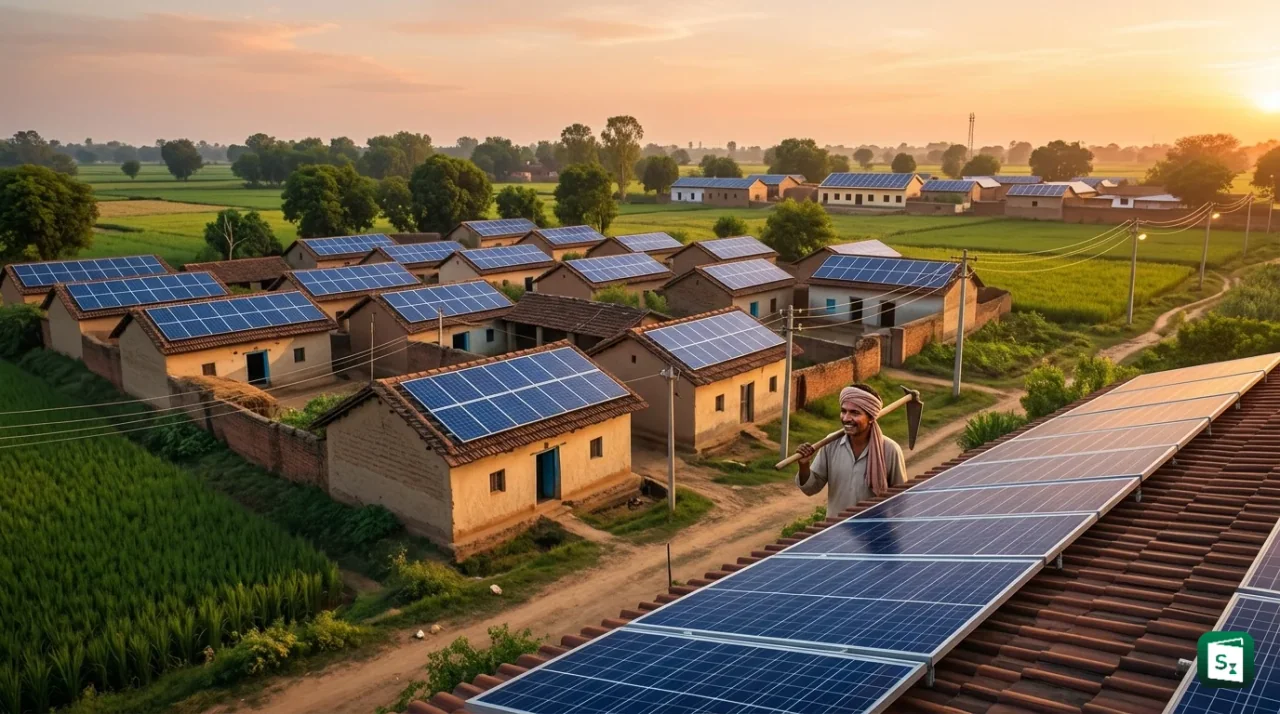
Uttar Pradesh has overtaken Maharashtra to become the second-largest state in India for domestic rooftop solar installations under the PM-Surya Ghar: Muft Bijli Yojana, with 6,74,393 households now generating solar power from their rooftops. Gujarat continues to lead the national rankings with 7,49,839 installations, while Maharashtra has slipped to third place with 6,73,717 installations. The development marks a significant shift in India’s residential solar landscape, driven by Uttar Pradesh’s accelerated implementation of the scheme.
What Is PM-Surya Ghar: Muft Bijli Yojana?
The PM-Surya Ghar: Muft Bijli Yojana is a flagship central government scheme launched by Prime Minister Narendra Modi on 13 February 2024. It is administered by the Ministry of New and Renewable Energy (MNRE) and is widely regarded as the world’s largest domestic rooftop solar programme. The scheme has a total outlay of ₹75,021 crore and targets installing rooftop solar systems in one crore households by March 2027.
The scheme provides households with free electricity of up to 300 units per month by enabling them to generate their own solar power. It offers a Central Financial Assistance (CFA) of up to ₹78,000 per household to reduce the upfront installation cost. The subsidy structure is based on system capacity: households installing a 1 kW system receive ₹30,000, those installing 2 kW receive ₹60,000, and those installing 3 kW or more receive ₹78,000. The CFA is capped at 3 kW capacity.
Several supporting features have driven the scheme’s adoption. Households can access collateral-free loans at around 7% interest for installing rooftop solar systems up to 3 kW. Under net metering arrangements, households can sell surplus electricity back to the grid, creating an additional income stream. The entire application and subsidy disbursement process is managed through a National Portal (pmsuryaghar.gov.in), which allows consumers to register, select MNRE-approved vendors, track installation progress, and receive subsidies directly in their bank accounts.
The scheme also includes a Model Solar Village component, under which one village per district is developed as a model for solar adoption, with each selected village receiving ₹1 crore in central financial assistance.
Uttar Pradesh Among the Top Three States
Uttar Pradesh’s climb to the second position reflects a remarkable acceleration in rooftop solar adoption. According to state government data, the state has installed 6,74,393 residential rooftop solar systems with a combined capacity of approximately 2,283.8 MW (2.28 GW). This places it behind Gujarat, which has installed 7,49,839 systems, and ahead of Maharashtra at 6,73,717 systems.
The numbers highlight how rapidly the rankings have shifted. As recently as July 2025, Uttar Pradesh had only about 1.65 lakh installations, well behind both Gujarat and Maharashtra. By December 2025, the state had crossed 3.7 lakh installations. In June 2026, Uttar Pradesh set a national record by installing 71,888 systems in a single month, the highest monthly installation by any state since the scheme’s launch. This pace allowed it to overtake Maharashtra around mid-July 2026.
The top three states together account for a significant share of all rooftop solar installations under the scheme nationally.
| Rank | State | Installations | Capacity |
|---|---|---|---|
| 1 | Gujarat | 7,49,839 | ~2,600 MW |
| 2 | Uttar Pradesh | 6,74,393 | ~2,284 MW |
| 3 | Maharashtra | 6,73,717 | ~2,300 MW |
Beyond increasing its installation count, Uttar Pradesh has also generated substantial economic benefits from the programme. Households across the state are collectively saving approximately ₹6.5 crore per day on electricity bills. More than 85,000 people have found employment through over 7,000 solar companies operating in the state. Many consumers are now earning additional income by exporting surplus solar power to the grid under net metering.
How Uttar Pradesh Surged Ahead
Uttar Pradesh’s rapid rise can be attributed to several coordinated measures taken by the state government. The Uttar Pradesh New and Renewable Energy Development Agency (UPNEDA), the state nodal agency for renewable energy, played a central role in driving implementation. UPNEDA streamlined the approval process, coordinated with distribution companies (DISCOMs) for faster inspections, and ensured timely subsidy disbursement to beneficiaries.
Key factors that contributed to the state’s performance include:
Faster approvals and coordination. The state government established a coordinated mechanism involving UPNEDA, DISCOMs, and banks to reduce delays. Application processing times were shortened, and DISCOM inspections were expedited to ensure installations were commissioned quickly.
Aggressive outreach and awareness. The state launched extensive awareness campaigns to educate households about the scheme’s benefits, subsidy availability, and the application process. This helped drive a steady flow of applications, with the state receiving over 10.89 lakh applications so far.
Simplified subsidy disbursement. The state ensured that Central Financial Assistance was released promptly after installation verification, building consumer trust in the scheme. The average time for subsidy transfer was brought down significantly.
Bank loan facilitation. The state worked with public sector banks to ensure that households could access collateral-free loans for installing rooftop solar systems. This reduced the upfront financial burden on consumers.
Vendor ecosystem development. A robust network of over 7,000 solar companies and vendors was developed across the state, ensuring that consumers had access to quality installation services in both urban and rural areas. This vendor ecosystem also generated significant local employment.
State-level supplementary support. In addition to the central subsidy, Uttar Pradesh provides an additional state subsidy of ₹15,000 per kW, up to a maximum of ₹30,000 per consumer, for residential rooftop solar installations. This extra incentive made rooftop solar more affordable for households.
How the Scheme Works for Households
Any residential household with a valid electricity connection can apply for the scheme through the National Portal at pmsuryaghar.gov.in. The process is fully digital and involves a few straightforward steps:
- Register on the portal using your electricity consumer number, mobile number, and email ID.
- Submit a rooftop solar application along with necessary documents, including proof of ownership and a recent electricity bill.
- Receive feasibility approval from the local DISCOM.
- Select an MNRE-registered vendor from the empaneled list on the portal.
- Install the rooftop solar system through the chosen vendor.
- Apply for net metering after installation is complete.
- After DISCOM inspection and commissioning, submit bank details for subsidy transfer.
The subsidy is credited directly to the beneficiary’s bank account, usually within 15 days of inspection and commissioning. The system size recommended depends on the household’s monthly electricity consumption:
| Monthly Consumption | Recommended Capacity | Subsidy Support |
|---|---|---|
| 0-150 units | 1-2 kW | ₹30,000 to ₹60,000 |
| 150-300 units | 2-3 kW | ₹60,000 to ₹78,000 |
| Over 300 units | Above 3 kW | ₹78,000 (capped) |
A typical 3 kW rooftop solar system generates about 300 units per month, enough to eliminate the electricity bill for most households that consume within this range. Under net metering, any surplus electricity fed into the grid earns credits that can offset future bills. Over its 25-year lifespan, the system pays for itself many times over through electricity savings.
The Bigger Picture: India’s Renewable Energy Goals
The PM-Surya Ghar Yojana is a critical component of India’s broader renewable energy strategy. The programme directly supports India’s commitment to achieving 500 GW of non-fossil fuel-based electricity capacity by 2030, as announced under the Panchamrit framework at COP26 in Glasgow in November 2021. India has already surpassed its interim target of 50% electricity capacity from non-fossil sources five years ahead of schedule.
As of June 2026, India’s total installed solar capacity stands at approximately 162 GW, with rooftop solar contributing 30.11 GW of that total. The PM-Surya Ghar scheme alone has added over 9.5 GW of rooftop solar capacity since its launch in February 2024. By March 2026, the scheme had crossed the 40 lakh household milestone, and the government has set a revised target of 75 lakh households by December 2026.
The scheme’s impact extends beyond electricity generation. Over its projected 25-year lifespan, the rooftop installations under the scheme are expected to generate 1,000 billion units of renewable electricity and reduce 720 million tonnes of CO2-equivalent emissions. The programme is also projected to create approximately 17 lakh jobs across manufacturing, logistics, sales, installation, and maintenance.
The World Bank approved $890 million in financing in July 2026 to support India’s rooftop solar programme, including an $820 million loan from the International Bank for Reconstruction and Development. This funding is expected to mobilise an additional $4.2 billion in private financing for residential rooftop solar installations.
Key Takeaways
- Uttar Pradesh overtook Maharashtra to become the second-largest state in India for domestic rooftop solar installations under the PM-Surya Ghar: Muft Bijli Yojana, with 6,74,393 residential systems installed.
- Gujarat leads the national ranking with 7,49,839 installations, while Maharashtra is third with 6,73,717 installations.
- Uttar Pradesh’s total residential rooftop solar capacity stands at approximately 2,283.8 MW (2.28 GW), with households saving about ₹6.5 crore daily on electricity bills.
- The PM-Surya Ghar: Muft Bijli Yojana was launched on 13 February 2024 with a total outlay of ₹75,021 crore and targets one crore households by March 2027.
- The scheme is administered by the Ministry of New and Renewable Energy (MNRE) and provides Central Financial Assistance of up to ₹78,000 per household for rooftop solar installations.
- Over 85,000 people have gained employment through more than 7,000 solar companies operating in Uttar Pradesh under the scheme.