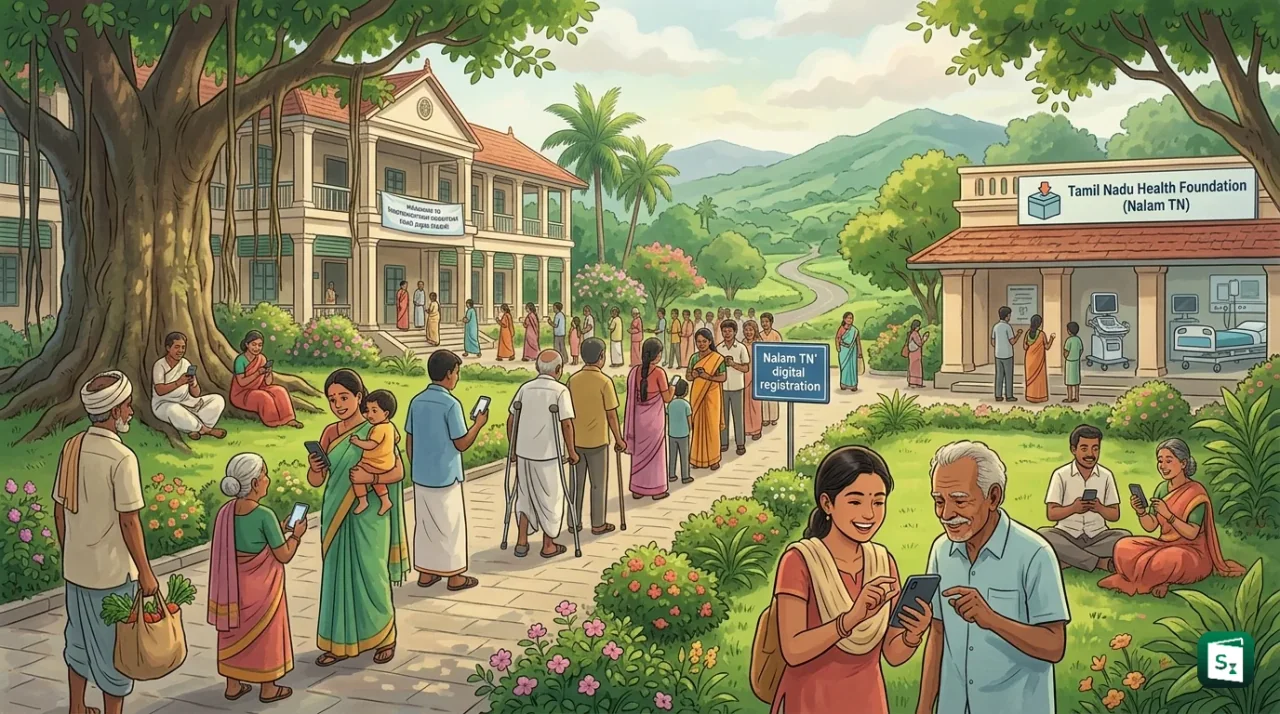
Tamil Nadu Chief Minister C. Joseph Vijay launched the Nalam TN integrated digital platform on July 14, 2026, at Presidency College in Chennai, bringing together two significant healthcare initiatives under a single umbrella. The platform combines an AI-powered WhatsApp chatbot for remote outpatient registration with a transparent digital donation portal aimed at mobilising corporate and individual contributions for government hospitals. The launch was accompanied by the inauguration of medical infrastructure worth ₹139.47 crore and appointment orders for 2,144 healthcare personnel.
Two Key Initiatives Under Nalam TN
The Nalam TN platform addresses two fundamentally different but complementary challenges facing Tamil Nadu’s public healthcare system. One initiative focuses on improving patient experience through technology, while the other seeks to bridge the funding gap in government hospitals through structured philanthropy.
The first initiative, called Nalam AI, is a WhatsApp-based chatbot that allows patients to register for outpatient consultations, book appointments, and receive prescriptions and lab reports through their mobile phones. The second is the Tamil Nadu Health Foundation portal (www.tnhealthfoundation.org), a Section 8 non-profit company under the Companies Act, 2013, that provides a transparent mechanism for corporations and individuals to donate directly to government hospitals. Health Minister K.G. Arunraj announced both components during the launch event.
Nalam AI: WhatsApp-Based OP Registration
Nalam AI is designed to tackle one of the most persistent problems in Tamil Nadu’s busy government hospitals: long queues at outpatient registration counters. Government medical college hospitals in the state see an average of 8,000 to 18,000 outpatients per day, with patients often spending two hours or more waiting just to register. The chatbot allows patients to complete this process from home by sending the word “Hi” to the phone number 9619222999 on WhatsApp.
Key Features of the Chatbot
The service is currently operational on a pilot basis in 22 districts, including Chennai and Chengalpattu, and will be expanded to all 38 districts of the state based on the pilot’s success. Appointment booking has been introduced initially at the Department of Cardiology at Rajiv Gandhi Government General Hospital in Chennai. The chatbot is available in both Tamil and English.
Once a patient books an appointment and arrives at the hospital, geo-fencing technology confirms their presence and automatically generates a consultation token, eliminating the need to stand in line. Patients can also receive digital prescriptions and laboratory reports directly on WhatsApp. Aadhaar is optional, and the system allows family members or friends to book appointments on behalf of a patient using OTP verification. For those without smartphones, the service can be accessed through relatives or nearby e-Seva centres. The existing manual registration system continues to operate alongside the digital platform to ensure no patient is left behind.
Tamil Nadu Health Foundation: A Transparent Donation Platform
The second component of Nalam TN addresses the chronic funding gap in public healthcare infrastructure. The Tamil Nadu Health Foundation was conceptualised through a Government Order issued on August 1, 2025, following an announcement in the state assembly to formally channel corporate social responsibility (CSR) contributions into government hospitals. The foundation was incorporated as a Section 8 company under the Companies Act, 2013, on February 16, 2026, and operates under the Tamil Nadu Health Systems Project (TNHSP).
A Pooled Model for Greater Impact
Unlike conventional donation drives that direct funds to individual hospitals without oversight, the Tamil Nadu Health Foundation introduces a state-level pooled fund that can finance needs across multiple institutions. According to the foundation’s framework, the fund can be deployed for common infrastructure shared across hospitals, statewide disease programmes such as cancer and dialysis care, civil works across multiple institutions, high-cost surgeries for patients requiring specialised treatment, and emergency response during disasters or epidemics.
The foundation’s board of directors is chaired by the Health Secretary, with the Project Director of TNHSP serving as Member Secretary. Other board members include the Mission Director of National Health Mission (NHM) Tamil Nadu, the Managing Director of Tamil Nadu Medical Services Corporation (TNMSC), and directors of medical education, rural health services, and public health.
The portal provides donors with the ability to choose a specific government hospital and purpose for their contribution, whether for medical equipment, infrastructure upgrades, or patient care programmes. The government has stated that the initiative will be 100% transparent, with every rupee tracked and audited.
Immediate Response
The platform received significant contributions on its launch day. Caplin Point Laboratories and Apollo Hospitals each committed ₹1 crore under their CSR programmes, while Titan Engineering and Automation Limited donated ₹60 lakh towards civil works in government hospitals. In a gesture that symbolised the platform’s inclusive vision, S. Sathya, a Chennai resident who had delivered her child at the Government Hospital for Women and Children in Egmore two years earlier, donated ₹1,000. Within three days of the launch, the foundation had received total donations of ₹2.8 crore.
Why Tamil Nadu Needs These Reforms
Tamil Nadu has long been regarded as having one of India’s most robust public health systems. With 36 government medical college hospitals, 37 district headquarters hospitals, 286 other government hospitals, and 2,336 primary health centres, the state’s public health infrastructure serves about 8.09 lakh outpatients and 74,591 inpatients every day. Approximately 63% of the state’s population seeks care from public facilities, one of the highest rates among Indian states.
However, this high demand has put enormous pressure on the system. Between 2021-22 and 2024-25, the average daily outpatient numbers in tertiary public health facilities rose by 49%, while bed capacity grew by 37%. A major tertiary hospital such as Rajiv Gandhi Government General Hospital now sees 17,000 to 18,000 outpatients daily, up from 8,000 to 9,000 a few years ago.
Despite this growth, many government hospitals still rely on fragmented, paper-based processes for outpatient registration. The digital initiative arrives in a state that was an early pioneer of health information systems, having developed comprehensive disease surveillance and maternal health databases over successive decades. Yet the patient’s first point of contact, the registration counter, remained largely untouched by technology. Nalam AI seeks to fill this gap.
The funding challenge is equally urgent. Out-of-pocket spending accounts for 77% of total health expenditure in Tamil Nadu, and government health spending represents only about 1% of the state’s GDP. The Tamil Nadu Health Foundation is designed to supplement the state health budget, the Chief Minister’s Comprehensive Health Insurance Scheme, and the National Health Mission by providing an additional, transparent channel for private philanthropy to strengthen public infrastructure.
Broader Health Infrastructure Push
The Nalam TN launch was part of a wider set of announcements aimed at strengthening Tamil Nadu’s public healthcare system. The Chief Minister inaugurated new hospital buildings and medical equipment worth ₹139.47 crore, covering facilities at Kilpauk Government Medical College Hospital, the Government Headquarters Hospital at Paramakudi, and 78 newly constructed Primary Health Centres and Health Sub-Centres across various districts.
On the human resources front, the government handed over appointment orders to 751 Assistant Medical Officers (Assistant Surgeons) and 1,393 Health Inspectors (Grade II) selected through the Medical Services Recruitment Board (MRB). This recruitment drive is part of the state’s stated goal of achieving zero vacancy in the Health Department, addressing a long-standing gap between patient load and medical workforce strength. Prior to these appointments, Tamil Nadu’s public health system had approximately 22,000 sanctioned doctor posts, with associations estimating that nearly double that number was required to meet demand.
Key Takeaways
- The Nalam TN integrated digital platform was launched on July 14, 2026, by Tamil Nadu CM C. Joseph Vijay at Presidency College, Chennai.
- Nalam AI, a WhatsApp chatbot, allows patients to register for outpatient consultations by sending “Hi” to 9619222999, and is operational on a pilot basis in 22 districts.
- The chatbot uses geo-fencing technology to confirm patient arrival and automatically generate consultation tokens, and is available in Tamil and English.
- The Tamil Nadu Health Foundation, established through a Government Order on August 1, 2025, is a Section 8 company under the Companies Act, 2013, incorporated on February 16, 2026.
- Within three days of launch, the foundation received ₹2.8 crore in donations, including ₹1 crore each from Apollo Hospitals and Caplin Point Laboratories.
- The launch also included the inauguration of healthcare infrastructure worth ₹139.47 crore and appointment orders for 2,144 healthcare personnel recruited through the Medical Services Recruitment Board (MRB).