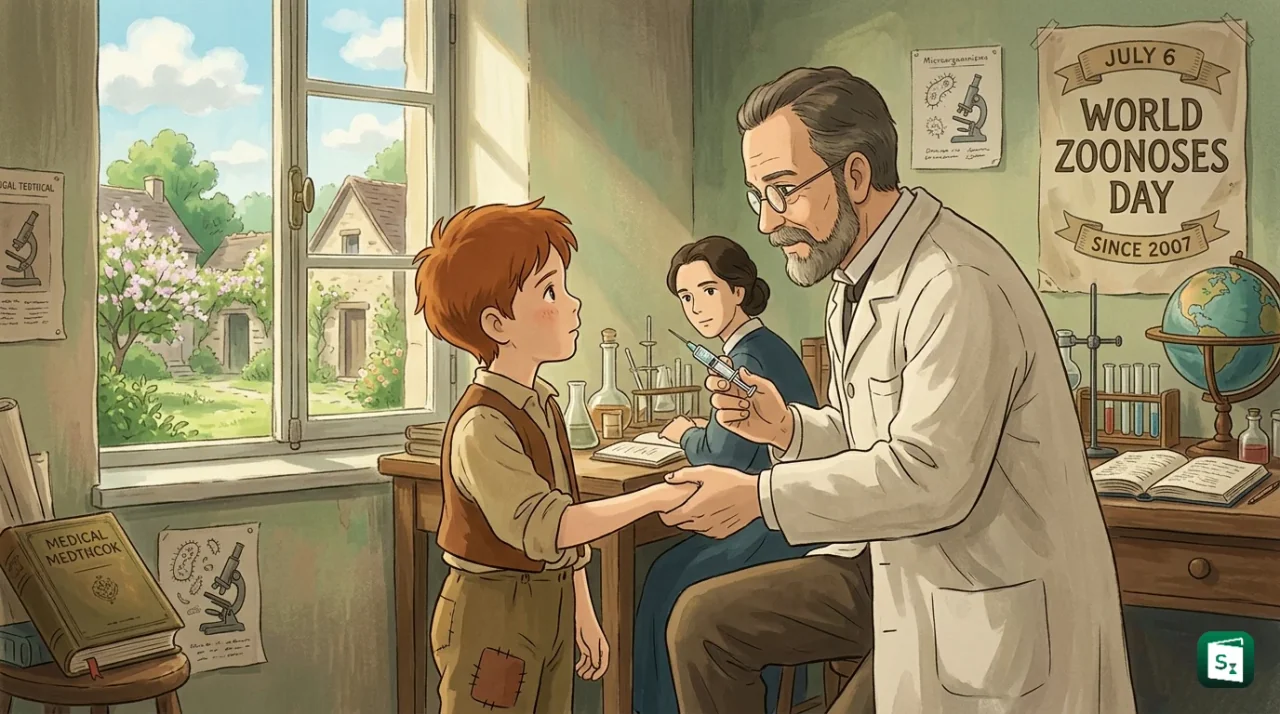
World Zoonoses Day is observed every year on July 6 to raise awareness about diseases that spread between animals and humans. The day marks the anniversary of a landmark event in medical history: on July 6, 1885, French microbiologist Louis Pasteur successfully administered the first rabies vaccine to a human, a nine-year-old boy named Joseph Meister. First observed in 2007, the day now serves as an annual reminder of the growing threat posed by zoonotic diseases and the need for a coordinated global response.
What Is World Zoonoses Day?
World Zoonoses Day was first observed in 2007, on the 122nd anniversary of Pasteur’s breakthrough. The idea was proposed by Professor Bernard Vallat, then director-general of the World Organisation for Animal Health (WOAH), formerly known as the Office International des Epizooties (OIE). The date was deliberately chosen to link a modern public health concern to the moment when vaccination first proved it could stop an animal-to-human disease.
The day aims to educate the public, healthcare workers, veterinarians, policymakers, and farmers about the risks of zoonotic diseases. It promotes responsible animal care, vaccination, food safety, hygiene, and early disease detection. In India, awareness programmes, health camps, and veterinary initiatives are often organised on this day, especially in rural areas where human-animal contact is higher.
The theme for World Zoonoses Day 2026 is “One World, One Health: Prevent Zoonoses”, supported by the guiding principle “Zoonoses Are Rising, Shared Responsibility, Shared Space”. This theme underscores the need to break the cycle of transmission and prevent future pandemics through the One Health approach, which integrates human, animal, and environmental health.
Louis Pasteur and the First Rabies Vaccine
Louis Pasteur (1822-1895) was a French chemist and microbiologist whose discoveries laid the foundation for modern microbiology and immunology. He is best known for developing pasteurisation, disproving the theory of spontaneous generation, and establishing the germ theory of disease. His research led to the creation of vaccines for chicken cholera, anthrax, and most famously, rabies.
By the early 1880s, Pasteur and his assistants, including Emile Roux and Charles Chamberland, had developed a method to weaken the rabies virus by drying spinal cord tissue from infected rabbits. The attenuated virus could then be injected to build immunity. The method had been tested successfully on dogs, but never on a human.
On July 4, 1885, a nine-year-old boy from Alsace, France, named Joseph Meister, was bitten at least 14 times by a rabid dog. His mother brought him to Paris, desperate for help. Pasteur, who was not a medical doctor, consulted physicians Alfred Vulpian and Jacques Grancher. Facing the certainty that the boy would die from rabies, Pasteur agreed to try the experimental vaccine.
On the evening of July 6, 1885, Dr. Grancher administered the first injection. Over the next 10 days, Meister received 13 progressively stronger doses of the vaccine. The boy survived and never developed rabies. This was the first successful human vaccination against rabies and a defining moment in medical history.
Pasteur went on to treat Jean-Baptiste Jupille, a 15-year-old shepherd bitten while protecting other children from a rabid dog, and soon hundreds of people from across the world came to receive the treatment. The success led to the establishment of the Institut Pasteur in Paris, inaugurated in 1888, which remains one of the world’s leading biomedical research centres. Joseph Meister later worked at the institute as a concierge.
Understanding Zoonotic Diseases
Zoonotic diseases, or zoonoses, are infectious diseases that spread naturally between animals and humans. They can be caused by viruses, bacteria, parasites, or fungi. The scale of the problem is enormous: zoonotic diseases account for approximately 60% of all known infectious diseases and up to 75% of emerging infectious diseases in humans. Globally, they contribute to an estimated 2.5 billion infections and 2.7 million deaths every year.
Transmission Pathways
Zoonotic diseases can spread through several routes:
| Route | Description | Examples |
|---|---|---|
| Direct contact | Contact with body fluids or tissues of infected animals | Rabies, Anthrax |
| Vector-borne | Transmitted by insects or ticks | Japanese Encephalitis, Plague, KFD |
| Food-borne | Consuming contaminated meat, milk, or eggs | Brucellosis, Salmonellosis |
| Water-borne | Contaminated water sources | Leptospirosis |
| Air-borne | Inhalation of dust or droplets | Avian Influenza, Q fever |
Classification of Zoonoses
Zoonoses can be classified based on the type of pathogen:
| Type | Examples |
|---|---|
| Viral zoonoses | Rabies, COVID-19, Nipah, Avian Influenza, Japanese Encephalitis |
| Bacterial zoonoses | Anthrax, Brucellosis, Plague, Leptospirosis, Lyme disease |
| Rickettsial zoonoses | Scrub typhus, Q fever, Murine typhus |
| Protozoal zoonoses | Toxoplasmosis, Leishmaniasis |
| Helminthic zoonoses | Echinococcosis (hydatid disease), Taeniasis |
| Fungal zoonoses | Histoplasmosis, Cryptococcosis |
Factors Driving the Rise of Zoonotic Diseases
The frequency of zoonotic disease outbreaks has increased significantly in recent decades. Deforestation and habitat loss bring humans into closer contact with disease-carrying wildlife. Climate change is altering the geographic range of vectors such as mosquitoes and ticks. Intensive farming practices raise the risk of pathogen transmission within livestock populations. Wildlife trade and consumption create direct exposure to novel pathogens. Rapid urbanisation puts dense populations in close contact with animals, while international travel and trade enable diseases to spread across borders at unprecedented speeds.
Zoonotic Diseases in India
India is among the global hotspots for zoonotic diseases due to its rich biodiversity, high population density, extensive livestock population, and close human-animal interface. A study published in 2020 found that 13 zoonotic diseases alone were responsible for approximately 2.4 billion human illness cases and 2.2 million deaths annually in India.
Outbreak Trends
Analysis of data from India’s Integrated Disease Surveillance Programme (IDSP) for the period 2018-2023 reveals significant patterns:
| Metric | Data |
|---|---|
| Total outbreaks reported | 6,948 |
| Zoonotic outbreaks | 583 (8.3% of total) |
| Increase in zoonotic outbreaks (2023 vs 2022) | 58.8% |
| Peak season | June, July, August (monsoon) |
| Most common zoonotic outbreak | Japanese Encephalitis (29.5%) |
| Second most common | Leptospirosis (18.7%) |
| Third most common | Scrub typhus (13.9%) |
Regional Distribution
The burden of zoonotic outbreaks varies significantly across regions. The Northeast region contributed 35.8% of all zoonotic outbreaks, with Assam consistently reporting the highest numbers. The Southern region accounted for 31.7%, with Karnataka and Kerala showing an increasing trend. The Western region contributed 15.4%, and notably, Gujarat reported all Crimean-Congo Haemorrhagic Fever outbreaks in the country. The Eastern and Central regions reported lower numbers, but Japanese Encephalitis remains significant in Jharkhand.
Top Priority Zoonotic Diseases in India
India has identified ten priority zoonotic diseases based on severity, economic burden, pandemic potential, and prevention capacity. These are Zoonotic Influenza, Anthrax, Japanese Encephalitis, Leptospirosis, Brucellosis, Dengue, Rabies, Scrub typhus, Plague, and Crimean-Congo Haemorrhagic Fever (CCHF).
Key Programmes for Zoonotic Disease Control
The government of India has launched several initiatives to tackle zoonotic diseases. The National One Health Programme for Prevention and Control of Zoonoses (NOHP-PCZ) is a central sector scheme under the National Centre for Disease Control (NCDC) in the Ministry of Health and Family Welfare, approved during the 12th Five Year Plan in 2013. It aims to operationalise the One Health approach at national, state, and district levels. The National Rabies Control Programme (NRCP) was initiated in 2008 as a pilot in five cities and later expanded nationwide, focusing on post-exposure prophylaxis and human health components. The Integrated Disease Surveillance Programme (IDSP), launched in 2009, provides a decentralised laboratory-based surveillance system for epidemic-prone diseases. The National Animal Disease Control Programme (NADCP) targets Foot and Mouth Disease and Brucellosis through mass vaccination in livestock.
The One Health Approach
One Health is an integrated, unifying approach that recognises the interconnectedness of human, animal, and environmental health. It is the central framework promoted by World Zoonoses Day and the primary strategy for preventing future pandemics.
The concept is not new. German pathologist Rudolf Virchow first noted the link between human and veterinary medicine in the 19th century and coined the term “zoonosis”. However, the modern One Health framework gained significant traction after the COVID-19 pandemic, which demonstrated how a zoonotic spillover could cripple the global economy and healthcare systems.
Key Pillars of One Health
| Pillar | Focus Area |
|---|---|
| Human health | Disease surveillance, diagnosis, treatment, vaccination |
| Animal health | Veterinary care, livestock vaccination, wildlife monitoring |
| Environmental health | Ecosystem conservation, climate action, habitat protection |
One Health in India
India has adopted the One Health approach through the NOHP-PCZ, which brings together the Ministry of Health and Family Welfare, the Department of Animal Husbandry and Dairying, the Ministry of Environment, Forest and Climate Change, and various research institutions including the Indian Council of Medical Research (ICMR) and the Indian Veterinary Research Institute (IVRI).
The programme has established Regional Coordinators for One Health at selected institutions, including AIIMS, veterinary colleges, and wildlife institutes, to provide technical support. Sentinel Surveillance Sites for Zoonoses (SSSZ) are being set up across the country to assess the disease burden and strengthen diagnostic capacity at the district level.
Key Takeaways
- World Zoonoses Day is observed on July 6 every year, commemorating Louis Pasteur’s first successful rabies vaccine on Joseph Meister in 1885.
- The day was first observed in 2007, on the 122nd anniversary of Pasteur’s breakthrough, following a proposal by Professor Bernard Vallat, former director-general of the World Organisation for Animal Health (WOAH).
- Zoonotic diseases account for approximately 60% of all known infectious diseases and up to 75% of emerging infectious diseases in humans.
- The 2026 theme is “One World, One Health: Prevent Zoonoses” with the guiding principle “Zoonoses Are Rising, Shared Responsibility, Shared Space”.
- Louis Pasteur (1822-1895) was a French chemist and microbiologist who developed pasteurisation, established the germ theory of disease, and created vaccines for anthrax, chicken cholera, and rabies.
- India’s National One Health Programme for Prevention and Control of Zoonoses (NOHP-PCZ) is implemented by the National Centre for Disease Control (NCDC) under the Ministry of Health and Family Welfare.