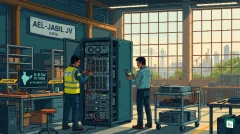
Tata Consultancy Services (TCS) has signed a multi-million, multi-year agreement with ABB, the Swiss-Swedish technology leader in electrification and automation, to transform the company’s global network operations using artificial intelligence. The deal expands a 20-year partnership between the two firms, with TCS moving beyond its earlier role of managing infrastructure and applications to delivering end-to-end network operations through an AI-driven network-as-a-service (NaaS) model. The engagement is built around ABB’s Future Network Model programme, an enterprise-wide initiative to create a standardized, centrally managed digital backbone for operations worldwide.
The Scope of the Partnership
Under the agreement, TCS will serve as the strategic programme partner for ABB’s Future Network Model, taking full responsibility for designing, integrating, and running the company’s global network ecosystem. The deal significantly expands TCS’s role from managing discrete technology layers to overseeing the entire network operating model across ABB’s worldwide operations.
TCS will help ABB improve user experience, enhance operational efficiency, strengthen security and compliance, and scale service delivery across its global footprint. A key feature of the engagement is the use of a network-as-a-service (NaaS) model, where network services are consumed on a subscription basis rather than built and maintained as physical infrastructure. This shifts ABB’s networking costs from capital expenditure (CapEx) to operational expenditure (OpEx).
The partnership also involves orchestrating ABB’s multi-vendor network environment, ensuring seamless and standardized operations across different regions and technology suppliers. TCS will provide end-to-end monitoring and orchestration to deliver high-performance connectivity across all of ABB’s network services worldwide.
ABB’s Future Network Model Programme
The Future Network Model is ABB’s enterprise-wide initiative to replace its existing fragmented network environments with a single, secure, and scalable architecture. The programme uses a centralized control framework that brings together multiple technology components under one operational umbrella.
| Component | Description |
|---|---|
| Service Integration and Management (SIAM) | A single framework to manage multiple technology service providers and vendors |
| Global Network Operations Centre (NOC) | A centralized facility for round-the-clock monitoring and management of network performance |
| Advanced Cybersecurity Capabilities | Integrated security tools to protect ABB’s global infrastructure from threats |
| Modernized LAN, WAN, and SD-WAN | Upgraded local and wide area networks, including software-defined WAN for flexible, cloud-ready connectivity |
The programme is designed to create a service-driven architecture where network services are delivered on demand, with built-in automation and AI. By consolidating disparate systems into a unified digital foundation, ABB expects to achieve greater operational visibility, faster issue resolution, and more consistent performance across its global operations, which span roughly 100 countries and employ about 110,000 people.
A 20-Year Partnership in Review
The current deal is the latest chapter in a relationship that has evolved significantly over two decades. TCS first partnered with ABB on traditional IT services and gradually expanded its role into larger transformation programmes. Previous milestones include consolidating ABB’s multiple enterprise resource planning (ERP) systems onto a single, unified SAP platform, and accelerating the company’s cloud transformation and adoption initiatives.
In November 2025, TCS expanded an earlier partnership with ABB to implement the company’s Future Hosting Model, an AI-powered modular IT infrastructure designed to streamline systems and enable predictive operations through a Zero Ops framework. This earlier engagement focused on modernizing ABB’s global hosting operations and simplifying its IT landscape.
The July 2026 agreement represents a further deepening of ties, with TCS now taking on end-to-end network operations, a domain more closely tied to business continuity than its previous scope of work. The evolution reflects a pattern seen in many of TCS’s large client relationships, where the company starts with discrete projects and gradually becomes the strategic technology partner for the client’s core infrastructure.
TCS and ABB at a Glance
Tata Consultancy Services (TCS) is India’s largest IT services company and a part of the Tata Group, one of India’s oldest and largest business conglomerates. Founded in 1968, TCS is headquartered in Mumbai and has a workforce of over 584,000 employees spread across 55 countries. The company reported consolidated revenues of over $30 billion for the fiscal year ending March 31, 2026. Its annualized AI services revenue crossed $2.3 billion in the fourth quarter of FY26, reflecting the growing role of artificial intelligence in its service offerings.
ABB is a global technology leader in electrification and automation, formed in 1988 through the merger of ASEA of Sweden and Brown, Boveri & Cie of Switzerland. The company is headquartered in Zurich, Switzerland and employs around 110,000 people across roughly 100 countries. ABB operates through four business areas: Electrification, Motion, Process Automation, and Robotics and Discrete Automation. Morten Wierod serves as the company’s Chief Executive Officer, having taken the role in August 2024.
| Aspect | TCS | ABB |
|---|---|---|
| Founded | 1968 | 1988 (merger) |
| Headquarters | Mumbai, India | Zurich, Switzerland |
| Revenue (FY26) | $30 billion | $33.2 billion |
| Employees | 584,000+ | ~110,000 |
| CEO | K Krithivasan (MD & CEO) | Morten Wierod |
| Industry | IT Services, Consulting | Electrification, Automation |
Why This Deal Matters
The agreement between TCS and ABB reflects several broader trends in the global technology landscape. First, large industrial companies are increasingly moving away from fragmented, hardware-centric network setups toward unified, service-based models. The shift to AI-driven NaaS allows enterprises to replace manual network management with automated systems that can detect issues, reroute traffic, and optimize performance in real time.
Second, the deal signals the growing importance of AI in infrastructure management. Rather than using AI only for analytics or application-layer tasks, companies are now embedding AI into the core network operations layer. TCS’s approach, which it calls moving from “infrastructure to intelligence,” aims to create networks that can sense, adapt, and improve continuously without human intervention.
Third, the agreement strengthens TCS’s position in the manufacturing and industrial technology sector, a key growth area for the IT services industry. As factories become more connected and data-intensive, companies like ABB need robust, AI-enabled network backbones to support smart manufacturing, industrial IoT, and real-time data exchange across global sites.
For ABB, the deal provides a path to standardize operations across its vast global footprint while reducing complexity and improving security. The company’s CIO, Alec Joannou, described the Future Network Model as a critical step in reinforcing the digital foundation of ABB’s global operations.
Key Takeaways
- Tata Consultancy Services (TCS) signed a multi-million, multi-year agreement with ABB in July 2026 to transform the latter’s global network operations using artificial intelligence.
- The deal marks the next phase of a 20-year partnership between the two companies, with TCS shifting from infrastructure management to end-to-end global network operations.
- The engagement is built around ABB’s Future Network Model programme, which aims to replace fragmented networks with a standardized, centrally managed digital infrastructure.
- TCS will deliver services through a network-as-a-service (NaaS) model, incorporating AI-driven automation, a global network operations centre, and advanced cybersecurity capabilities.
- TCS was founded in 1968, is headquartered in Mumbai, and reported revenues of $30 billion in FY26, with over 584,000 employees worldwide.
- ABB, formed in 1988 from the merger of ASEA (Sweden) and Brown, Boveri & Cie (Switzerland), is headquartered in Zurich and employs about 110,000 people across roughly 100 countries.