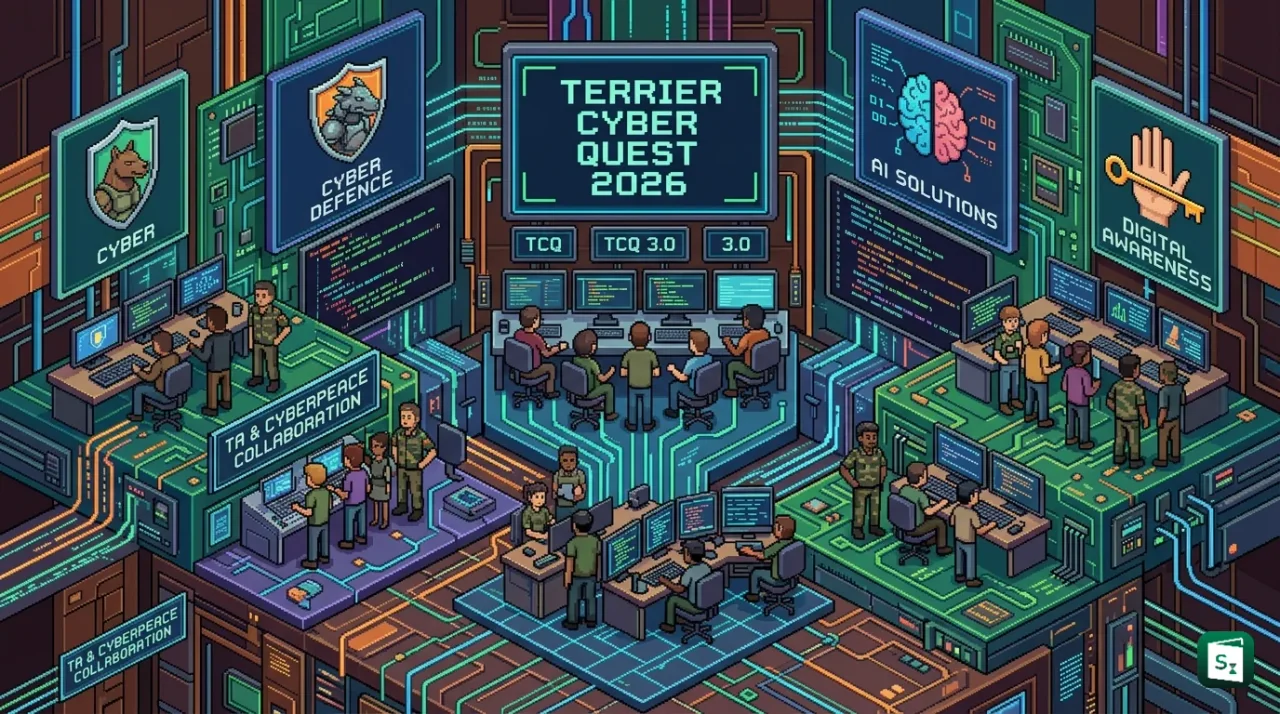
The Territorial Army, in collaboration with the non-profit CyberPeace, has launched the third edition of its national-level hackathon, Terrier Cyber Quest 2026 (TCQ 3.0). The competition seeks innovative, indigenous solutions to challenges in defence, cybersecurity and the information domain, with a focus on Artificial Intelligence (AI), threat mitigation and digital awareness. The hackathon connects the Armed Forces with ethical hackers, software developers, AI researchers and digital content creators from across the country.
What Is Terrier Cyber Quest 2026?
Terrier Cyber Quest is an apex national hackathon and cyber challenge organised by the Territorial Army in partnership with CyberPeace. The name draws from the nickname of the Territorial Army, which is popularly known as the “Terriers”. The quest serves as an open innovation bridge that brings the Armed Forces together with the country’s brightest technical minds to build capabilities that matter for national security.
The event was first held in 2024 (TCQ 1.0) to mark the 75th anniversary (Platinum Jubilee) of the Territorial Army. The second edition, TCQ 2.0, followed in 2025. Building on the experience of these two editions, TCQ 3.0 now focuses squarely on the emerging challenges of artificial intelligence, cyber threats and the manipulation of public opinion through digital media.
The competition follows a structured, multi-phase format. It begins with nationwide open registration, moves through an online shortlisting round, and culminates in a grand finale in New Delhi, where shortlisted teams compete in person. This format allows participation from every corner of the country while keeping the final round rigorous and competitive.
The Three Competition Tracks
TCQ 3.0 is organised across three distinct tracks, each addressing a different facet of cybersecurity and the information domain.
Bug Hunting (Infrastructure Defence)
The Bug Hunting track is a technical, offensive security challenge. Participants first take part in an online Capture-the-Flag (CTF) qualifier, a standard format in which competitors solve a series of cybersecurity puzzles to capture hidden “flags” or codes. The top teams then advance to a 36-hour live in-person sandbox finale in New Delhi, where they must identify and document vulnerabilities in a simulated critical national infrastructure environment.
This track tests the ability of participants to detect and assess weaknesses in systems that resemble power grids, banking networks, transport systems and other vital services. The findings help the defence establishment understand how such infrastructure could be attacked and, equally important, how to harden it.
AI Kavach (Machine Learning Security)
The AI Kavach track focuses on artificial intelligence and machine learning. Participants are invited to build AI-driven cybersecurity solutions capable of detecting, analysing and mitigating security threats. This includes developing architectures for predictive cyber threat intelligence, real-time anomaly detection and automated, autonomous defence responses.
The word “kavach” means shield in Hindi, and the track lives up to that name. Shortlisted teams are expected to develop working prototypes during the finale, moving from a five-slide concept presentation at registration to a functional demonstration on the ground.
Creators Challenge (Cognitive Domain Defence)
The Creators Challenge is a digital storytelling and media track aimed at creators, designers, communicators and influencers. Participants must produce original short videos, reels or carousels that raise public awareness about deepfakes, phishing scams, online fraud and state-backed disinformation.
This track recognises that modern warfare is no longer fought only with weapons. The information domain, the space in which public opinion is shaped, is now a battlefield. Creative counter-narratives that teach citizens to recognise manipulated content are seen as a vital line of defence.
Eligibility, Registration and Key Dates
The competition is open to a broad cross-section of participants, including students, cybersecurity professionals, AI researchers, ethical hackers, software developers, content creators, startups and technology enthusiasts. Armed forces personnel can also take part in the Bug Hunting track. Team sizes range from up to three members for the technical tracks to up to four members for the Creators Challenge.
Registration is conducted through the official portal, where participants select their preferred track, create a profile and submit the required details. AI Kavach applicants must upload a five-slide presentation of their proposed solution, while Creators Challenge participants submit their original awareness content.
| Event | Date |
|---|---|
| Registration opened | 30 July 2026 |
| Last date to register | 31 August 2026 |
| Online shortlisting round | 1 to 10 September 2026 |
| Grand Finale, New Delhi | 6 to 8 October 2026 |
| Award ceremony | 9 October 2026 |
Finalists receive certificates and medallions from the Territorial Army, cash prizes and national-level recognition. Winners also get the opportunity to interact with senior government and defence officials, visit defence establishments and contribute to future cybersecurity initiatives of the Territorial Army.
The Territorial Army: India’s Citizens’ Army
The Territorial Army (TA) is a military reserve force of part-time volunteers who serve alongside the regular Indian Army. It is constituted under the Territorial Army Act, 1948 and was formally inaugurated on 9 October 1949 by C. Rajagopalachari, the first Governor-General of independent India. Every year, 9 October is observed as Territorial Army Day.
Its personnel hold ranks identical to those in the regular army but continue to pursue civilian occupations, such as doctors, engineers, lawyers, farmers and corporate employees. The primary role of the TA is to relieve the regular army from static duties, assist civil administration during natural calamities and provide units for the regular army when required. Members are expected to undergo a minimum period of paid service each year, making it a part-time commitment.
The force has a nickname of its own, the “Terriers”, and its motto is Savdhani Va Shoorta (Vigilance and Valour). With more than 43,000 first-line troops and 160,000 second-line troops, the TA is one of the largest reserve forces in the world. It has participated in every war India has fought since independence, including the Sino-Indian War (1962), the Indo-Pakistani Wars (1965 and 1971) and the Kargil War (1999). TA units have also contributed to counter-insurgency operations and disaster relief efforts, including the Uttarkashi and Latur earthquakes.
In recent years, the role of the TA has expanded beyond conventional warfare. It now includes ecological battalions for environmental restoration and specialised units for infrastructure protection. The cyber domain represents the newest frontier of this expansion, and Terrier Cyber Quest is the platform through which the TA draws on the skills of civilian technology experts.
CyberPeace: The Civilian Partner
CyberPeace (CyberPeace Foundation) is a non-profit organisation working on cybersecurity and digital safety. It was founded in 2005 by Vineet Kumar, a former Chief Technical Officer of the Jharkhand Police, and is registered as a society under the Societies Registration Act, 1860. The organisation is headquartered in New Delhi and works with governments, educational institutions and international bodies, including the United Nations.
The foundation’s mission is to build collective resilience against cybercrime and the growing threat of cyber warfare. Over the years, it has launched several notable initiatives, including the e-Raksha Research Centre, set up with Gujarat Technological University to fight cybercrime, and the e-Raksha Competition, a digital citizenship and online safety programme run with NCERT and UNESCO. It has also partnered with the National Commission for Women on campaigns for the online safety of young women and worked with law enforcement agencies on cybercrime investigation training.
CyberPeace has been a partner of the Territorial Army for all three editions of Terrier Cyber Quest. The organisation provides the technological expertise, industry network and citizen outreach that allow the hackathon to reach talent well beyond the defence establishment.
Why This Initiative Matters for National Security
India’s digital footprint has grown enormously. Internet connections in the country crossed the 100 crore mark by 2025, and the Unified Payments Interface (UPI) processed over 21 billion transactions in December 2025 alone. This digital expansion has made India’s cyberspace one of the most targeted in the world, with rising incidents of ransomware, phishing, data breaches and AI-powered attacks. In 2025, the Indian Computer Emergency Response Team (CERT-In) handled more than 29.44 lakh cyber incidents.
Against this backdrop, the hackathon serves several strategic purposes. First, it promotes indigenous cybersecurity solutions, reducing dependence on foreign technology to protect critical networks. The principle of self-reliance, long a pillar of defence policy, now extends to the digital realm.
Second, the initiative builds resilience against AI-driven cyberattacks and digital disinformation. Adversaries increasingly operate in the grey zone, the space below the threshold of open war, using cyber operations, deepfakes and fake news to weaken a nation without firing a shot. The AI Kavach and Creators Challenge tracks are designed to counter exactly these threats.
Third, the hackathon creates a civil-military technical synergy. By opening a window into the Armed Forces for ethical hackers, researchers and creators, it builds a talent pipeline that the defence establishment can draw upon in times of crisis. This approach, which the TA itself describes as part of its Citizens’ Army mandate, treats every skilled citizen as a potential defender of national security.
The Way Forward
Terrier Cyber Quest 2026 comes at a time when India is strengthening its entire cybersecurity architecture. The Defence Cyber Agency (DCyA), an integrated tri-services agency established by the Ministry of Defence in 2019 and operational since 2021, coordinates the cyber operations of the Armed Forces. The National Cyber Security Policy, 2013, and the designation of CERT-In as the national nodal agency for cyber incident response have laid the institutional foundation. The upcoming National Cyber Security Strategy is expected to provide a comprehensive national framework.
Hackathons like TCQ 3.0 complement these institutional efforts by working at the grassroots level. They identify hidden talent, test innovative ideas and create awareness among the public. The solutions generated in the technical tracks could potentially be adopted by the Armed Forces, while the awareness campaigns produced by the Creators Challenge help build a digitally literate and vigilant citizenry.
The success of the hackathon will depend on wide participation and on the quality of the solutions it produces. As cyber threats grow more sophisticated, initiatives that combine national security with open innovation will only become more important. Terrier Cyber Quest represents a model in which the nation’s defence draws directly on the ideas and energy of its people.
Key Takeaways
- Terrier Cyber Quest 2026 (TCQ 3.0) is the third edition of a national hackathon launched by the Territorial Army in collaboration with CyberPeace.
- The hackathon is organised across three tracks: Bug Hunting, AI Kavach and the Creators Challenge.
- The Bug Hunting track features an online Capture-the-Flag (CTF) qualifier followed by a 36-hour live finale in New Delhi.
- Registrations remain open until 31 August 2026, with the Grand Finale scheduled in New Delhi from 6 to 8 October 2026.
- The Territorial Army, established under the Territorial Army Act, 1948, was inaugurated on 9 October 1949 and is known as India’s “Citizens’ Army”.
- CyberPeace, the partner organisation, is a non-profit founded in 2005 by Vineet Kumar, headquartered in New Delhi.