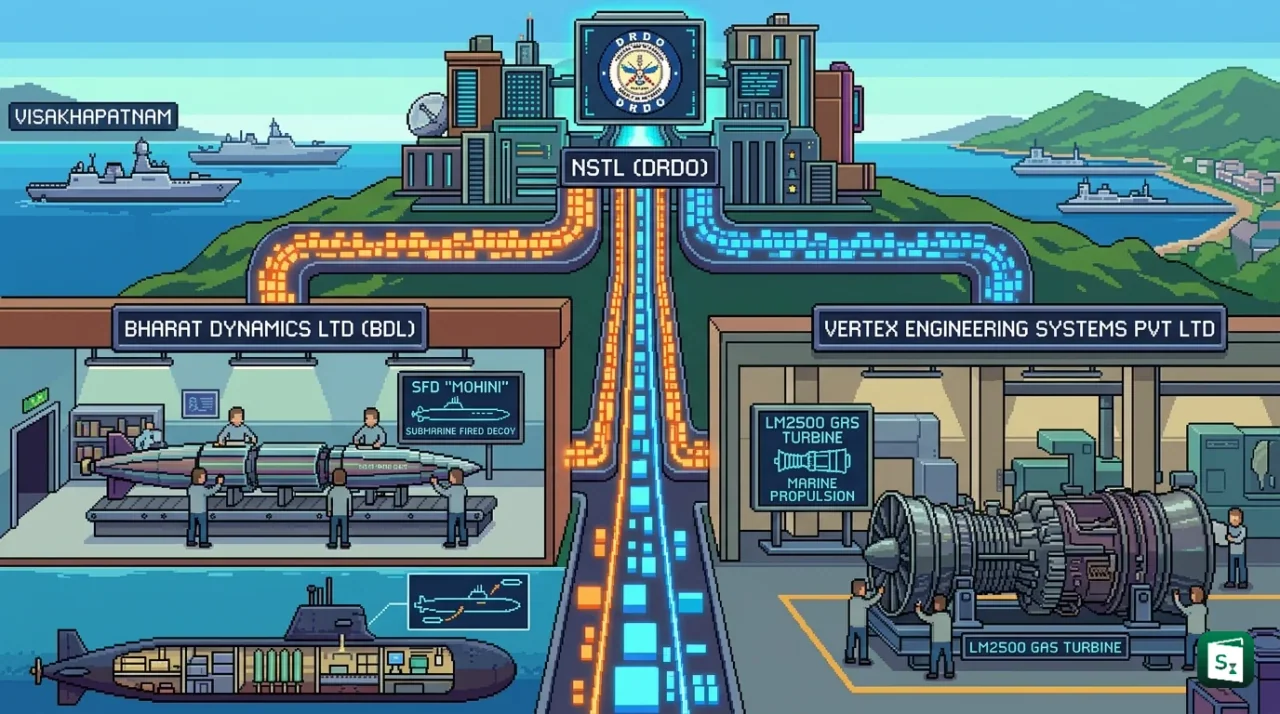
The Naval Science & Technological Laboratory (NSTL), a laboratory of the Defence Research and Development Organisation (DRDO) in Visakhapatnam, signed two Licensing Agreements for Transfer of Technology (LAToT) in August 2026. Under the first agreement, the technology of the Submarine Fired Decoy (SFD) ‘Mohini’ will be produced by Bharat Dynamics Ltd (BDL), while the second covers the fabrication, installation, and commissioning of the LM2500 Gas Turbine by the Hyderabad-based Vertex Engineering Systems Pvt Ltd. Together, the agreements mark another step in India’s push to build critical naval systems inside the country.
What is Technology Transfer and the LAToT Mechanism?
Technology transfer is the process of handing over the knowledge, designs, manufacturing processes, and technical know-how of a developed product or system to another party so that it can be produced commercially. In the defence sector, it is the bridge between a research laboratory that invents a system and an industry that manufactures it at scale.
The Licensing Agreement for Transfer of Technology (LAToT) is the formal legal contract through which the DRDO transfers its developed technologies to Indian industries. The agreement spells out the terms of use, royalty arrangements, quality standards, and production responsibilities. Through such agreements, DRDO laboratories hand over technologies for manufacturing, fabrication, installation, and commissioning to public and private companies.
This mechanism is central to the Aatmanirbhar Bharat vision in defence. Instead of importing weapons and equipment, India’s research laboratories develop the technology, and Indian companies produce it, creating a self-reliant defence industrial base.
About NSTL: DRDO’s Underwater Weapons Lab
The Naval Science & Technological Laboratory (NSTL), established on 20 August 1969, is a premier DRDO laboratory located in Visakhapatnam, Andhra Pradesh. Its core mandate is the research and development of underwater weapons and associated systems for the Indian Navy.
NSTL works on torpedoes, naval mines, decoys, targets, simulators, fire control systems, and weapon launchers. The laboratory also studies the hydrodynamic parameters and structural design of surface and submerged naval platforms. Among its well-known products are the Varunastra heavy-weight anti-submarine torpedo, the MIGM multi-influence ground mine, and the HEAUV high-endurance autonomous underwater vehicle.
The agreements were signed in the presence of Vice Admiral Sanjay Bhalla, Flag Officer Commanding-in-Chief of the Eastern Naval Command, Dr R. Balamuralikrishnan, Director General (Naval and Strategic Systems), DRDO, and Dr Abraham Varughese, Director of NSTL.
The Submarine Fired Decoy ‘Mohini’ and Bharat Dynamics Ltd
A decoy is a device used to mislead an enemy system into attacking it instead of the real target. A submarine decoy is a countermeasure launched by a submarine to protect itself from incoming torpedoes. The Submarine Fired Decoy (SFD) ‘Mohini’ is an underwater countermeasure system launched from a submarine’s decoy launch tubes or torpedo tubes.
When a submarine senses an approaching threat, it deploys Mohini to create a false cover. The decoy emits sound signals that mimic the acoustic signature, propeller noise, and sonar echoes of a real submarine. This deceives both passive-homing and active-homing torpedoes into targeting the decoy instead of the actual vessel. Mohini also generates high-intensity broadband acoustic noise that blinds the sonar receiver of an incoming torpedo or an enemy surface ship, masking the host submarine’s movement. After the torpedo is engaged, the submarine executes evasive manoeuvres and clears the area safely.
The technology was developed by NSTL over about three years, starting in 2019. The production partner for Mohini is Bharat Dynamics Ltd (BDL), a defence public sector undertaking (DPSU) under the Ministry of Defence. BDL was incorporated on 16 July 1970 and is headquartered in Hyderabad. It is a premier weapon system integrator and prime production agency for guided missiles and heavy strategic military hardware, and has earlier partnered with NSTL on products such as the MIGM naval mine.
The LM2500 Gas Turbine and Vertex Engineering Systems
A gas turbine is an engine that burns fuel to spin a turbine and produce power. The LM2500 is a marine gas turbine derived from the TF39/CF6 aircraft engine, originally developed by General Electric in the United States. It is one of the world’s most widely used marine gas turbines, installed in frigates, destroyers, cruisers, and aircraft carriers of many navies, often in combined gas/diesel or combined gas/gas propulsion configurations.
The LM2500 delivers about 33,600 shaft horsepower in its base version, with more than 2,500 units in service globally. In India, LM2500 engines power several naval platforms, including INS Vikrant, the country’s first indigenous aircraft carrier, and the Shivalik and Nilgiri class frigates, which use combined diesel and gas (CODAG) and combined diesel or gas (CODOG) propulsion. Hindustan Aeronautics Limited has been the long-time licensed assembler of these engines in India.
Under the second LAToT, the technology for the fabrication, installation, and commissioning of the LM2500 Gas Turbine was transferred to Vertex Engineering Systems Pvt Ltd, based in Hyderabad. The company manufactures high-pressure components from specialised metals such as titanium, nickel-aluminium-bronze, and speciality stainless steels for warship, aircraft carrier, and missile applications. The transfer covers precision manufacturing of base frames, piping systems, and acoustic enclosures, along with system integration of gas generator modules, fuel systems, and lubrication systems, and the installation, testing, and commissioning procedures. This builds domestic capability for repair and overhaul, reducing turnaround times and dependence on foreign original equipment manufacturers for support.
Why These Agreements Matter
The two agreements bridge the gap between laboratory development and industrial production. When DRDO develops a system in its lab, the technology needs a manufacturer to turn it into usable military equipment for the armed forces. The LAToT route hands this production responsibility to Indian industry, keeping both the design and the manufacturing inside the country.
For the Indian Navy, the deals mean quicker availability of critical countermeasure and propulsion technologies. The SFD Mohini strengthens submarine survivability in anti-submarine warfare, while indigenous LM2500 fabrication and support keeps warships operational for longer periods with shorter maintenance turnaround times. This improves fleet readiness without waiting on overseas suppliers.
For Indian industry, the agreements open new business lines. BDL adds an underwater countermeasure system to its missile portfolio, and Vertex Engineering, a private company, gains entry into the naval propulsion value chain, which has traditionally been dominated by foreign original equipment manufacturers and large public sector firms. The private sector currently contributes about 24% of India’s total defence production, and such transfers expand its role further.
The Bigger Push for Self-Reliance in Defence
These agreements are part of a wider effort to make India self-reliant in defence. India’s annual defence production reached a record ₹1.78 lakh crore in FY 2025-26, a 15.6% increase over the previous year, while defence exports touched a record ₹38,424 crore. DRDO has been progressively opening its technologies to industry through its Transfer of Technology (ToT) Policy, most recently updated in 2025, and the Industry Partner Registration portal that lets companies register with DRDO laboratories for collaboration.
The Ministry of Defence has also been driving indigenisation through the Positive Indigenisation Lists, under which over 5,000 items that were earlier imported are now to be made locally, and the SRIJAN portal, which has offered more than 33,000 items to domestic industry for indigenisation. The LAToT agreements by NSTL fit directly into this framework, converting laboratory research into production lines for the armed forces.
Key Takeaways
- The Naval Science & Technological Laboratory (NSTL), established on 20 August 1969 in Visakhapatnam, is the DRDO laboratory that develops underwater weapons such as torpedoes, mines, and decoys.
- The Licensing Agreement for Transfer of Technology (LAToT) is the formal contract through which DRDO hands over its developed technologies to Indian industry for manufacturing.
- The Submarine Fired Decoy (SFD) ‘Mohini’, developed over about three years from 2019, will be produced by Bharat Dynamics Ltd (BDL), a defence public sector undertaking incorporated on 16 July 1970 and headquartered in Hyderabad.
- The LM2500 Gas Turbine, a marine gas turbine derived from an aircraft engine, powers naval warships including INS Vikrant and the Shivalik and Nilgiri class frigates.
- The fabrication, installation, and commissioning technology of the LM2500 was transferred to Vertex Engineering Systems Pvt Ltd of Hyderabad.
- India’s defence production touched a record ₹1.78 lakh crore in FY 2025-26, with defence exports reaching ₹38,424 crore.