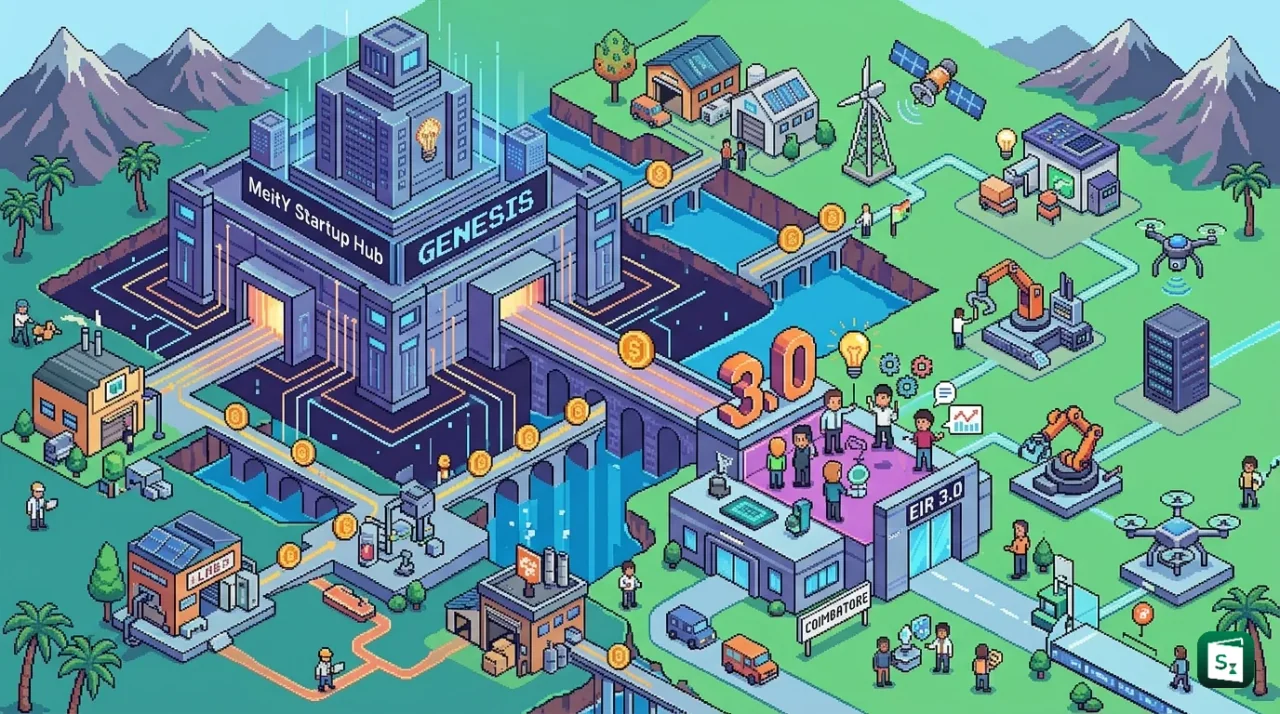
The Ministry of Electronics and Information Technology (MeitY), through the MeitY Startup Hub (MSH), has launched the third cohort of its Gen-Next Support for Innovative Startups (GENESIS) Entrepreneur-in-Residence (EIR) programme. The launch took place on 4 August 2026 at the GENESIS NextGen Startup Summit (Coimbatore Edition) held at Rathinam Global University in Coimbatore, Tamil Nadu. Under the programme, selected innovators will receive financial assistance of up to ₹10 lakh through participating GENESIS incubators, along with incubation and mentorship support.
What Is the GENESIS EIR Programme?
The GENESIS Entrepreneur-in-Residence (EIR) programme is the ideation-stage component of the broader GENESIS (Gen-Next Support for Innovative Startups) scheme. It is designed to help students, researchers, innovators, and early-stage founders convert a raw business idea into a pilot-ready solution through a mix of funding, incubation, and mentorship.
The term EIR stands for Entrepreneur-in-Residence. In this model, a promising entrepreneur is placed inside an incubator or accelerator for a fixed tenure, much like a scholar-in-residence at a university. The entrepreneur gets a working space, expert guidance, and financial support to build and test the idea full time, instead of struggling alone without resources.
What Is an Entrepreneur-in-Residence?
An Entrepreneur-in-Residence is essentially an experienced or promising founder who works within a startup support organisation to develop a venture. Under the GENESIS EIR component, each selected innovator receives a subsistence grant of up to ₹10 lakh to pursue a technology business idea. The grant is released in two tranches of 50 percent each, with the second tranche tied to the achievement of agreed milestones.
The programme focuses on technology-led ideas in Electronics, Information Technology (IT), Information and Communication Technology (ICT), and DeepTech. Selected innovators are physically incubated at one of the empanelled GENESIS incubators for the duration of the tenure, which gives them access to makerspaces, anchor mentors, co-working space, and networking events with investors and industry experts.
GENESIS EIR 3.0: What Was Announced
The GENESIS EIR 3.0 was launched by Dr. Panneerselvam Madanagopal, Chief Executive Officer of the MeitY Startup Hub, at the GENESIS NextGen Startup Summit (Coimbatore Edition). The event was held in the presence of Thiru. Pavankumar G. Giriyappanavar, IAS, District Collector of Coimbatore, and Dr. Madan A. Senthil, Chancellor of Rathinam Global University.
The summit was organised as a collaborative platform to inspire, connect, and empower aspiring entrepreneurs, startups, innovators, researchers, students, academia, industry leaders, and ecosystem partners. It focused on promoting innovation-led entrepreneurship through knowledge sharing, mentorship, networking, and ecosystem collaboration.
Who Can Apply?
The eligibility criteria for GENESIS EIR 3.0 are structured around the applicant, the innovation, and prior funding. Applicants must be Indian citizens. They may be entrepreneurs, innovators, researchers, students, or founders and co-founders of early-stage startups. The innovation must be in emerging technologies within the Electronics and IT domain, DeepTech, Artificial Intelligence and Machine Learning (AI/ML), Internet of Things (IoT), Semiconductor/VLSI, Cybersecurity, Blockchain, Quantum Technologies, or AR/VR, Spatial and Immersive Technologies. It should be at Technology Readiness Level (TRL) 1 to 4, which covers ideation, proof of concept, prototype, minimum viable product (MVP), or early validation. The startup must be based in a Tier-II or Tier-III city. If incorporated, the startup must be less than two years old as on the date of application. The idea or startup must not have received financial assistance exceeding ₹10 lakh under any Central or State government scheme.
The Technology Readiness Level (TRL) is a standard scale used to measure how ready a technology is for real-world use. TRL 1 means only the basic idea has been researched, while TRL 4 means a working prototype has been validated in a laboratory environment.
What Do Selected Innovators Receive?
Selected innovators get financial assistance of up to ₹10 lakh through participating GENESIS incubators. Beyond the grant, each EIR receives one-on-one mentorship and expert guidance, product development and MVP support, incubation and business growth support, and help with prototyping, technology development, and validation. They also get industry and startup ecosystem connections, and guidance towards commercialisation and startup development.
Application Process and Timeline
The application window for GENESIS EIR Cohort-3 opened on 4 August 2026 and closes on 3 September 2026. Applications are submitted online on the MeitY Startup Hub portal, where applicants select up to two preferred incubators from the list of MSH-empanelled GENESIS incubators.
Applications go through screening and shortlisting, followed by evaluation committee pitches and scoring. The MeitY Startup Hub then reviews and approves the final list, after which selected EIRs are onboarded, given sanction letters, and receive the first tranche of funding. Screening typically runs through September 2026, with results expected around mid-October 2026.
The Broader GENESIS Scheme
The GENESIS (Gen-Next Support for Innovative Startups) scheme is a flagship initiative of the MeitY Startup Hub. It was approved in July 2023 with a total budget outlay of ₹490 crore for a duration of five years. The scheme aims to support around 1,600 technology startups over this period and consolidate the startup-related schemes and assets of MeitY for greater efficiency.
The core objective of GENESIS is to boost the startup ecosystem in Tier-II and Tier-III cities across India. It seeks to discover, grow, and nurture technology startups by providing Tier-II and Tier-III city-focused funding for pilot, investment, early-stage, and deep-tech startups, while also strengthening incubators through capacity-building initiatives.
Four Components of GENESIS
The GENESIS scheme operates through four distinct funding components that support startups at different stages of their journey:
| Component | Purpose | Nature of Support |
|---|---|---|
| Entrepreneur-in-Residence (EIR) | Helps students and entrepreneurs validate startup ideas | Funding of up to ₹10 lakh per startup for ideation and prototype stage |
| Pilot Funding | Helps startups with a validated idea run a pilot of their product | Funding of up to ₹40 lakh to demonstrate market-ready solutions |
| Investment Support | Supports startups raising funds from the market | Brings domestic rupee capital into Tier-II and Tier-III cities |
| DeepTech Funding | Supports startups developing high-impact deep-tech solutions | Select funding for high-impact technology ventures |
The EIR component sits at the very first stage of this support chain. It bridges the gap between an idea and a viable startup, after which a venture can move on to pilot funding and later to investment and scale-up support.
MeitY Startup Hub: The National Enabler
The MeitY Startup Hub (MSH) is the implementing agency for the GENESIS scheme. It was established in 2016 as a unified national platform under the Ministry of Electronics and Information Technology (MeitY) to integrate the ministry’s startup, incubation, and innovation initiatives.
MSH acts as a national coordination, facilitation, and monitoring centre. It connects startups, incubators, accelerators, industry, investors, mentors, academia, and government stakeholders, and supports the innovation journey from ideation and validation to commercialisation and scale. The hub is registered as an Independent Business Division of the Digital India Corporation, the implementing agency of MeitY’s digital initiatives.
MSH oversees a network of incubation centres and Centres of Excellence (CoEs) across the country. Through GENESIS, it channels funding to empanelled incubators in Tier-II and Tier-III cities, which then implement the programme on the ground and provide physical incubation to selected EIRs.
Why the Focus on Tier-II and Tier-III Cities?
India’s startup ecosystem has historically been concentrated in metropolitan hubs such as Bengaluru, Mumbai, Delhi-NCR, and Hyderabad. Data from the Department for Promotion of Industry and Internal Trade (DPIIT) shows that the country has crossed 2.23 lakh recognised startups, but a large share of them remain clustered in big cities.
The GENESIS scheme directly addresses this regional imbalance. By targeting Tier-II and Tier-III cities, it aims to unlock the entrepreneurial potential of emerging regions and connect them more deeply with India’s growing innovation ecosystem. Coimbatore itself is a rapidly emerging manufacturing and engineering hub in Tamil Nadu, and hosting the GENESIS NextGen Startup Summit there signals a deliberate push to extend startup support beyond the metros.
This focus also aligns with the broader startup policy direction of the government. The Startup India Seed Fund Scheme (SISFS), launched in April 2021 by the DPIIT with an outlay of ₹945 crore, provides seed funding to early-stage startups recognised under the Startup India initiative. While SISFS is implemented through incubators registered with the Startup India portal, GENESIS is implemented specifically through MeitY’s empanelled GENESIS incubators and concentrates on electronics, IT, and deep-tech innovation.
Another related policy is the Draft National Deep Tech Startup Policy, released for public consultation in July 2023 by the Office of the Principal Scientific Adviser, which seeks to build a dedicated framework for deep-tech research and startups in India. Together, these initiatives reflect a coordinated effort to take innovation-led entrepreneurship beyond the metros.
The Way Forward
The third cohort of GENESIS EIR builds on the experience of earlier cohorts and expands the reach of the programme to a wider pool of innovators. By combining financial assistance with physical incubation and mentorship, the programme aims to convert early-stage ideas into validated prototypes that can attract pilot funding, investment, and eventual scale.
For the startup ecosystem, the bigger test will be whether EIR graduates from Tier-II and Tier-III cities are able to move smoothly through the subsequent components of the GENESIS scheme, from pilot funding to investment support. If the pipeline works as designed, GENESIS could become a reliable channel for channeling domestic capital into emerging regional innovation hubs, and a template for decentralised startup support in the country.
Key Takeaways
- The GENESIS EIR 3.0 programme was launched on 4 August 2026 at the GENESIS NextGen Startup Summit (Coimbatore Edition) held at Rathinam Global University, Coimbatore.
- The GENESIS EIR programme is implemented by the MeitY Startup Hub (MSH), which was established in 2016 under the Ministry of Electronics and Information Technology (MeitY).
- Selected EIRs receive financial assistance of up to ₹10 lakh through participating GENESIS incubators, released in two tranches of 50 percent each.
- The GENESIS scheme, approved in July 2023, has a total budget outlay of ₹490 crore over five years and targets around 1,600 technology startups in Tier-II and Tier-III cities.
- The four components of the GENESIS scheme are Entrepreneur-in-Residence (EIR) Support, Pilot Funding, Investment Support, and DeepTech Funding.
- Applications for GENESIS EIR Cohort-3 closed on 3 September 2026, and applicants must be Indian citizens with innovations at Technology Readiness Level (TRL) 1 to 4.