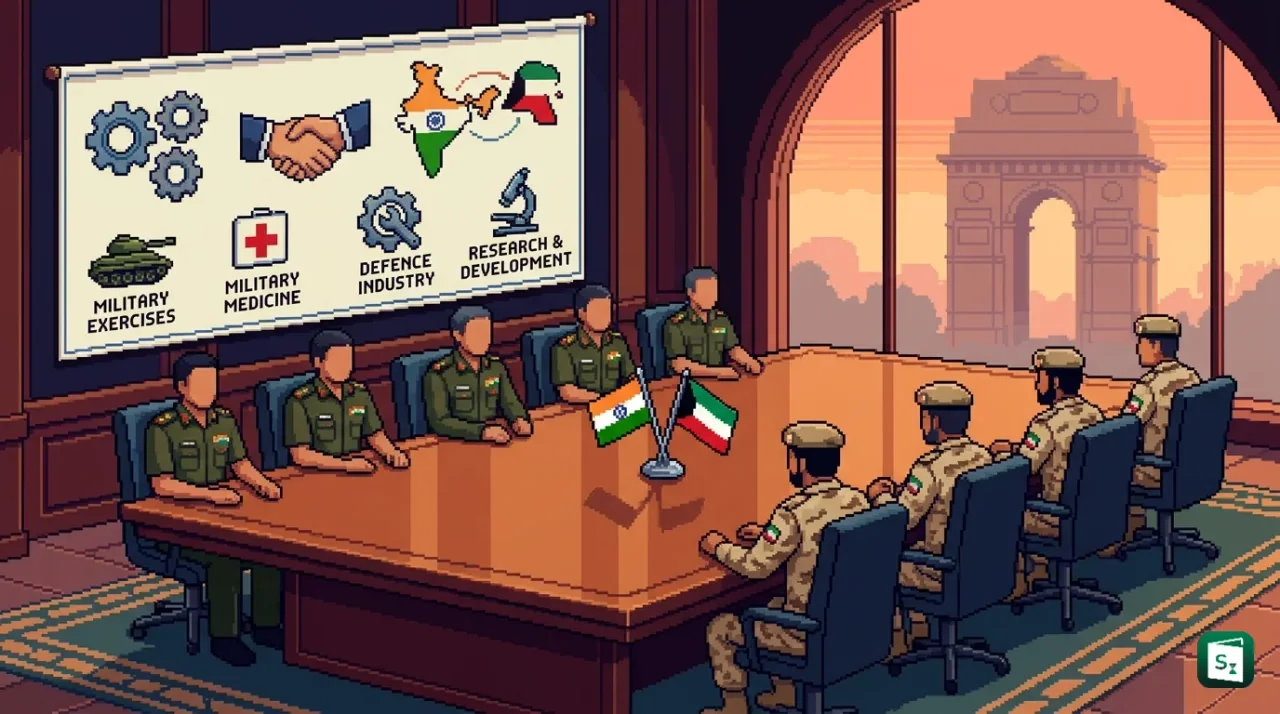
India and Kuwait held the inaugural meeting of their Joint Defence Committee (JDC) in New Delhi on 28 August 2026. At the meeting, the two countries agreed to deepen bilateral defence cooperation across areas such as training, military exercises, military medicine, staff talks, defence industry, and Research and Development (R&D). The meeting is a concrete step towards implementing the defence MoU the two sides signed in December 2024, when their ties were elevated to a Strategic Partnership.
What is the Joint Defence Committee (JDC)?
A Joint Defence Committee (JDC) is an official, institutional forum created by two countries to plan and supervise their military cooperation on a regular basis. Its full form is Joint Defence Committee. Such committees act as the working engine of a bilateral defence relationship, deciding where to train soldiers, which exercises to run together, how to share expertise, and how to promote cooperation between their defence industries.
The JDC works under the umbrella of a broader agreement, usually a Memorandum of Understanding (MoU) on defence cooperation. Both sides nominate their representatives, and the committee meets periodically, either in rotation between the two capitals or wherever the parties agree. Its decisions are taken back to the respective defence ministries for final approval. In the India-Kuwait case, the committee is co-chaired from the Indian side by a senior official of the Ministry of Defence and from the Kuwaiti side by a senior officer of the Kuwaiti armed forces.
How the JDC Mechanism Works
India uses this exact pattern across the Gulf and beyond. The committee format creates a fixed calendar of dialogue, so that military cooperation does not depend only on occasional high-level visits. It also allows the two sides to track whether earlier decisions have actually been implemented and to add new areas of cooperation over time.
The structure mirrors India’s other defence engagement mechanisms. For instance, India and Saudi Arabia run a Joint Committee on Defence Cooperation (JCDC) under their defence MoU, and India has similar institutional dialogues with countries such as the UAE. Each of these committees has its own scope, but the logic is the same: a standing body that meets at regular intervals keeps the relationship moving steadily forward.
What Happened at the Inaugural Meeting
The first meeting of the India-Kuwait JDC was co-chaired by Amitabh Prasad, Joint Secretary in the Ministry of Defence, and Brigadier General Raed Alsakran, who led the five-member Kuwaiti delegation. The Indian delegation brought together the three armed services, the Department of Defence Production (DDP), the Defence Research and Development Organisation (DRDO), the Armed Forces Medical Services, and the Ministry of External Affairs (MEA).
The discussions covered the full spread of defence cooperation that the December 2024 MoU envisages. Both sides reviewed progress and agreed to push forward in six broad areas: training of military personnel, joint military exercises, military medicine, staff talks, cooperation in the defence industry, and joint work in research and development. The Indian side described the meeting as an important step towards operationalising the objectives of the defence MoU.
Delegations and Co-Chairs
Staff talks deserve special attention because they are the professional, working-level conversations between the armies, navies, and air forces of the two countries. Regular staff talks allow the forces to plan joint exercises, exchange best practices, and build the trust that makes larger cooperation possible. Military medicine, meanwhile, covers shared work in medical training, health research, and the exchange of doctors and military medical personnel, a field where India’s hospitals and medical schools already have deep links with Kuwait.
The presence of the Department of Defence Production and DRDO in the Indian team shows where the relationship is heading. The focus is no longer limited to training and goodwill visits. Both sides are now talking about the defence industry, which means procurement of defence equipment, possible joint production, and technology collaboration.
Beyond the Meeting Room
The Kuwaiti visit was not confined to the meeting table. Before the JDC sat down, Brigadier General Alsakran laid a wreath at the National War Memorial in New Delhi to honour Indian soldiers who fell in the line of duty. The delegation also visited DPSU Bhawan, the headquarters of India’s defence public sector undertakings, where it held discussions with representatives of the Indian defence industry on potential areas of cooperation. A dedicated industry interaction with the Kuwaiti delegation was planned for the second day of the visit.
These engagements signal that the JDC is meant to be a working partnership, not just a ceremonial one. Getting Kuwaiti officers and officials to meet India’s defence manufacturing ecosystem face to face is an important step towards real contracts and joint projects.
What is the India-Kuwait Defence MoU?
The JDC is the follow-through of a framework agreement signed on 21-22 December 2024. During the first visit of an Indian Prime Minister to Kuwait in 43 years, Prime Minister Narendra Modi and the Kuwaiti leadership elevated the bilateral relationship to a Strategic Partnership and signed four agreements. The most significant of these was an MoU on Cooperation in the field of Defence.
This defence MoU institutionalised defence cooperation between the two countries. Its stated areas include training, exchange of personnel and experts, joint exercises, cooperation in the defence industry, supply of defence equipment, and collaboration in research and development. The MoU also covers coastal defence, maritime safety, and the joint development and production of defence equipment.
The December 2024 Strategic Partnership
The December 2024 visit was a turning point in India-Kuwait ties. Along with the defence MoU, the two sides signed a cultural exchange programme, an executive programme on sports cooperation, and a framework agreement for Kuwait to join the International Solar Alliance (ISA), a treaty-based international organisation headquartered in Gurugram, India. Prime Minister Modi was also conferred Kuwait’s highest national honour, the Order of Mubarak Al-Kabeer.
The Strategic Partnership sits above a set of older institutional mechanisms. The two countries have run a Joint Commission on Cooperation (JCC), headed by their foreign ministers, with a network of Joint Working Groups (JWGs) covering trade, investments, hydrocarbons, health, manpower, education, security, and counter-terrorism. The defence MoU and the new JDC add a military pillar to this structure.
Why Kuwait Matters to India
India and Kuwait share ties that go back centuries. Before oil was discovered, Kuwait’s economy rested on its harbour and maritime trade, and wooden dhows sailed between Kuwaiti and Indian ports carrying dates, Arabian horses, and pearls, which were traded for wood, cereals, clothes, and spices. So close was the link that the Indian Rupee was legal tender in Kuwait until 1961.
Diplomatic relations were established in 1962, soon after Kuwait gained independence from British protection. India was among the first countries to recognise the new state, and Kuwait was among the first to support India during the 1962 conflict with China. The two countries celebrated 60 years of diplomatic relations in 2021-22.
Defence and Maritime Dimension
Kuwait sits at the head of the Persian Gulf, close to Iraq and Iran, and commands the sea lanes that carry much of India’s energy imports through the Strait of Hormuz. Maritime cooperation has been the oldest pillar of the defence relationship, with Indian naval ships visiting Kuwaiti ports regularly. During the second wave of the COVID-19 pandemic in 2021, Indian naval ships carried more than 425 metric tonnes of liquid medical oxygen from Kuwait to India, in an operation that showed the practical value of the maritime link.
For India, deeper defence ties with Kuwait fit a wider Gulf strategy. Countries like the UAE, Saudi Arabia, and Oman have become partners in training, exercises, maritime security, and increasingly in the defence industry. The JDC with Kuwait extends that institutional network to one more key Gulf state.
Trade, Energy and the Diaspora
The economic stakes are substantial. Bilateral trade between India and Kuwait stood at around $10 billion in 2024-25. Kuwait is among India’s top suppliers of crude oil and a major source of liquefied petroleum gas (LPG), which matters directly for millions of Indian households. Kuwait’s sovereign wealth fund, the Kuwait Investment Authority, holds investments of over $10 billion in the Indian economy.
The human bridge is just as important. Around one million Indians live in Kuwait, making them the largest expatriate community in the country. Indian workers, engineers, doctors, and nurses form the backbone of several Kuwaiti sectors, and their remittances flow back to India every year. Their welfare, safety, and the rules that govern their employment remain a constant item on the bilateral agenda.
India’s Broader Gulf Defence Diplomacy
The India-Kuwait JDC is part of a wider pattern in India’s defence diplomacy across West Asia. India runs regular institutional defence dialogues with several Gulf states, including the JCDC with Saudi Arabia, and has expanded military engagement with the UAE through exercises and defence industry cooperation. These mechanisms allow India to translate its growing political and economic weight in the Gulf into military-to-military relationships built on training, exercises, and increasingly on defence manufacturing collaboration.
The Way Forward
The inaugural JDC meeting has set the machinery in motion. The next steps will involve converting the six agreed areas into concrete activity: fixed calendars for joint training and exercises, planned rounds of staff talks between the three services, and structured engagement between the defence industries of both countries.
The defence industry dimension carries the most potential. As India pushes its indigenous defence manufacturing and exports, Gulf states are emerging as natural buyers and partners. A richer relationship with Kuwait could open doors for Indian defence companies in the wider Gulf market, while giving Kuwait access to India’s growing defence industrial base as an alternative to traditional suppliers. The industry interaction held alongside the JDC was a direct step in that direction.
For the relationship to mature, the JDC will need to meet regularly and expand its scope. The groundwork laid in December 2024, and the institutional framework now in place, give India and Kuwait a clear path to turn a centuries-old friendship into a modern strategic partnership spanning energy, trade, people, and now defence.
Key Takeaways
- The inaugural meeting of the India-Kuwait Joint Defence Committee (JDC) was held in New Delhi on 28 August 2026.
- The meeting was co-chaired by Amitabh Prasad, Joint Secretary, Ministry of Defence, and Brigadier General Raed Alsakran, who led the five-member Kuwaiti delegation.
- The JDC operationalises the defence MoU signed during Prime Minister Narendra Modi’s visit to Kuwait in December 2024.
- Both sides agreed to strengthen cooperation in training, military exercises, military medicine, staff talks, defence industry, and R&D.
- India and Kuwait established diplomatic relations in 1962 and elevated their ties to a Strategic Partnership in December 2024.
- Around one million Indians live in Kuwait, the largest expatriate community in the country, and bilateral trade stands at roughly $10 billion.