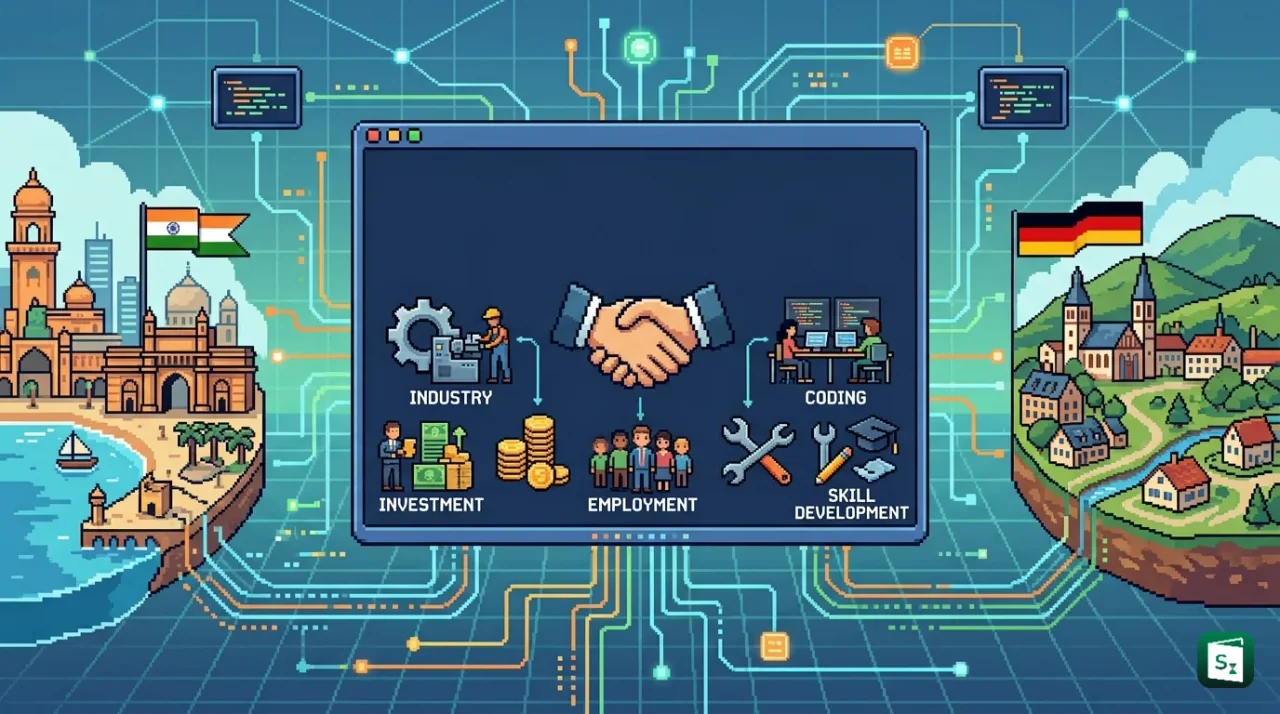
Maharashtra Chief Minister Devendra Fadnavis and Hesse Minister-President Boris Rhein signed a Memorandum of Understanding (MoU) at Sahyadri Guest House in Mumbai, marking a formal partnership between the western Indian state and the German state of Hesse. The pact seeks to deepen bilateral cooperation in investment, industry, innovation, employment and skill development. Fadnavis called the arrangement one between two economically strong regions, with Hesse set to act as Maharashtra’s gateway to Germany and Europe while Maharashtra becomes Hesse’s gateway to India and the Indo-Pacific.
What Is the Maharashtra-Hesse MoU?
An MoU, or Memorandum of Understanding, is a formal document that records an agreement between two parties before a binding treaty or contract is signed. It lays down shared intentions, areas of cooperation and broad responsibilities, without creating legally enforceable obligations. In diplomacy and business, MoUs serve as a first step that signals goodwill and sets the direction for detailed agreements to follow.
The Maharashtra-Hesse MoU is a non-binding framework for cooperation between the Maharashtra government and the state government of Hesse. It covers four broad areas: industry, services, information technology, and skilled manpower and cross-border mobility. Under this umbrella, the two sides will work on a joint working group to implement the agreement and hold regular Maharashtra-Hesse Business Dialogues in Mumbai and in Hesse.
The pact reflects a growing trend of state-to-state, or subnational, diplomacy, where individual Indian states forge direct economic ties with foreign federal states instead of depending only on national-level agreements. Such arrangements allow faster, more focused cooperation that is tailored to the specific industrial strengths of each region.
The German State of Hesse: Key Facts
Hesse, known in German as Hessen, is one of the 16 federal states (Bundesländer) that make up the Federal Republic of Germany. Germany’s federal structure gives each state its own government, constitution and legislative powers, much like the states in India’s federal system. This is why Hesse can sign a separate cooperation agreement with Maharashtra even while the national governments of India and Germany maintain their own relationship.
The state is central to Germany’s economy. Its capital is Wiesbaden, while the largest city and the main economic engine is Frankfurt am Main, widely regarded as Germany’s principal financial centre. Frankfurt hosts the headquarters of the European Central Bank (ECB), the Deutsche Börse stock exchange, and the European headquarters of many global banks. It also has one of Europe’s busiest airports, making it a critical logistics and travel hub.
| Attribute | Hesse (Hessen) |
|---|---|
| Status | Federal state (Land) of Germany |
| Capital | Wiesbaden |
| Largest city | Frankfurt am Main |
| Population | About 6.4 million |
| Economic strengths | Financial services, chemicals and pharmaceuticals, biotechnology, automobiles, engineering, logistics, IT |
| Key institution | Headquarters of the European Central Bank |
Hesse is Germany’s largest biotechnology production centre, and chemical and pharmaceutical products are among its leading exports. Small and medium-sized companies form the backbone of its economy, and more than 12,500 foreign companies already operate in the state, a sign of its openness to international investment. Its gross domestic product, at roughly €368 billion in 2024, makes it one of the richest German states by economic output.
Sectors Covered Under the MoU
The cooperation framework identifies eight priority sectors where Maharashtra and Hesse will work together. The list closely matches Hesse’s industrial strengths with Maharashtra’s manufacturing and services base.
| Priority Sector | Maharashtra’s Strength | Hesse’s Strength |
|---|---|---|
| Pharmaceuticals | Large generic drug manufacturing base around Mumbai and Pune | Major chemical and pharma cluster, including the Frankfurt region |
| Healthcare | Growing hospital and medical infrastructure | Advanced medical technology and research |
| Engineering | Auto and machine components manufacturing | Precision engineering and machinery |
| Automobiles | Hub of India’s auto industry, including the Chakan cluster near Pune | Home to major automotive manufacturers and suppliers |
| Financial services | Mumbai is India’s financial capital, hosting the RBI and stock exchanges | Frankfurt is Europe’s financial hub, hosting the ECB |
| Logistics | Ports at Mumbai and Jawaharlal Nehru Port | Frankfurt airport is among the world’s busiest cargo hubs |
| Digital economy | Growing IT and startup ecosystem | Strong IT and digital infrastructure |
| Artificial intelligence | Expanding AI research and talent pool | Cutting-edge AI research and innovation |
The sector list also opens the door for cooperation in education and research. Fadnavis expressed the hope that leading universities from Hesse would set up a presence at the Education City planned near Navi Mumbai, a project aimed at creating a global higher education hub in the state. This would bring German research culture and technical education closer to Indian students.
Why Hesse Matters for Maharashtra
Maharashtra is already India’s most attractive destination for foreign investment. It accounted for the highest share, about 39%, of total foreign direct investment (FDI) equity inflows into India in FY 2024-25, ahead of Karnataka and Delhi. The state houses India’s financial capital, Mumbai, a large industrial belt stretching through Pune, Nashik and Aurangabad, and a strong services economy. In FY 2025-26, Maharashtra continued to lead with roughly $18.4 billion in FDI equity inflows.
Germany is one of the world’s most industrialised economies and has long been a key economic partner for India. Germany is Maharashtra’s eighth-largest export partner among countries, and a substantial number of German companies operate in the state, particularly in and around Pune and Mumbai. These include leaders in automobiles, engineering, chemicals and machinery.
The MoU turns this existing economic contact into a structured partnership. Fadnavis described Frankfurt and Mumbai as gateways to each other’s economies, since both are financial centres with strength in finance, industry, technology, research and skilled manpower. For Maharashtra, the pact offers a reliable channel to attract high-technology investment, while for Hesse it offers an entry point into one of India’s most industrialised states and, through it, into the wider Indo-Pacific region.
India-Germany Ties: The Bigger Picture
India and Germany established a Strategic Partnership in 2000, and their relationship has deepened steadily since then. The two countries hold Inter-Governmental Consultations (IGC) on a regular basis, a high-level dialogue mechanism unique among India’s partnerships, in which multiple ministries from both sides meet together. The 7th India-Germany IGC was held in New Delhi in October 2024.
Trade between the two countries has been growing. India-Germany bilateral trade crossed $33 billion in recent years and reached record levels in 2025, with more than 2,000 German companies active in India. Germany is also one of India’s important sources of foreign direct investment. Beyond trade, the partnership covers defence, energy, green hydrogen, innovation and technology through the Green and Sustainable Development Partnership and the Indo-German Innovation and Technology Partnership.
A particularly relevant element is the Comprehensive Migration and Mobility Partnership Agreement (MMPA) signed between India and Germany in December 2022, which came into effect in March 2023. The MMPA eases legal pathways for Indian students, apprentices, skilled workers and professionals to live and work in Germany. The Skilled Worker Immigration Act in Germany, along with tools such as the Opportunity Card, has also made it simpler for qualified foreign workers to enter the German labour market. The Maharashtra-Hesse MoU directly supports this national framework by preparing workers at the state level to take advantage of these pathways.
Skill Development and Employment: The People Dimension
The most striking feature of the MoU for Maharashtra’s youth is its focus on skill development and employment. Germany faces a serious shortage of skilled workers. Estimates suggest the country could have hundreds of thousands of unfilled skilled positions by the late 2020s, with acute demand in fields such as nursing, IT, engineering and construction. At the same time, Maharashtra has a large young population entering the workforce every year, a demographic advantage that Germany lacks.
The MoU aims to connect these two realities. Specialised skill training for Maharashtra’s youth, aligned with Germany’s labour-market requirements, is a stated goal, which would create international employment opportunities. In practical terms, this could mean industry-linked training programmes in partnership with Hesse-based companies, German language instruction, and certification systems that Indian workers can use to secure jobs in Germany.
German language proficiency is widely recognised as an important employability skill for anyone seeking to work in Germany. Cooperation under the MoU could expand access to German language training in Maharashtra, a development that would benefit young people looking at international careers. Fadnavis noted that cooperation in skill development could help meet Germany’s demand for skilled manpower while creating new opportunities for Maharashtra’s large young population, a clear statement of the mutual benefit at the heart of the pact.
The Way Forward
The success of the MoU will depend on implementation. A joint working group will be responsible for turning the broad commitments into concrete projects, and the proposed Maharashtra-Hesse Business Dialogues are expected to bring companies from both sides together on a regular basis. These mechanisms give the agreement a practical structure beyond the initial signing.
The pact also connects to wider trade developments. Fadnavis pointed to the India-European Union Free Trade Agreement, negotiations for which have been underway, as a future driver of trade and investment that would benefit sectors such as machinery, chemicals, pharmaceuticals, medical technology, automobiles, manufacturing and life sciences in Maharashtra. A completed agreement would make the Maharashtra-Hesse channel even more valuable.
Rhein described the relationship as resting not only on economic and industrial cooperation but also on shared values of democracy, the rule of law, multilateral cooperation and a rules-based international order. If the two sides deliver on the stated goals, the MoU could become a model for how Indian states and German federal states cooperate, and strengthen the larger India-Germany strategic partnership in the process.
Key Takeaways
- The Maharashtra government and the German state of Hesse signed an MoU covering investment, industry, innovation, employment and skill development at Sahyadri Guest House in Mumbai.
- The MoU was signed by Maharashtra Chief Minister Devendra Fadnavis and Hesse Minister-President Boris Rhein.
- Hesse (Hessen) is one of Germany’s 16 federal states, with Wiesbaden as its capital and Frankfurt am Main as its largest city and financial hub.
- The MoU covers eight priority sectors, including pharmaceuticals, healthcare, engineering, automobiles, financial services, logistics, the digital economy and artificial intelligence.
- A joint working group will implement the agreement, along with regular Maharashtra-Hesse Business Dialogues.
- The pact builds on the India-Germany Comprehensive Migration and Mobility Partnership Agreement (MMPA), signed in December 2022, which eases pathways for skilled Indian workers to Germany.