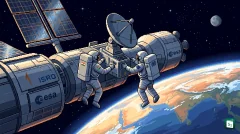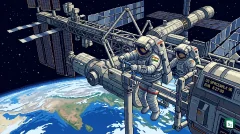
Sophie Adenot, a French astronaut of the European Space Agency (ESA), has made history as the first French woman to perform a spacewalk. She stepped out of the International Space Station (ISS) on 18 August 2026 to repair a communications system, spending about six and a half hours in the vacuum of space. With this feat, she also became the second European woman to walk in space, following Samantha Cristoforetti of Italy, who completed her first spacewalk in 2022.
Who Is Sophie Adenot?
Born on 5 July 1982 in Cosne-Cours-sur-Loire, France, Adenot is an engineer, a helicopter pilot and a colonel in the French Air and Space Force. She studied aerospace engineering at ISAE-SUPAERO in Toulouse and earned a master’s degree from the Massachusetts Institute of Technology (MIT), where she worked on how the human body adapts to artificial gravity.
Before joining the space sector, she logged more than 3,000 flight hours across 22 types of helicopters, flying search and rescue missions for the French Air Force. In 2018, she became the first female helicopter test pilot in France. She was inspired to pursue space by Claudie Haigneré, the first French woman in space, whose 1996 launch she watched live on television as a teenager.
Adenot was selected into the European Astronaut Corps in the 2022 ESA astronaut class, chosen from a pool of about 22,500 applicants. She is the second French woman to join the corps, after Claudie Haigneré. Her first spaceflight, the Epsilon mission, began on 13 February 2026, when she launched aboard the SpaceX Crew-12 mission to the ISS as a mission specialist. During her roughly eight-month stay, she is expected to take part in more than 200 experiments in microgravity across medicine, biology and physics.
The Repair Mission: What Was Done
Adenot carried out the spacewalk alongside NASA astronaut Anil Menon. The pair stepped out of the station’s Quest airlock on 18 August 2026 at 8:29 a.m. EDT, when their spacesuits switched to battery power. Their task was to remove a failed Space-to-Ground antenna, a critical link that tracks NASA’s data-relay satellites and enables high-speed communication between the ISS and Mission Control in Houston.
The work did not go exactly as planned. The two astronauts successfully removed the failed antenna, but disconnecting its tight power and data cables and loosening the bolts took longer than expected. Flight controllers decided there was not enough time to install the replacement unit, so the failed antenna was tied down near its mount. The astronauts re-entered the airlock at 2:52 p.m. EDT, ending the outing after 6 hours and 23 minutes.
A Two-Visit Repair Job
The task was completed during a follow-up spacewalk on 25 August 2026, when Menon and Adenot installed and connected the spare Space-to-Ground antenna on the station’s truss. Initial checkouts showed good power and data transmission, and the failed unit was moved to a spare-parts platform. That outing lasted 6 hours and 30 minutes and was the 283rd spacewalk in support of station assembly and maintenance.
Analogy · Like a Home Repair Visit Expand analogy
A spacewalk repair is similar to an electrician arriving at your house to fix a rooftop dish. The first visit might not finish the job because the old cables are stubborn and the work takes longer than planned, so a second visit completes it. During a spacewalk, the astronauts’ time outside is strictly limited by the oxygen and battery power in their suits, so ground controllers often choose the safe option of stopping and returning.
What Exactly Is a Spacewalk?
A spacewalk, officially called an extravehicular activity (EVA), is any time an astronaut leaves a spacecraft while in orbit and works in the vacuum of space. The term “extravehicular” simply means “outside the vehicle”. Astronauts do not actually walk in the usual sense, since there is no gravity to step against. Instead, they float and move using handrails, tethers and the station’s robotic arm, so a “walk” in space really means moving carefully from one worksite to another.
The first human spacewalk was carried out by Soviet cosmonaut Alexei Leonov on 18 March 1965, when he spent about 12 minutes outside the Voskhod 2 capsule. EVAs are needed for tasks that machines and robots cannot easily do, such as repairing damaged parts, installing new equipment, servicing experiments and performing inspections. Astronauts can train for hours in underwater pools on Earth, which recreate the slow, floating movements of space, before they are cleared to work outside.
How a Spacewalk Is Conducted
A typical spacewalk involves two astronauts, because safety rules require one astronaut to always stay near the other so that help is available in an emergency. The astronauts wear a spacesuit, also called an extravehicular mobility unit (EMU) for the US version, which provides oxygen, temperature control and protection from micrometeoroids and the harsh radiation of space. The spacesuits used for ISS spacewalks are white to reflect sunlight, since temperatures can swing between extreme heat and extreme cold as the station orbits Earth roughly every 90 minutes.
Why Spacewalks Matter
Spacewalks are not merely symbolic acts. They keep the ISS alive. The station is a huge structure, weighing almost 400 tonnes and covering an area roughly the size of a football pitch, and it has been orbiting Earth continuously since its first module was launched in November 1998. Over the years, more than 270 spacewalks have been carried out in support of its assembly, maintenance and upgrades, and each one keeps a critical system working or fixes one that has failed.
The repair mission completed by Adenot and Menon is a good example. The failed Space-to-Ground antenna had stopped tracking NASA’s data-relay satellites since November, and while a second working antenna carried the high-speed link, mission managers wanted a healthy spare in place for redundancy. Spacewalks are also where astronauts install new solar arrays, replace external experiment equipment and inspect the outer skin of the station for damage from micrometeoroids and space debris.
Spacewalks also prepare humanity for the future. The techniques developed for moving, working and surviving outside the ISS are being refined for longer journeys, including a return to the Moon and eventual missions to Mars, where astronauts will need to repair spacecraft far from any help. Every walk outside the station, however routine it seems, is practice for those deeper expeditions.
Women and Spacewalks: A Timeline of Milestones
Adenot’s spacewalk is the latest step in a long line of firsts for women in space. Women have been flying to space since 1963, when Soviet cosmonaut Valentina Tereshkova became the first woman in space aboard Vostok 6, and she remains the only woman to have flown in space alone. It took more than two decades after that for a woman to step outside a spacecraft.
| Year | Astronaut | Milestone |
|---|---|---|
| 1963 | Valentina Tereshkova (Soviet Union) | First woman in space |
| 1984 | Svetlana Savitskaya (Soviet Union) | First woman to perform a spacewalk |
| 1984 | Kathryn Sullivan (US) | First American woman to perform a spacewalk |
| 1996 | Claudie Haigneré (France) | First French woman in space |
| 2019 | Christina Koch and Jessica Meir (US) | First all-female spacewalk |
| 2022 | Samantha Cristoforetti (Italy) | First European woman to perform a spacewalk |
| 2026 | Sophie Adenot (France) | First French woman to perform a spacewalk |
The milestone trail is instructive. Svetlana Savitskaya became the first woman to walk in space on 25 July 1984, during a mission to the Soviet Salyut 7 station, when she spent about three and a half hours outside testing tools and welding in the vacuum. Later that same year, Kathryn Sullivan became the first American woman to walk in space. It would take another 35 years before the first all-female spacewalk, carried out by NASA astronauts Christina Koch and Jessica Meir on 18 October 2019.
Adenot now joins this list as the fifth French citizen to perform a spacewalk, after Jean-Loup Chrétien, Jean-Pierre Haigneré, Philippe Perrin and Thomas Pesquet. The first French national to reach space was Jean-Loup Chrétien in 1982, and he also performed the first spacewalk by a French citizen. Adenot is the first French woman among these five.
France, Europe and the ISS: The Bigger Picture
France’s Space Programme
France has one of the world’s oldest space programmes. Its national space agency, the Centre National d’Études Spatiales (CNES), was established in 1961, making it Europe’s largest national space agency, and it is headquartered in Paris. CNES is one of the founding members of ESA, and France has long been the largest national contributor to ESA’s budget, reflecting the country’s deep investment in space capability, from launch vehicles to Earth observation.
French astronauts carry the title spationaute in French, a term coined to match the American astronaut and Russian cosmonaut. The first French woman in space, Claudie Haigneré, flew in 1996 and later became the first European woman to visit the ISS in 2001. Adenot is the second French woman to fly to space and the first to walk in it.
The European Space Agency and Its Astronaut Corps
The European Space Agency (ESA) is an intergovernmental organisation founded in 1975 by the merger of two earlier European bodies, and its headquarters are in Paris. ESA brings together the space resources of its member states, and astronauts are selected into the European Astronaut Corps, which is based at the European Astronaut Centre (EAC) in Cologne, Germany. The corps has its own training facilities, including a giant swimming pool for spacewalk practice.
ESA’s 2022 astronaut class, nicknamed “The Hoppers”, selected five career astronauts and twelve reserve astronauts from a pool of about 22,500 applicants. Adenot was among the five selected. The class marked a new generation of European astronauts, and Adenot became the first member of that class to fly to the ISS.
The ISS in Context
The International Space Station is a joint project of the United States (NASA), Russia (Roscosmos), Japan (JAXA), Canada (CSA) and Europe (ESA). Assembly began with the launch of the Russian Zarya module on 20 November 1998, and the station has been continuously occupied since November 2000. It orbits Earth at an altitude of about 400 kilometres, hosting astronauts from many nations who conduct scientific research in microgravity that is impossible to carry out on Earth.
The spacewalk by Adenot and Menon took place during Expedition 75 on the station, after both astronauts had arrived in the first half of 2026. Anil Menon, an Indian-American NASA astronaut and physician who was SpaceX’s first flight surgeon, performed his first-ever spacewalk in August 2026 alongside Jessica Meir, and the Adenot spacewalk was his second.
Key Takeaways
- Sophie Adenot of ESA became the first French woman and the fifth French citizen to perform a spacewalk on 18 August 2026 on the ISS.
- The spacewalk, carried out with NASA astronaut Anil Menon, lasted 6 hours and 23 minutes and was aimed at replacing a failed Space-to-Ground antenna on the station’s truss.
- A follow-up spacewalk on 25 August 2026 installed the spare antenna, completing the repair after 6 hours and 30 minutes.
- Adenot is the second European woman to perform a spacewalk, after Samantha Cristoforetti of Italy, who did so in July 2022.
- A spacewalk is officially called an extravehicular activity (EVA), and the first human spacewalk was performed by Soviet cosmonaut Alexei Leonov on 18 March 1965.
- The first woman to perform a spacewalk was Soviet cosmonaut Svetlana Savitskaya on 25 July 1984, and the first all-female spacewalk was carried out by Christina Koch and Jessica Meir on 18 October 2019.
- The European Space Agency (ESA), founded in 1975 and headquartered in Paris, selects astronauts into the European Astronaut Corps based at the European Astronaut Centre in Cologne, Germany.