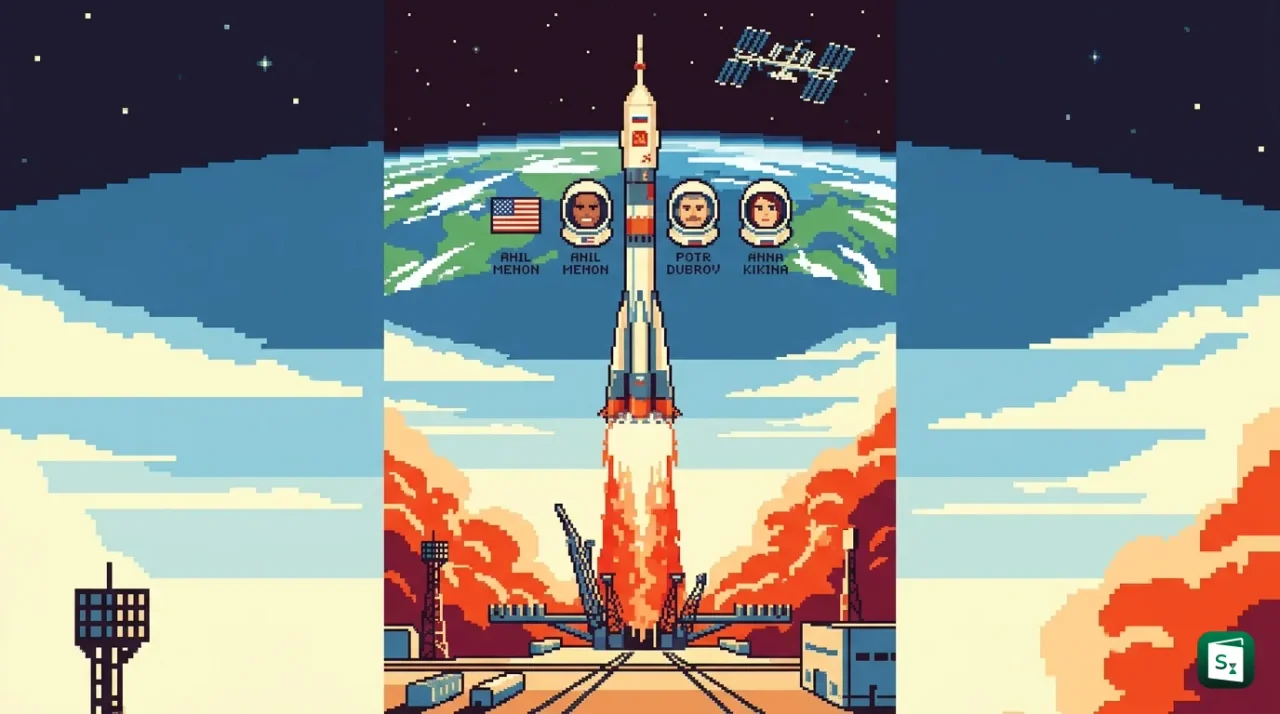
Russia launched the Soyuz MS-29 spacecraft from the Baikonur Cosmodrome in Kazakhstan on July 14, 2026, carrying NASA astronaut Anil Menon and Roscosmos cosmonauts Pyotr Dubrov and Anna Kikina to the International Space Station (ISS). The spacecraft lifted off atop a Soyuz-2.1a launch vehicle and docked with the station’s Prichal module after a fast two-orbit rendezvous. The crew will spend approximately 261 days aboard the ISS as part of Expeditions 74 and 75, conducting scientific research and technology demonstrations.
The Soyuz MS-29 Mission
The Soyuz MS-29 lifted off from Site 31/6 at Baikonur Cosmodrome at 14:47 UTC on July 14, 2026. The Soyuz-2.1a rocket completed a nominal ascent, inserting the spacecraft into orbit less than nine minutes after launch. The crew followed a fast two-orbit rendezvous profile, docking with the station’s Prichal module at 17:52 UTC the same day.
The mission is identified by NASA as Soyuz 75S. The lower stage of the rocket featured sponsorship branding from LIT energy, a Russian energy drink company. This is the second spaceflight for both Dubrov and Kikina and the first for Menon.
Upon docking, the three crew members joined the existing Expedition 74 team aboard the ISS, which included NASA astronauts Jessica Meir, Jack Hathaway, and Chris Williams, ESA astronaut Sophie Adenot, and Roscosmos cosmonauts Sergey Kud-Sverchkov, Sergei Mikaev, and Andrey Fedyaev. The enlarged crew will conduct a range of scientific experiments before Menon, Dubrov, and Kikina return to Earth in April 2027.
The Crew of Soyuz MS-29
Anil Menon: Physician, Engineer, and Astronaut
Anil Menon is a NASA astronaut of Indian origin, making his first spaceflight on this mission. Born in Minneapolis, Minnesota in 1976 to an Indian father from Kerala and a Ukrainian mother, Menon brings a rare combination of medical, engineering, and military experience to the ISS.
He holds a bachelor’s degree in neurobiology from Harvard University, a master’s degree in mechanical engineering and a medical degree from Stanford University, and a master’s in public health from the University of Texas Medical Branch. He completed residencies in both emergency medicine and aerospace medicine.
Before becoming an astronaut, Menon served as a flight surgeon with the US Air Force, flying over 100 sorties in F-15 aircraft and supporting critical care air transport missions in Afghanistan during Operation Enduring Freedom. He also volunteered with the Himalayan Rescue Association, providing medical care to climbers on Mount Everest.
In 2018, Menon joined SpaceX as its first flight surgeon, where he built the company’s medical programme and supported the historic Demo-2 mission, the first crewed flight of the Crew Dragon spacecraft. He was selected as a NASA astronaut candidate in December 2021 as part of NASA Group 23 and completed training in 2024. He holds the rank of colonel in the United States Space Force.
During his stay on the ISS, Menon will conduct experiments on the physiological effects of long-duration spaceflight, including how microgravity affects blood flow, vein structure, and blood composition. He will also test technologies to produce intravenous (IV) fluids using the station’s potable water system, a capability critical for future deep-space missions. Additionally, he will advance research on manufacturing semiconductor crystals in microgravity for high-performance computing and artificial intelligence applications.
Pyotr Dubrov: The Veteran Commander
Pyotr Valerievich Dubrov, born on January 30, 1978 in Khabarovsk, Russia, serves as the commander of Soyuz MS-29. A software engineer by training, Dubrov graduated from Khabarovsk State Technical University in 1999 and worked as a senior software engineer before being selected as a cosmonaut by Roscosmos in October 2012.
Dubrov’s first spaceflight was aboard Soyuz MS-18 in April 2021, where he spent 355 days on the ISS as part of Expeditions 64, 65, and 66, returning aboard Soyuz MS-19 in March 2022. During that mission, he conducted four spacewalks totaling nearly 30 hours. For his service, he was awarded the title Hero of the Russian Federation in April 2023.
Anna Kikina: Russia’s Only Active Female Cosmonaut
Anna Yuryevna Kikina, born on August 27, 1984 in Novosibirsk, Russia, is the only female cosmonaut currently in active service at Roscosmos. She graduated from the Novosibirsk State Academy of Water Transport with degrees in emergency protection engineering and economics.
Kikina was selected in the same 2012 cosmonaut group as Dubrov. Her first spaceflight was on SpaceX Crew-5 in October 2022, making her the first Russian cosmonaut to fly aboard a US spacecraft since 2002. She spent 157 days on the ISS as part of Expedition 68. Like Dubrov, she was awarded the title Hero of the Russian Federation.
This mission marks Kikina’s second spaceflight and her first aboard a Russian Soyuz spacecraft. Before her cosmonaut career, she worked as a programme director at Radio Siberia Altai and held qualifications as a rescue worker, swimming instructor, and paratrooper instructor. She is a Master of Sports in polyathlon and rafting.
The Soyuz-2.1a Launch Vehicle
The Soyuz MS-29 mission was launched atop a Soyuz-2.1a rocket, part of the legendary R-7 rocket family that traces its lineage to the world’s first intercontinental ballistic missile designed by Sergei Korolev’s OKB-1 in the 1950s. The R-7 family launched Sputnik 1 (1957) and carried Yuri Gagarin into orbit (1961), and derivatives have been flying continuously ever since, accumulating over 2,000 flights.
The Soyuz-2.1a variant introduced a digital flight control system, replacing the earlier analog system. This upgrade allows the rocket to launch from a fixed launch platform rather than an angled one and to adjust its heading during flight. The digital system also enables the use of larger payload fairings, which the older analog system could not handle due to aerodynamic instability.
| Parameter | Value |
|---|---|
| Height | 46.3 meters |
| Diameter | 2.95 meters |
| Launch mass | 312 tonnes |
| Liftoff thrust | 4,550 kN |
| Stages | 3 (plus 4 strap-on boosters) |
| Propellant | Liquid oxygen / kerosene (all stages) |
| Payload to LEO | 7,500 kg |
| First launch | November 2004 |
| Manufacturer | Progress Rocket Space Centre, Samara |
The rocket’s first flight was on November 8, 2004, from Plesetsk Cosmodrome. It is manufactured by the Progress Rocket Space Centre in Samara, Russia, and is used for both crewed Soyuz and uncrewed Progress cargo missions to the ISS.
Baikonur Cosmodrome: The World’s Largest Spaceport
The Soyuz MS-29 launched from Site 31/6 at the Baikonur Cosmodrome, the world’s largest and oldest operational space launch facility. Located in the Kazakh steppe near the Syr Darya river, about 200 km east of the Aral Sea, Baikonur was established by the Soviet Union in 1955 as a testing range for the R-7 intercontinental ballistic missile.
Baikonur holds a special place in space history. It was the launch site for Sputnik 1 (October 4, 1957), the world’s first artificial satellite, and Vostok 1 (April 12, 1961), which carried Yuri Gagarin as the first human in space. The legendary launch pad used for Gagarin’s flight, known as Gagarin’s Start (Site 1/5), remains in use today.
Following the dissolution of the Soviet Union in 1991, the cosmodrome fell within the territory of independent Kazakhstan. Russia currently leases the facility from Kazakhstan under an agreement extending to 2050, paying an annual rent of approximately $115 million. The cosmodrome is jointly managed by Roscosmos and the Russian Aerospace Forces.
All Russian crewed spaceflights are launched from Baikonur, making it an indispensable asset for ISS operations despite Russia’s development of the newer Vostochny Cosmodrome in its Far East.
The International Space Station and Expedition 74/75
The International Space Station (ISS) is a modular space station in low Earth orbit, jointly operated by five space agencies: NASA (United States), Roscosmos (Russia), ESA (Europe), JAXA (Japan), and CSA (Canada). Assembly began in 1998 with the launch of the Russian Zarya module, and the station has been continuously inhabited since November 2, 2000, the longest uninterrupted human presence in space.
The ISS orbits at approximately 400 km altitude at a speed of 27,600 km/h, completing one orbit every 92 minutes. It measures 109 meters in length (end to end with solar arrays) and has a habitable volume comparable to a Boeing 747. Over 270 individuals from more than 20 countries have visited the station, conducting more than 4,000 experiments.
Soyuz MS-29 docked at the Prichal module, a Russian nodal module added to the station in November 2021. Prichal, meaning “pier” in Russian, provides five additional docking ports for Soyuz and Progress spacecraft, expanding the station’s capacity to accommodate visiting vehicles.
The crew will serve as part of Expedition 74 (current) and Expedition 75 (upcoming), contributing to the station’s research programme. Menon’s experiments focus on space medicine and semiconductor manufacturing, while the Russian programme includes 38 experiments and two spacewalks during their stay.
NASA-Roscosmos Cooperation Through the Seat Swap Agreement
Menon’s presence on a Russian Soyuz spacecraft is part of the ongoing NASA-Roscosmos seat swap agreement, first signed in July 2022 and extended through 2027. Under this no-exchange-of-funds barter agreement, NASA astronauts fly on Soyuz spacecraft while Roscosmos cosmonauts fly on SpaceX Crew Dragon vehicles.
The arrangement ensures that at least one NASA astronaut and one Roscosmos cosmonaut remain aboard the ISS at all times, maintaining operational continuity in both the US and Russian segments. This is critical because the ISS was designed as an interdependent facility where both partners contribute essential systems.
The seat swap agreement has survived geopolitical tensions and demonstrates that space cooperation remains a rare area of sustained collaboration between the two nations. Roscosmos Director General Dmitry Bakanov confirmed after the Soyuz MS-29 docking that seat swap flights will continue as long as the ISS remains operational.
India-Russia Space Ties: A Broader Context
Menon’s Indian heritage provides an opportunity to recall the long history of India-Russia space cooperation. This partnership began with the launch of Aryabhata, India’s first satellite, from a Soviet cosmodrome in 1975. In 1984, Wing Commander Rakesh Sharma became the first Indian in space aboard the Soviet Soyuz T-11, spending eight days on the Salyut 7 space station.
The Soviet Union later transferred cryogenic engine technology to ISRO in the 1990s, which helped India develop its heavy-lift launch capabilities. More recently, Russia has been assisting India’s Gaganyaan human spaceflight programme, including training Indian astronauts at the Yuri Gagarin Cosmonaut Training Centre near Moscow from 2020 to 2021.
In 2026, India and Russia continue to deepen space ties. Roscosmos and ISRO have discussed collaboration on semi-cryogenic engines for India’s launch vehicles, and Russia’s Space Research Institute has been selected as a partner payload provider for India’s planned Venus Orbiter Mission. The BRICS space agency meeting hosted by ISRO in Bengaluru in June 2026 further highlighted the expanding multilateral space engagement.
Menon, whose father hails from Ottapalam in Kerala’s Palakkad district, is the first astronaut of Malayali descent to fly to space. Interestingly, the same district has connections to two other astronauts: Anna Menon (Anil’s wife, who flew on SpaceX’s Polaris Dawn mission in 2024) and Air Commodore Prasanth Balakrishnan Nair, one of India’s Gaganyaan astronaut-designates.
Key Takeaways
- Soyuz MS-29 launched on July 14, 2026 from Baikonur Cosmodrome in Kazakhstan atop a Soyuz-2.1a rocket, docking with the ISS’s Prichal module after a fast two-orbit rendezvous.
- The crew includes Anil Menon (NASA, first spaceflight), Pyotr Dubrov (Roscosmos commander, second spaceflight), and Anna Kikina (Roscosmos, second spaceflight), who will spend 261 days on the ISS as part of Expeditions 74 and 75.
- Anil Menon is a physician, engineer, and US Space Force colonel of Indian origin (Kerala). He was selected as a NASA astronaut in 2021 and previously served as SpaceX’s first flight surgeon, supporting the Demo-2 mission.
- Pyotr Dubrov, a software engineer turned cosmonaut, previously spent 355 days on the ISS and was awarded Hero of the Russian Federation. Anna Kikina is the only active female cosmonaut at Roscosmos and was the first Russian to fly on a US spacecraft (SpaceX Crew-5) since 2002.
- The Soyuz-2.1a is the current digital variant of the legendary R-7 rocket family, featuring a digital flight control system and the ability to launch from fixed platforms.
- The Baikonur Cosmodrome, established in 1955, launched Sputnik 1 and Vostok 1, and is leased by Russia from Kazakhstan until 2050.