Moozhikkal Pankajakshi, the Padma Shri awardee who single-handedly kept alive Kerala’s rare puppetry tradition of Nokkuvidya Pavakkali for over seven decades, passed away at her home in Monippally, Kottayam district. She was 90. Her death marks the end of an era for one of India’s most demanding and visually stunning folk art forms, which now has only one active practitioner left in the world.
Who Was Moozhikkal Pankajakshi?
Born on 14 March 1936 in Urulikunnath, Pala, Kottayam district, Kerala, Moozhikkal Pankajakshi, popularly known as Pankajakshi Amma, belonged to the Velapanikar community, a traditional artisan community whose families had practised Nokkuvidya Pavakkali for nearly five centuries. Financial difficulties forced her to drop out of school after the fifth standard, but at the age of 11, she began learning the art from her mother, Paappiyamma. By 13, she was already performing alongside her parents at temples and homes across Kerala.
She married Shivarama Panicker at age 20. He proved to be a transformative influence on her career, composing the songs that accompanied her performances and providing vocal support. Together, they formed a complete artistic unit, with Panicker crafting the puppets and writing the lyrics while Pankajakshi brought them to life on stage.
Over a career spanning more than 60 years, Pankajakshi performed across India and abroad. Her most notable international appearance was in 2008 in Paris as part of the Kerala Tourism Festival. She stopped performing at 72 after losing her front teeth and suffering vision loss and memory decline, all of which made it impossible to balance the puppets with the precision the art demands.
What Is Nokkuvidya Pavakkali?
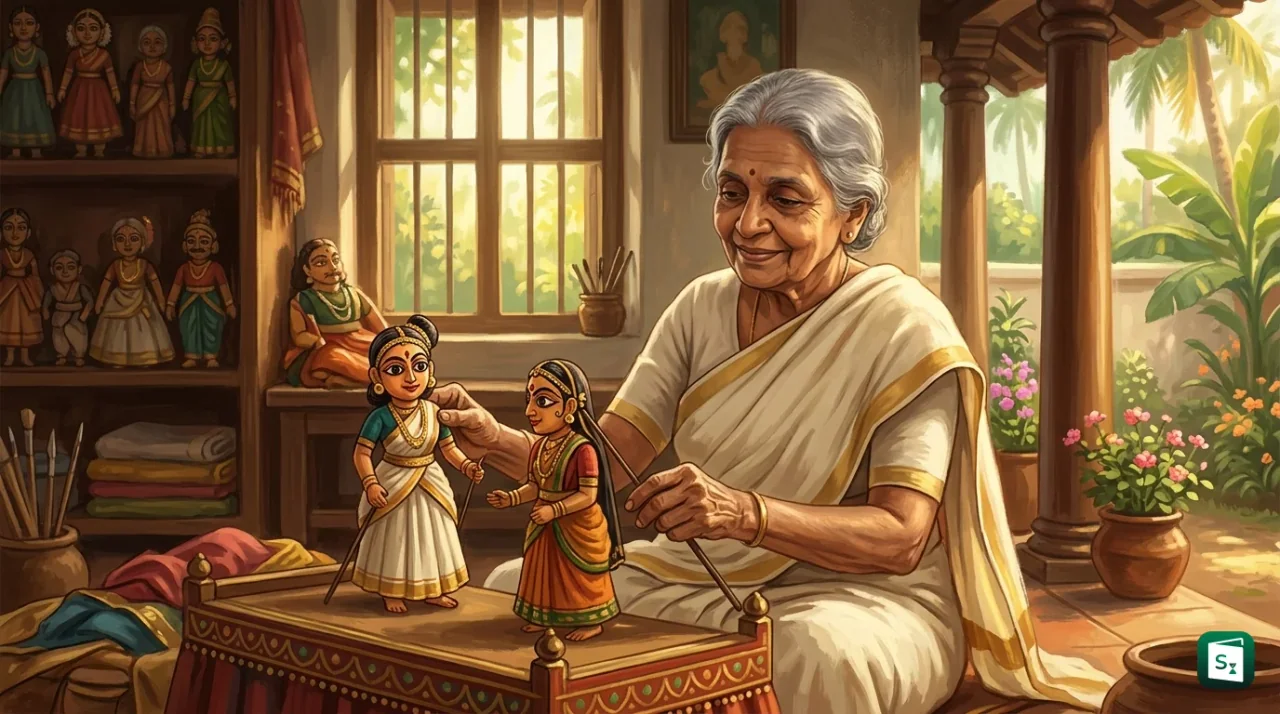
The name itself describes the art. Nokku means “look” or “gaze”, Vidya means “technique” or “knowledge”, and Pavakkali means “puppet play”. It is a form of stick puppetry where the performer balances a two-foot-long wooden rod on the philtrum (the groove between the nose and the upper lip), with small wooden puppets attached at the top. The performer controls the puppets by pulling strings while keeping the rod perfectly still using only the upper lip and the tip of the nose.
The Technique
The puppets, carved from the wood of the Ezhilampala tree (Alstonia scholaris), weigh approximately 500 grams in total. The rod itself is made from the kamuk (Areca catechu) wood. Natural colours derived from charcoal, leaf extracts, and fruit juice are used to paint the figures.
The performer sits on a grass mat with legs stretched out, face tilted upward, maintaining absolute stillness of the head while using both hands to manipulate the puppets via strings. A performance typically lasts one hour, during which the artist cannot blink freely, as even a momentary loss of focus can cause the rod to fall. The physical toll is immense, with performers often experiencing bleeding gums, neck pain, and exhaustion after a show.
A troupe typically includes male singers and musicians who narrate the story through songs while the female puppeteer brings the visual narrative to life. Stories are drawn from the Ramayana and the Mahabharata, with the battle between Rama and Ravana being a popular piece.
Historical and Cultural Significance
Nokkuvidya Pavakkali is believed to be around 500 years old and finds mention in the ancient Tamil epic Chilappathikaram. It was traditionally performed during Onam in the courtyards of ancestral homes in South Kerala and was patronised by the kings of Travancore, who rewarded performers with silk and bangles.
The art form was originally called Onamthullal and was practised by the Velan (Velapanikar) community. A distinctive feature is that women were the central performers while men provided the musical accompaniment, a reversal of the usual gender roles in traditional Indian puppetry. As other families abandoned the practice over the decades, the Moozhikkal family remained the sole custodians of this tradition.
A Life in Service of Art
Pankajakshi’s contributions were recognised with the Padma Shri in 2020, India’s fourth highest civilian honour. The award was presented to her by the Kottayam District Collector at her residence in December 2021, as she was unable to travel to New Delhi due to age-related health issues. She also received the Kerala Folklore Academy Award and Fellowship in 2012.
Despite these honours, Pankajakshi lived a modest life in Monippally, storing her precious wooden puppets in a box under her bed. Her performance in Paris in 2008 was a bittersweet milestone. It brought international recognition to Nokkuvidya Pavakkali, but it also made her realise that age had diminished her ability to perform at her best. This fear of the art form dying with her pushed her to find a successor within her own family.
A Fading Legacy: The Sole Successor
Pankajakshi’s granddaughter, K.S. Renjini, is now the only active practitioner of Nokkuvidya Pavakkali in the world. Renjini began learning the art at the age of eight, initially alongside her cousins, all of whom eventually dropped out due to the extreme difficulty of the training. She persisted, spending years mastering the art of balance by starting with baby coconuts before progressing to actual puppets.
Today, Renjini performs the same stories her grandmother once did, using the original puppets crafted by her grandfather Shivarama Panicker. However, the future of the art form remains uncertain. Renjini, a BCom graduate, has acknowledged that Nokkuvidya Pavakkali may never provide a stable livelihood. She has expressed a desire to register a trust and train the next generation, but finding willing learners has proven difficult given the physical pain and years of practice the art demands.
Key Takeaways
- Moozhikkal Pankajakshi, a Padma Shri awardee (2020) and the last master of Nokkuvidya Pavakkali, passed away on 15 July 2026 at her home in Monippally, Kottayam, Kerala at the age of 90.
- Nokkuvidya Pavakkali is a rare Kerala puppetry form where the performer balances a two-foot stick with puppets on the philtrum (upper lip groove) and controls them using strings while maintaining absolute stillness.
- The art form, nearly 500 years old, is mentioned in the ancient Tamil epic Chilappathikaram and was traditionally performed during Onam under the patronage of Travancore kings.
- Pankajakshi learned the art at age 11 from her mother, performed for over 60 years, and staged her most notable international show in Paris in 2008.
- Her granddaughter K.S. Renjini is now the sole active practitioner of Nokkuvidya Pavakkali in the world, keeping a fragile five-century-old tradition alive.