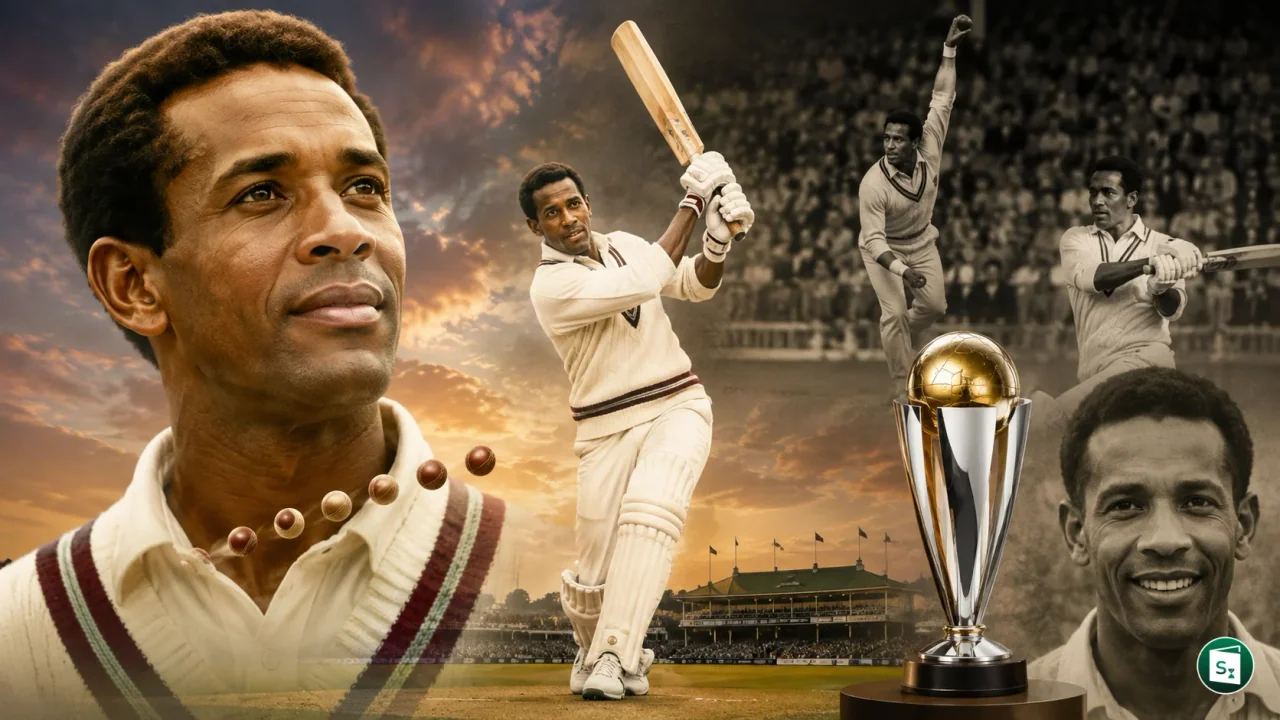
Sir Garfield Sobers, the legendary West Indies all-rounder widely regarded as the greatest cricketer to ever play the game, passed away on 17 July 2026 at the age of 89. A left-handed batsman who could bowl both pace and spin with equal mastery, Sobers redefined what it meant to be a complete cricketer during a 20-year Test career. He was the first batsman to hit six sixes in a first-class over, and the International Cricket Council’s highest individual honour, the Sir Garfield Sobers Trophy, is named in his memory.
The Rise of a Legend: From Barbados to the World Stage
Garfield St Aubrun Sobers was born on 28 July 1936 in Bridgetown, Barbados, the fifth of six children. His father, a merchant seaman, died when his ship was torpedoed by a German U-boat in 1942, leaving his mother to raise the family alone. Sobers turned to cricket at a young age, playing beach cricket with his siblings and excelling in school sports.
He made his first-class debut for Barbados at the age of 16 in 1953 against the touring Indians at the Kensington Oval in Bridgetown, taking four wickets in the first innings. Just 14 months later, at the age of 17, he made his Test debut for the West Indies against England at Sabina Park in Jamaica in March 1954, stepping in as a replacement for the injured left-arm spinner Alf Valentine. He took four wickets in the match, batting at number nine.
Sobers initially played as a specialist bowler. But his batting potential soon became evident. Against Australia in 1955, he was promoted up the order and hit the first three balls he faced from the legendary all-rounder Keith Miller for four. This aggressive, fearless approach would come to define his game.
A Record That Stood for 36 Years
It took Sobers four years and 29 Test innings to score his maiden century, but when it came, it was historic. Against Pakistan at Sabina Park, Kingston in February 1958, the 21-year-old scored an unbeaten 365, breaking the world record for the highest individual Test score previously held by England’s Len Hutton (364). He batted for 614 minutes and hit 38 fours. At 21 years and 216 days, he remains the youngest batsman ever to break the individual scoring record in Tests and the youngest to score a Test triple-century.
That innings was also the first instance of a batsman converting his maiden Test century into a triple-century. It began a remarkable purple patch: in his next 24 Tests, Sobers scored 2,250 runs at an average of 93.75, including five more centuries in the five Tests that followed immediately. His record of 365 stood for 36 years until Brian Lara scored 375 against the same opposition in 1994.
Sobers scored 26 Test centuries and 30 half-centuries in his career, with 11 of those hundreds exceeding 150. He also scored two double-centuries apart from his triple-century. His Test aggregate of 8,032 runs came at an average of 57.78, the fifth-highest among all batsmen with more than 5,000 Test runs.
Six Sixes in an Over: The Unforgettable Feat
On 31 August 1968, playing for Nottinghamshire against Glamorgan at the St Helen’s Ground in Swansea, Sobers became the first batsman in cricket history to hit six sixes in a single over in a first-class match. The over, bowled by left-arm spinner Malcolm Nash, yielded 36 runs and remains one of the most celebrated moments in the sport.
Sobers, captaining Nottinghamshire, was looking for quick runs to set up a declaration. Nash had been asked to bowl spin by his captain Tony Lewis. What followed was a display of clean hitting that stunned the cricketing world. The fifth ball was caught by Roger Davis at long-on, but the fielder tumbled over the boundary rope, and under a law change in 1968, it was ruled a six. The sixth ball was smashed out of the ground onto Gorse Lane, where a schoolboy retrieved it and returned it the next day. The ball now sits in the Trent Bridge museum.
Sobers declared immediately after, remaining unbeaten on 76, and Nottinghamshire went on to win the match by 166 runs. The feat has been equalled in first-class cricket only once, by Ravi Shastri in the Ranji Trophy in 1985. In international cricket, Herschelle Gibbs and Yuvraj Singh have hit six sixes in an over in limited-overs formats.
The Complete Cricketer
What set Sobers apart was not just his batting but his rare versatility with the ball. He could bowl left-arm fast-medium, slow left-arm orthodox, and left-arm wrist spin (chinaman googlies) with equal skill. This made him a captain’s dream: he could open the bowling with pace on helpful tracks or toss up spin on turning pitches. He remains the only bowler in Test history to have taken wickets bowling three distinct styles.
Sobers took 235 wickets in Tests at an average of 34.03, with best figures of 6 for 73 against Australia at Brisbane in 1968. He claimed five wickets in an innings six times. In 383 first-class matches, he took 1,043 wickets at an average of 27.74. He was also an outstanding fielder, holding 109 catches in Tests.
In the 1960-61 series against Australia, Sobers bowled 22 eight-ball overs on the trot in oppressive heat during the famous Tied Test in Brisbane. His fitness, athleticism, and sheer willpower set a benchmark that few all-rounders have matched. Sir Donald Bradman described him as a “five in one cricketer”, and Australia’s Alan Davidson said Sobers could do everything on a cricket field except umpire.
Captaincy and Later Career
Sobers succeeded Sir Frank Worrell as captain of the West Indies in 1965 and led the side in 39 Test matches until 1972. He led the team to a famous 3-1 series victory in England in 1966, during which he scored 722 runs at an average of 103.14 and took 20 wickets, earning the nickname “King Cricket” from the English press. The Trinidadian calypso icon Mighty Sparrow celebrated his feats in a song.
Beyond West Indies cricket, Sobers played for South Australia in the Sheffield Shield, winning the competition in 1963-64 largely through his efforts. He was the season’s leading run-scorer and leading wicket-taker. He also played for Nottinghamshire in English county cricket from 1968 to 1974, serving as captain.
Sobers also captained a Rest of the World XI in a series against England in 1970, filling in for the cancelled South African tour due to apartheid. Bradman called his double-century for the Rest of the World against Australia in Melbourne in 1972 “probably the greatest exhibition of batting ever seen in Australia”.
He played his final Test in March 1974 against England at Queen’s Park Oval in Port of Spain, Trinidad. His career came too early for the limited-overs era: he played just one ODI, in 1973, where he was dismissed for a duck. After retiring, he coached Sri Lanka in the early 1980s during their early years as a Test-playing nation.
Honours and Legacy
Sobers was knighted by Queen Elizabeth II on 19 February 1975 during her royal visit to Barbados. The knighthood was announced in the 1975 New Year Honours list, making him one of the youngest cricketers ever knighted at the age of 38. In 1998, the Parliament of Barbados named him a National Hero of Barbados, one of only 11 individuals to receive that honour.
Some of his major honours include:
- Wisden Cricketer of the Year: 1964
- Wisden Cricketer of the Century: 2000 (placed second only to Sir Donald Bradman, with 90 out of 100 votes)
- ICC Cricket Hall of Fame: Inducted in 2009 as an inaugural member
- Officer of the Order of Australia (AO): 2003
The Sir Garfield Sobers Trophy has been awarded annually by the ICC since 2004 to the ICC Men’s Cricketer of the Year. The first winner was Rahul Dravid in 2004, followed by legends such as Sachin Tendulkar (2010), Virat Kohli (2017, 2018), and most recently Jasprit Bumrah (2024). The panel that chose to name the award after Sobers included Richie Benaud, Sunil Gavaskar, and Michael Holding.
A statue of Sobers stands outside the Kensington Oval in Bridgetown, and the stadium’s pavilion bears his name. An international schools cricket tournament named after him, established in 1986, saw a young Brian Lara participate before going on to break Sobers’ Test batting record in 1994. Barbados declared two days of national mourning following his death, with Prime Minister Mia Mottley delivering a eulogy.
Key Takeaways
- Sir Garfield Sobers (28 July 1936 to 17 July 2026) was a Barbadian cricketer widely regarded as the greatest all-rounder in cricket history.
- He played 93 Tests for the West Indies, scoring 8,032 runs at an average of 57.78 with 26 centuries, and took 235 wickets.
- In 1958, at age 21, he scored 365 not out against Pakistan, the highest Test score at the time, a record that stood for 36 years.
- He became the first batsman to hit six sixes in an over in first-class cricket, playing for Nottinghamshire against Glamorgan on 31 August 1968.
- He was knighted by Queen Elizabeth II in 1975 and named a National Hero of Barbados in 1998.
- The ICC Sir Garfield Sobers Trophy is awarded annually to the ICC Men’s Cricketer of the Year, first won by Rahul Dravid in 2004.