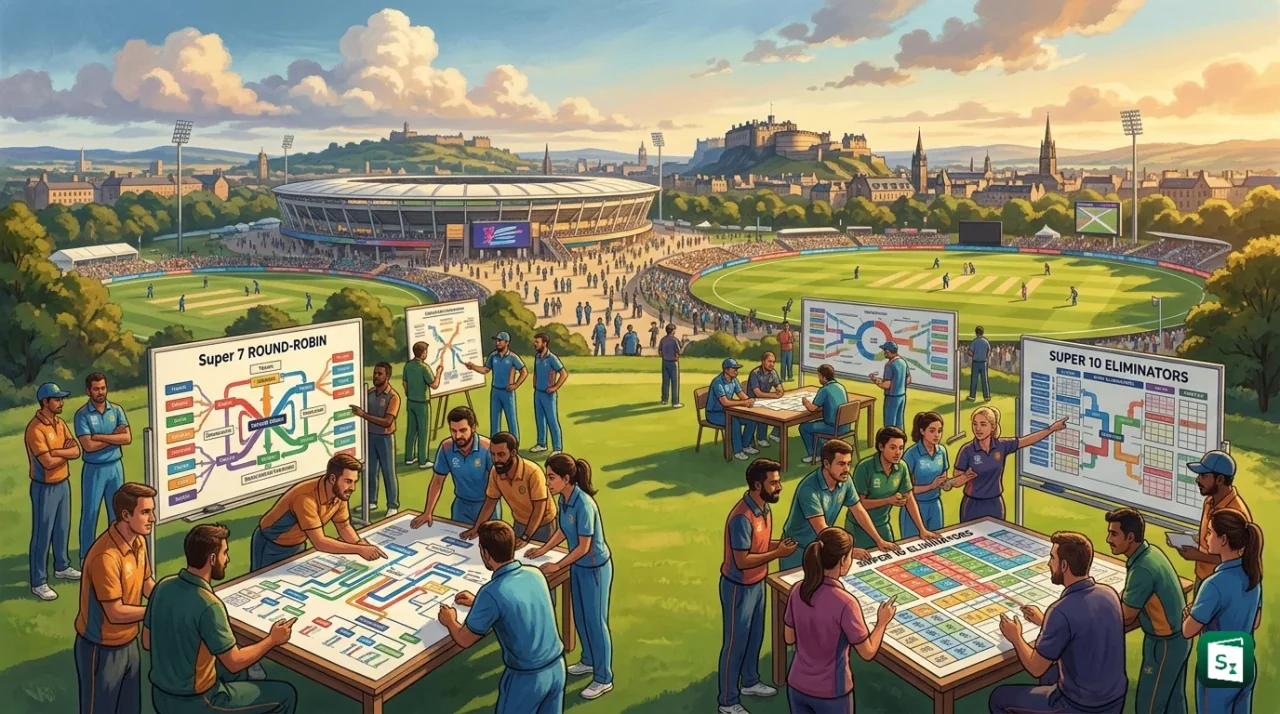
The ICC approved sweeping format changes for both the ODI and T20 World Cups at its annual board meetings in Edinburgh. The 2027 ODI World Cup, featuring 14 teams, will adopt a four-stage structure with a new Super 7 round-robin, increasing the total matches from 48 to 57. The 2028 T20 World Cup will replace its Super 8 stage with a Super 10 stage and introduce Eliminators for the first time.
ODI World Cup 2027: A Four-Stage Format
The 2027 ODI World Cup, scheduled to be co-hosted by South Africa, Zimbabwe and Namibia from October 4 to November 21, 2027, will be the first 50-over World Cup on African soil since 2003. This edition marks the return of the tournament to a 14-team format after the 2019 and 2023 editions featured only 10 teams. The new format replaces the single round-robin league stage with a four-stage competition designed to increase the number of high-stakes matches.
Super Series: Prelim for the Lowest Ranked
The tournament will begin with a Super Series involving the three lowest-ranked qualified teams. These three sides will play each other in a round-robin mini-league, and only the team that finishes top will progress to the main draw. The other two teams are eliminated at this stage itself. This preliminary round ensures that only the strongest among the lower-ranked qualifiers earns the right to compete against the top sides, adding consequence to every match from day one.
Group Stage: Two Pools of Six
After the Super Series, 12 teams will compete in the main group stage. These 12 are split into two groups of six, and each team plays every other side in its group once in a round-robin format, producing 30 matches in this stage. The top three teams from each group, along with the next best-placed team across both groups, qualify for the Super 7 stage. This means seven teams advance from the group stage, a crucial change from earlier formats where only four or six teams progressed.
Super 7: The New Centrepiece
The Super 7 is the most significant innovation in the new format. Seven teams that qualify from the group stage play a full round-robin against each other, producing 21 matches. At the end of this stage, the top four teams in the Super 7 standings advance to the semi-finals. The team finishing first plays the fourth-placed side, while the second and third-placed teams meet in the other semi-final. This stage, which replaces the earlier planned Super Six, guarantees more matches between top sides and ensures that every game carries weight since all seven teams remain in contention until the final round of league matches.
Knockouts: Semi Finals and Final
The knockout stage remains unchanged from previous editions. Two semi-finals determine the finalists, and the winner of the final is crowned world champion. However, notably, there are no quarter-finals in this format. The top four from the Super 7 proceed directly to the semi-finals, skipping the quarter-final round that was used in the 2011 and 2015 editions of the tournament.
T20 World Cup 2028: Super 10 and Eliminators
The ICC also approved a revamped format for the 2028 T20 World Cup, which will be co-hosted by Australia and New Zealand. While the tournament will continue to feature 20 teams and 55 matches, the path to the final has been restructured. The Super 8 stage used in the 2024 and 2026 editions has been replaced with a Super 10 stage, and a new Eliminators round has been added to determine the semi-final line-up.
Group Stage: Five Groups of Four
In the 2024 and 2026 editions, the 20 teams were split into four groups of five, producing 40 group-stage matches. The new format divides them into five groups of four, reducing the group stage to 30 matches. The top two teams from each group qualify for the next stage, meaning 10 teams advance. This change also means that each team plays three group matches instead of four, shortening the initial phase while increasing the number of teams that progress to the second stage.
Super 10: Two Groups of Five
The Super 10 replaces the Super 8 used in the previous two editions. The 10 qualifying teams are divided into two groups of five, each playing a round-robin format that produces 20 matches up from 12 in the Super 8. The winner of each Super 10 group qualifies directly for the semi-finals. The teams finishing second and third in each group do not get direct passage to the semi-finals but instead enter the new Eliminators round, adding an extra layer of competition before the knockouts.
Eliminators: A Second Chance
The Eliminators are a new addition to the T20 World Cup. In this round, the second-placed team from Super 10 Group 1 plays the third-placed team from Super 10 Group 2, and the second-placed team from Group 2 faces the third-placed team from Group 1. The winners of these two Eliminator matches complete the semi-final line-up, joining the two group winners who have already secured their spots. This system ensures that more teams stay in contention deeper into the tournament while rewarding the group winners with a direct path to the semi-finals.
Why the ICC Made These Changes
The ICC stated that the revised structures are designed to create greater context, competitiveness and consequence during the events. The new ODI format ensures that every group match carries higher stakes, as teams fight not only for a top-three finish in their group but also for the best fourth-place spot across both groups. The Super 7 stage guarantees that the seven best teams in the tournament play each other, eliminating dead rubbers and increasing the number of high-profile contests.
For the T20 World Cup, the ICC noted that it was encouraged by the performance of emerging teams in the 2026 edition and wanted to expand the representation of Associate nations in the second stage. By increasing the Super 8 to a Super 10, two additional teams get the opportunity to compete deeper into the tournament. The Eliminators add consequence to the closing matches of the Super 10 stage, as teams battle to finish in the top three rather than being eliminated after finishing outside the top two.
However, the changes have drawn criticism. The World Cricketers Association (WCA) expressed concern that the ODI format eliminates two of the three lowest-ranked teams early, which raises questions about the game’s commitment to global growth. Critics have also pointed out that the Super 7 stage increases the likelihood of multiple meetings between marquee teams such as India and Pakistan, suggesting commercial motives behind the restructuring.
Key Takeaways
- The ICC approved format changes for both the ODI and T20 World Cups during its annual board meetings in Edinburgh, Scotland.
- The 2027 ODI World Cup, co-hosted by South Africa, Zimbabwe and Namibia, will feature 14 teams in a four-stage format with a new Super 7 round-robin, increasing total matches from 48 to 57.
- The Super 7 stage involves seven teams playing a round-robin, with the top four advancing to the semi-finals replacing the quarter-final round.
- The 2028 T20 World Cup, co-hosted by Australia and New Zealand, will introduce a Super 10 stage (replacing Super 8) and Eliminators where second and third-placed teams from opposite groups compete for semi-final spots.
- In the T20 World Cup, the 20 teams will be split into five groups of four, with the top two from each group advancing to the Super 10 stage.
- The ICC was founded in 1909 as the Imperial Cricket Conference and is headquartered in Dubai, UAE.