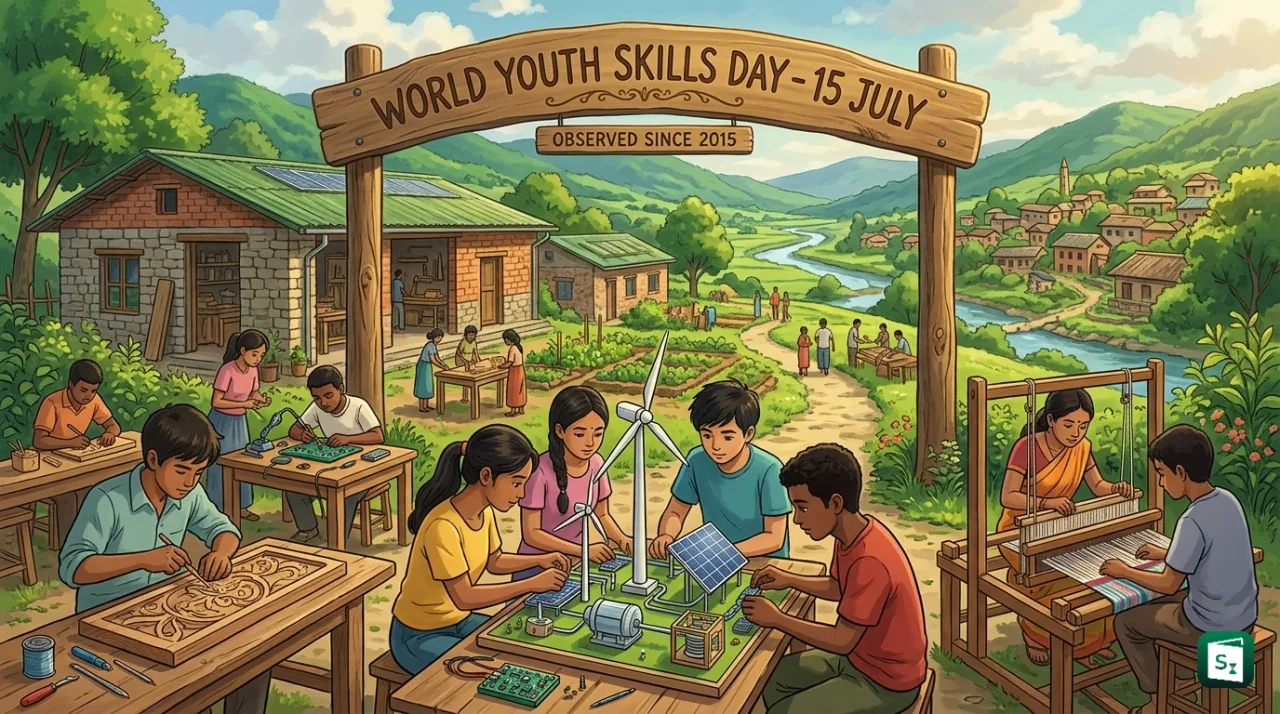
The United Nations observes World Youth Skills Day on 15 July every year to highlight the critical importance of equipping young people with skills for employment, decent work, and entrepreneurship. The 2026 edition, themed “Skills for a Shared Future” , comes at a time when the world of work is being reshaped by artificial intelligence, the green transition, and rapid technological change. Nearly 40% of today’s skillsets no longer match job market needs, making the day’s message more urgent than ever.
What Is World Youth Skills Day?
World Youth Skills Day was established by the United Nations General Assembly through Resolution A/RES/69/145 adopted on 18 December 2014. The resolution, spearheaded by Sri Lanka with support from the G77 and China, declared 15 July of every year as the official observance. The first World Youth Skills Day was celebrated on 15 July 2015.
The day serves as a platform for dialogue between young people, technical and vocational education and training (TVET) institutions, employers, policymakers, and development partners. It draws attention to the strategic importance of youth skills development in addressing unemployment, underemployment, and the widening gap between education and labour market demands. The observance is coordinated by UNESCO-UNEVOC, the International Centre for Technical and Vocational Education and Training, which is headquartered in Bonn, Germany on the UN Campus.
The 2026 Theme: Skills for a Shared Future
The theme “Skills for a Shared Future” reflects the understanding that skills development is a collective responsibility and the foundation of shared prosperity, social cohesion, and sustainable development. The 2026 observance moves beyond the previous year’s focus on AI and digital skills (the 2025 theme was “Youth Empowerment Through AI and Digital Skills”, which also marked the 10th anniversary of WYSD) to a broader, more integrated vision of what young people need to thrive.
Under this theme, the focus is on developing a balanced set of competencies that combines:
| Skill Category | What It Includes |
|---|---|
| Technical skills | Vocational and trade-specific know-how aligned to industry needs |
| Digital and AI skills | Literacy in emerging technologies, data analysis, and automation |
| Green skills | Knowledge for the transition to sustainable and low-carbon economies |
| Social-emotional skills | Empathy, resilience, cross-cultural communication, and teamwork |
| Civic skills | Active citizenship, ethical reasoning, and community participation |
The UNESCO-UNEVOC organised a global webinar on 15 July 2026 bringing together governments, educators, employers, and youth networks to confront the central question: “What will it take to equip every young person with the competencies they need to thrive in a shared future?” The event was co-hosted by the Permanent Mission of Sri Lanka and the Permanent Mission of Portugal to the UN, together with the International Labour Organization (ILO), UNESCO, and the United Nations Youth Office.
The Global Skills Challenge by the Numbers
The urgency behind World Youth Skills Day is rooted in stark global data. According to the UN, an estimated 273 million children and young people remain out of school worldwide. Among those aged 15 to 34, one in five are disengaged from formal pathways to skill development, meaning they are not in employment, education, or training (NEET).
The gender dimension of this crisis is particularly acute. Nearly 28.2% of young women globally are NEET, compared to 13.1% of young men. The ILO estimates that women and marginalised groups remain significantly underrepresented in AI and technology fields, risking the widening of existing inequalities as economies digitise.
The World Economic Forum’s Future of Jobs Report forecasts that 22% of all jobs will be transformed by 2030 due to technological disruption. The ILO has highlighted that investing in green and blue sectors could create 8.4 million jobs for youth by the same year, but only if training systems are redesigned to deliver relevant skills. These figures underscore why World Youth Skills Day is not merely a symbolic observance but a platform demanding structural action.
India’s Skill Development Ecosystem
India, with one of the largest youth populations in the world, faces a unique skilling challenge. The youth unemployment rate (ages 15 to 29) stood at 9.9% according to the Periodic Labour Force Survey Annual Report 2025, with urban youth unemployment significantly higher at 13.6%. More than 67% of unemployed youth in India are graduates, pointing to a fundamental mismatch between formal education and industry requirements.
Pradhan Mantri Kaushal Vikas Yojana (PMKVY)
India’s flagship skilling programme, the Pradhan Mantri Kaushal Vikas Yojana, was launched on 15 July 2015, coinciding with the first World Youth Skills Day. The scheme is implemented by the National Skill Development Corporation (NSDC) under the Ministry of Skill Development and Entrepreneurship (MSDE) . PMKVY aims to enable Indian youth to take up industry-relevant skill training and secure better livelihoods.
PMKVY has evolved through multiple phases. The current iteration, PMKVY 4.0, focuses on demand-driven, industry-aligned skill training including futuristic job roles in AI, drones, electric vehicles, and cybersecurity. Under PMKVY 4.0, over 5.10 lakh candidates have been trained across 162 futuristic job roles as of December 2025. Cumulatively across all phases, PMKVY has trained and certified over 1.64 crore youth since its inception.
The scheme operates through three main components:
| Component | Description |
|---|---|
| Short Term Training (STT) | 150 to 600 hours of skill training aligned to National Skills Qualifications Framework (NSQF) job roles |
| Recognition of Prior Learning (RPL) | Certification of existing informal skills through bridging courses and assessment |
| Special Projects | Bespoke training for vulnerable groups including transgenders, manual scavengers, and displaced youth |
National Skill Development Corporation (NSDC)
The National Skill Development Corporation was established in 2009 as a unique Public-Private Partnership (PPP) institution under the Ministry of Skill Development and Entrepreneurship. It serves as the strategic implementation and knowledge partner for the Skill India Mission, which was launched by the Prime Minister in 2015. NSDC works with 36 Sector Skill Councils, over 10,000 training centres, and more than 500 training partners to deliver vocational training across the country.
The Skill India Digital Hub (SIDH) platform serves as the digital backbone of the skilling ecosystem, offering online courses, certification, and placement support to learners across India. The government has also established the National Council for Vocational Education and Training (NCVET) as the apex regulator for quality assurance in vocational education.
India’s skilling efforts are closely tied to the National Policy for Skill Development and Entrepreneurship 2015, which provides the policy framework for creating a skilled workforce that meets global standards.
The Role of TVET in Sustainable Development
Technical and Vocational Education and Training (TVET) is at the heart of World Youth Skills Day. TVET connects education directly to the world of work by equipping learners with practical, industry-relevant skills rather than purely theoretical knowledge.
The UNESCO TVET Strategy 2022-2029 envisions transforming TVET systems to support successful and just transitions toward more digital, green, and inclusive economies. UNESCO-UNEVOC, as the UN’s designated centre for TVET, works with over 250 UNEVOC Centres across the world to strengthen vocational education systems in member states.
TVET directly contributes to multiple Sustainable Development Goals (SDGs) , particularly SDG 4 (ensuring inclusive and equitable quality education and promoting lifelong learning), SDG 8 (promoting sustained, inclusive economic growth and decent work for all), and SDG 10 (reducing inequality within and among countries).
The 2026 theme reinforces the idea that skills development cannot be viewed in isolation. It must be a shared societal project involving governments, educational institutions, the private sector, and young people themselves. As the UN Secretary-General António Guterres noted, unlocking the full potential of younger generations requires massive investment in inclusive quality education and training.
Key Takeaways
- World Youth Skills Day is observed globally on 15 July every year, established by UN General Assembly Resolution A/RES/69/145 on 18 December 2014.
- The 2026 theme is “Skills for a Shared Future” , focusing on a balanced set of technical, digital, AI, green, social-emotional, and civic skills.
- The resolution was proposed by Sri Lanka with support from the G77 and China, and the observance is coordinated by UNESCO-UNEVOC headquartered in Bonn, Germany.
- 40% of today’s skillsets no longer match job market needs, and 22% of jobs will be transformed by 2030 due to technological disruption.
- In India, PMKVY, launched on 15 July 2015, has trained over 1.64 crore youth, with PMKVY 4.0 covering 162 futuristic job roles in AI, drones, EVs, and cybersecurity.
- TVET directly supports the achievement of SDG 4 (Quality Education), SDG 8 (Decent Work), and SDG 10 (Reduced Inequalities).