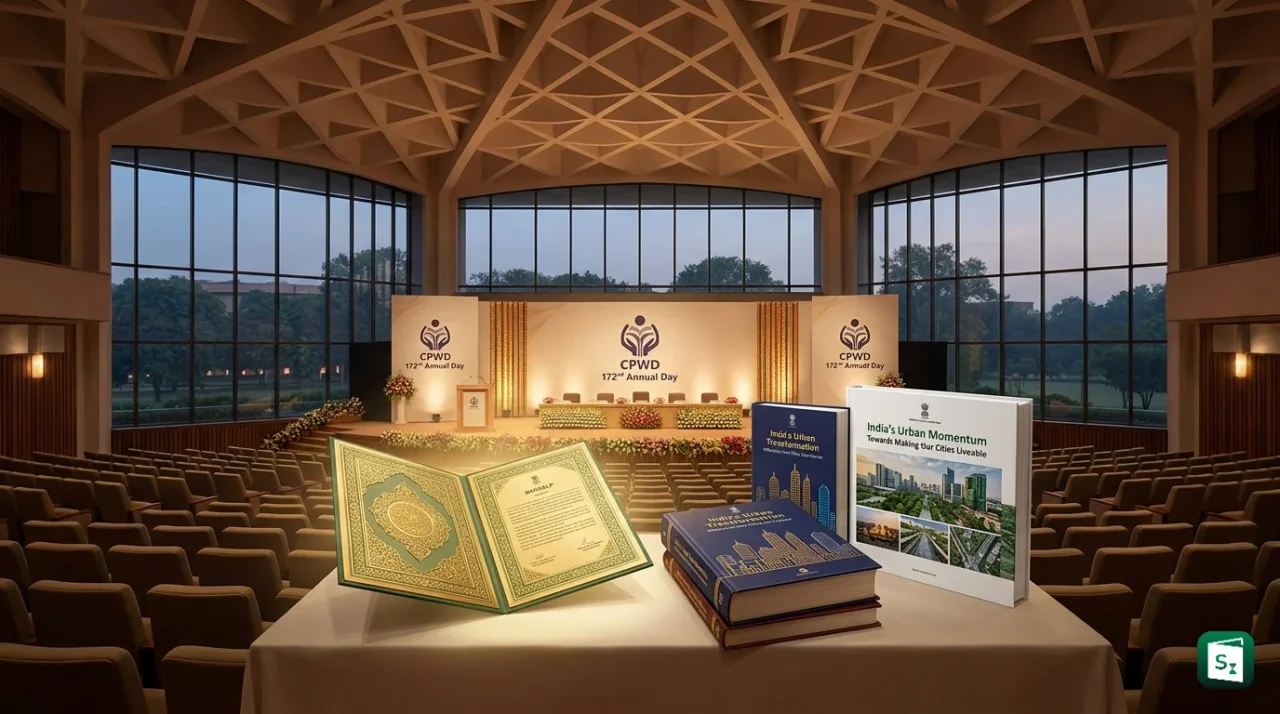
The Central Public Works Department (CPWD) celebrated its 172nd Annual Day at Vigyan Bhawan in New Delhi, where Union Minister for Housing and Urban Affairs Manohar Lal unveiled the SANKALP framework as the department’s guiding vision. The event also saw the release of two major publications on India’s urban development, alongside the launch of digital initiatives aimed at transforming CPWD into a future-ready, technology-driven organisation. The milestone marks more than 172 years of CPWD’s contribution to nation-building through public infrastructure.
CPWD: 172 Years of Nation Building
The Central Public Works Department (CPWD) is the principal engineering organisation of the Government of India, functioning under the Ministry of Housing and Urban Affairs (MoHUA). It was formally established in July 1854 by Lord Dalhousie, then Governor General of India, who created a central agency for the execution of public works. Colonel W.E. Baker of the Bengal Engineers was appointed the first Secretary of the Department of Public Works, marking the genesis of what would become CPWD. Sir Teja Singh Malik was the first Indian to head the department.
Headquartered at Nirman Bhawan in New Delhi, CPWD today has a pan-India presence and handles projects from conception to completion and maintenance. Its three Group A services are the Central Engineering Service (CES), Central Electrical and Mechanical Engineering Service (CEMES), and the Central Architects Service (CAS). The department trains its personnel at the National CPWD Academy in Ghaziabad.
CPWD has built some of India’s most iconic structures. These include the Rashtrapati Bhawan, the Parliament House, the North and South Blocks, and Vigyan Bhawan itself, the venue of the anniversary event. Vigyan Bhawan, built in 1956 and designed by CPWD architect R.P. Gehlote, has hosted landmark international conferences including the Commonwealth Heads of Government Meeting (1983) and the Non-Aligned Movement Summit (1983). CPWD also played a key role in building infrastructure for the Asian Games 1982 and the Commonwealth Games 2010.
The SANKALP Framework: Seven Pillars for a Future-Ready CPWD
Addressing officers, employees, and retired personnel at the event, Union Minister Manohar Lal introduced the SANKALP framework as the guiding vision for CPWD’s transformation. The acronym stands for seven core principles:
| Letter | Term | Meaning |
|---|---|---|
| S | Speed | Faster project execution |
| A | Accessibility | Easy access to public infrastructure |
| N | Nekneeyat | Integrity and good intent |
| K | Kartavyanishtha | Commitment to duty |
| A | Adoption of Technology | Embracing digital tools and modern methods |
| L | Lokhit | Public welfare |
| P | Pardarshita | Transparency in all operations |
The Minister said these values would align CPWD’s functioning with the national vision of Viksit Bharat while strengthening project delivery, governance, and institutional efficiency. He called upon the department to adopt a citizen-centric approach and leverage technology to ensure digital governance and transparency.
He also stressed the need for an efficient online transfer and posting system and continuous institutional reforms to prepare CPWD for future challenges in the infrastructure sector.
Push for Sustainable Construction and Digital Transformation
Manohar Lal urged CPWD to accelerate the adoption of sustainable construction practices and emerging technologies. He called for eco-friendly building methods without compromising on durability and strength. The Minister underlined the importance of timely project execution and transparency in all operations.
CPWD Director General Satinder Pal Singh highlighted the department’s recent achievements and emphasised the growing use of Building Information Modelling (BIM), digital project management tools, advanced construction materials, and automation to improve productivity, quality, and sustainability. He noted that capacity building remains a priority, with training programmes conducted through the National CPWD Academy in collaboration with premier institutions.
As part of the event, the Minister launched the e-NIRMIT ERP Modules, a digital initiative designed to integrate planning, execution, and monitoring across CPWD projects. The platform aims to reduce delays, improve accountability, and provide real-time data for decision-making. He also released the annual in-house magazine Nirman Bharati and other technical publications.
Ahead of the main celebrations, CPWD organised a technical session on July 11, 2026 at Vigyan Bhawan, where Professor K.V.L. Subramaniam of IIT Hyderabad delivered a keynote address on emerging technologies and sustainable construction. A Senior Officers’ Conference was also held to deliberate on ongoing reforms, project delivery, and the department’s future roadmap.
Two Publications on India’s Urban Development Journey
Minister Manohar Lal released two publications that capture the story of India’s evolving urban landscape.
India’s Urban Transformation: Reflections from Policy and Practice is published by the National Institute of Urban Affairs (NIUA) as the second volume in its ‘Urban India @2047: A National Strategic and Reference Series’. The release coincided with the culmination of NIUA’s Golden Jubilee year. The book examines the policy choices, institutional conditions, and implementation questions that will shape India’s urban future. NIUA, established in 1976, is the premier urban policy think tank under MoHUA and has played a pivotal role in shaping India’s urban development agenda over the past five decades.
India’s Urban Momentum: Towards Making Our Cities Liveable is a coffee table book prepared by the Ministry of Housing and Urban Affairs. It highlights India’s urban development journey and the Ministry’s initiatives towards sustainable and inclusive urban growth. Aligned with the Prime Minister’s vision of Viksit Bharat 2047, the publication captures urban transformation across multiple sectors and showcases how national initiatives are translating into more liveable, inclusive, and resilient cities.
Proposal for a National Council for Public Works
Srinivas Katikithala, Secretary of the Ministry of Housing and Urban Affairs, who was present at the event, proposed the establishment of a National Council for Public Works. This council would serve as a national platform to promote innovation, knowledge sharing, capacity building, and standardisation across public infrastructure agencies in the country.
He said such an institutional mechanism would facilitate collaboration among central and state government agencies, academic institutions, industry, and professional bodies. Katikithala noted that CPWD has evolved into a modern, technology-driven organisation capable of executing complex infrastructure projects and urged it to continue leading in the adoption of digital technologies, sustainable construction methods, and advanced project management systems.
Key Takeaways
- The Central Public Works Department (CPWD) was established in July 1854 by Lord Dalhousie and is the principal engineering organisation under the Ministry of Housing and Urban Affairs.
- The SANKALP framework stands for Speed, Accessibility, Nekneeyat, Kartavyanishtha, Adoption of Technology, Lokhit, and Pardarshita, guiding CPWD’s transformation into a future-ready organisation aligned with Viksit Bharat.
- Union Minister Manohar Lal launched the e-NIRMIT ERP Modules to improve transparency, project monitoring, and operational efficiency in CPWD projects.
- India’s Urban Transformation: Reflections from Policy and Practice was released by NIUA (established 1976) as part of its ‘Urban India @2047’ series.
- India’s Urban Momentum: Towards Making Our Cities Liveable, a MoHUA coffee table book, showcases India’s urban development journey aligned with Viksit Bharat 2047.
- Srinivas Katikithala, Secretary MoHUA, proposed a National Council for Public Works to promote innovation and standardisation across public infrastructure agencies.
- CPWD has built iconic structures including the Rashtrapati Bhawan, Parliament House, Vigyan Bhawan (built 1956), and infrastructure for the Commonwealth Games 2010.