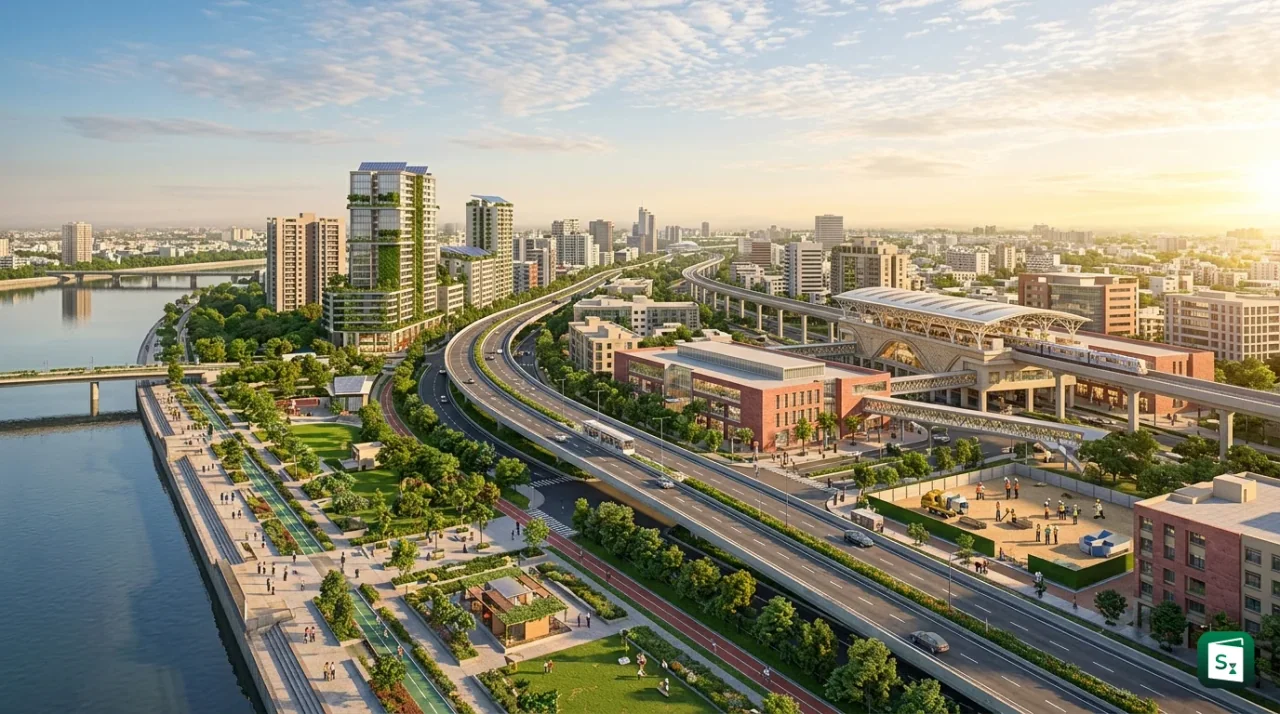
The Ministry of Housing and Urban Affairs has approved six urban infrastructure projects worth ₹2,719.80 crore for Ahmedabad under the Urban Challenge Fund (UCF), a flagship initiative launched by Prime Minister Narendra Modi to transform India’s urban development model. The projects span sewerage network rehabilitation, intelligent water management, sludge management, and an integrated transit system that will unify the city’s bus and metro services. This approval is among the first major project sanctions under the UCF, which represents a fundamental shift from grant-based urban financing to a market-linked, reform-driven approach.
What Is the Urban Challenge Fund?
The Urban Challenge Fund is a centrally sponsored scheme of the Ministry of Housing and Urban Affairs (MoHUA) with a total central assistance of ₹1 lakh crore, designed to run from FY 2025-26 to FY 2030-31, with an extendable implementation period up to FY 2033-34. First announced by Finance Minister Nirmala Sitharaman in the Union Budget 2025-26, the fund received formal Cabinet approval on 13 February 2026. The operational guidelines were launched by Union Housing and Urban Affairs Minister Manohar Lal in April 2026.
The fund marks a paradigm shift in how India finances urban infrastructure. Instead of relying entirely on government grants, the UCF requires cities to raise at least 50% of project costs from market sources such as municipal bonds, bank loans, and Public-Private Partnerships (PPPs). The Centre provides 25% of the project cost, while the remaining 25% comes from the state government or urban local body. This funding model is designed to unlock a total investment of ₹4 lakh crore in the urban sector over five years.
Projects under the UCF are selected through a competitive challenge mode, where cities compete by submitting proposals that demonstrate transformative impact, sustainability, and a credible plan for market financing. Funding is linked to reforms across five areas: governance and digital reforms; market and financial reforms to strengthen creditworthiness; operational reforms for service delivery; urban planning and spatial reforms; and project-specific Key Performance Indicators (KPIs) with third-party verification.
The scheme operates across three verticals: Cities as Growth Hubs, which focuses on greenfield developments, economic corridors, and urban mobility; Creative Redevelopment of Cities, covering renewal of central business districts, heritage cores, and legacy infrastructure retrofitting; and Water and Sanitation, which includes upgradation of water supply, sewerage, stormwater systems, and integrated solid waste management.
The fund also includes a ₹5,000 crore Credit Repayment Guarantee Sub-Scheme (CRGSS) to help smaller cities and urban local bodies in hilly and northeastern states access market finance for the first time. This provides a central guarantee of up to ₹7 crore or 70% of the loan amount for first-time borrowers.
MoHUA, the nodal ministry, traces its origins to the Ministry of Works, Housing and Supply established on 13 May 1952. It was reconstituted into its present form on 6 July 2017 through the merger of the Ministry of Urban Development and the Ministry of Housing and Urban Poverty Alleviation. It is headquartered at Nirman Bhawan, New Delhi.
Six Projects Approved for Ahmedabad
MoHUA approved six projects for Ahmedabad, Gujarat’s largest city and a major industrial and commercial hub, with a combined outlay of ₹2,719.80 crore. The Ahmedabad Municipal Corporation (AMC), which was established in July 1950 under the Bombay Provincial Corporation Act, 1949, will execute these projects. The city is divided into seven administrative zones: Central, East, West, North, South, North West, and South West.
Here is the complete list of approved projects:
| Project Name | Allocation (₹ crore) |
|---|---|
| Rehabilitation of main sewerage network in West Ahmedabad | 852.93 |
| Rehabilitation of main sewerage network in East Ahmedabad | 551.35 |
| Upgradation of ageing sewerage networks across the city | 290.24 |
| Intelligent Water Management System | 215.00 |
| 125 TPD Integrated Sludge Management Facility | 479.25 |
| Integrated Transit Management System and Automated Fare Collection System | 331.03 |
| Total | 2,719.80 |
Three of the six projects focus on sewerage infrastructure, accounting for nearly ₹1,694 crore or about 62% of the total outlay. The emphasis on sewerage reflects Ahmedabad’s urgent need to upgrade its ageing underground drainage network, much of which was laid decades ago and now suffers from frequent overflows, blockages, and leakages.
Key Projects and Their Impact
Sewerage Network Rehabilitation
The largest allocation of ₹852.93 crore is for rehabilitating the main sewerage network in West Ahmedabad, while ₹551.35 crore has been earmarked for East Ahmedabad. An additional ₹290.24 crore will upgrade ageing sewerage networks across various parts of the city. Together, these projects will replace and refurbish the city’s underground drainage infrastructure, much of which was built several decades ago and is unable to cope with the wastewater load from a rapidly growing population of over 55 lakh within the AMC area.
The rehabilitation is expected to significantly reduce sewer overflows and leakages, which have been a persistent public health and environmental concern. The projects will also introduce real-time digital monitoring and smart management of Ahmedabad’s entire sewerage and stormwater network, enabling the civic body to detect blockages, track flow patterns, and respond to emergencies more effectively.
Intelligent Water Management System
A sum of ₹215 crore has been approved for an Intelligent Water Management System that will use digital sensors, data analytics, and automation to improve the efficiency of Ahmedabad’s water supply network. The system will enable real-time monitoring of water distribution, leak detection, and demand-based supply management. Given that Ahmedabad faces seasonal water stress and relies on a combination of the Narmada canal system, groundwater, and treated wastewater, intelligent management can significantly reduce water losses and ensure equitable distribution across the city’s seven zones.
Integrated Sludge Management Facility
The ₹479.25 crore Integrated Sludge Management Facility with a capacity of 125 tonnes per day (TPD) is aimed at treating the sludge generated from sewage treatment plants. Instead of disposing sludge in landfills, the facility will convert it into biogas and green energy, supporting environmentally sustainable practices and promoting a circular economy. This project aligns with the Swachh Bharat Mission 2.0 and the government’s broader push towards waste-to-energy and resource recovery.
Integrated Transit Management System
The ₹331.03 crore Integrated Transit Management System (ITMS) and Automated Fare Collection System (AFCS) will unify Ahmedabad’s three public transport modes: Ahmedabad Municipal Transport Service (AMTS), the Bus Rapid Transit System (BRTS), and the Metro under a single digital platform. Citizens will be able to use a Common Mobility Card and a common journey application to travel seamlessly across all three modes without needing separate tickets.
The system will provide real-time public transport information, AI-enabled route planning, and enhanced incident management through modern in-bus surveillance. This integration is particularly significant as Ahmedabad prepares to host the 2030 Commonwealth Games, which will place increased pressure on the city’s public transport system. The ITMS project builds on an earlier ₹470 crore approval by the AMC Standing Committee in December 2025 for a unified mobility system covering AMTS and BRTS, with the UCF funding expanding its scope to include the Metro.
Funding Structure and State Allocation
The six Ahmedabad projects follow the UCF’s prescribed funding pattern. The Central Government will contribute 25% of the project cost, the Gujarat Government will contribute another 25%, and the remaining 50% will be mobilised by the Ahmedabad Municipal Corporation through loans, municipal bonds, or PPPs.
| Contributor | Share | Amount (₹ crore) |
|---|---|---|
| Central Government (MoHUA) | 25% | 679.95 |
| Gujarat Government | 25% | 679.95 |
| AMC (loans, bonds, or PPP) | 50% | 1,359.90 |
| Total | 100% | 2,719.80 |
Under the overall UCF allocation, Gujarat has been allocated ₹6,475 crore in central assistance. This enables urban local bodies across the state to undertake projects worth approximately ₹25,900 crore, given the 4x leverage factor built into the scheme’s financing model.
Significance for India’s Urban Transformation
The approval of Ahmedabad’s projects under the UCF is significant for several reasons. First, it demonstrates the operationalisation of the UCF’s challenge-based funding model, where cities compete on the merit and bankability of their proposals rather than receiving automatic grants. MoHUA Additional Secretary D. Thara recently stated at the FICCI Urban Infrastructure and Innovation Summit that projects worth ₹31,000 crore had been approved under the UCF within 20-25 days of the guidelines being finalised, with 44% of financing coming from NBFCs, 22% from PPPs, and 5-7% from bonds.
Second, the emphasis on sewerage, water management, and transit integration in a single approval shows how the UCF encourages holistic urban planning rather than piecemeal project funding. Ahmedabad’s six projects cut across two of the three UCF verticals: “Water and Sanitation” covers the sewerage, water management, and sludge projects, while “Cities as Growth Hubs” covers the transit management system.
Third, the funding model requires the AMC to raise ₹1,359.90 crore from market sources, which will test and strengthen the municipal corporation’s creditworthiness. Success here could set a precedent for other Indian cities to access bond markets and institutional finance for urban infrastructure, reducing their long-term dependence on central grants. Indian cities currently contribute an estimated 60-70% of the country’s GDP while occupying only about 3% of its land area, making urban infrastructure investment critical for sustained economic growth.
Key Takeaways
- The Ministry of Housing and Urban Affairs (MoHUA) approved six urban infrastructure projects worth ₹2,719.80 crore for Ahmedabad under the Urban Challenge Fund (UCF).
- The Urban Challenge Fund is a centrally sponsored scheme with ₹1 lakh crore central assistance, announced in Budget 2025-26 by Finance Minister Nirmala Sitharaman and approved by the Union Cabinet on 13 February 2026.
- Under the UCF funding model, the Centre provides 25%, the state provides 25%, and 50% must be raised from market sources such as municipal bonds, loans, or PPPs.
- The three largest approved projects are: rehabilitation of sewerage networks in West Ahmedabad (₹852.93 crore), East Ahmedabad (₹551.35 crore), and an Integrated Sludge Management Facility (₹479.25 crore).
- The Integrated Transit Management System will unify AMTS, BRTS, and Metro through a Common Mobility Card and a single digital platform.
- Gujarat has been allocated ₹6,475 crore under the UCF, enabling urban projects worth approximately ₹25,900 crore across the state.
- MoHUA, headquartered at Nirman Bhawan, New Delhi, traces its origin to the Ministry of Works, Housing and Supply established on 13 May 1952.