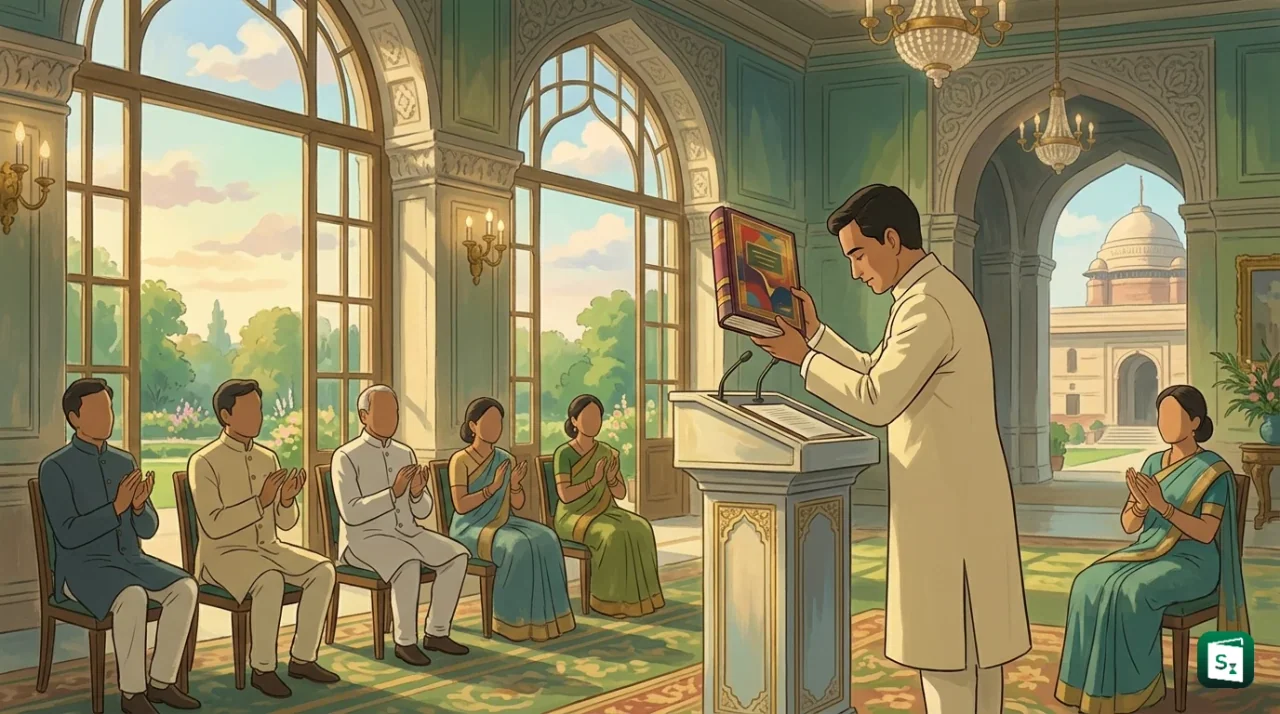
Vice President C. P. Radhakrishnan released the Hindi book Sankalp Se Siddhi Ka Modi Yug, authored by Rajya Sabha MP Ghanshyam Tiwari, at Uprashtrapati Bhavan in New Delhi. The book presents an account of India’s recent journey through governance and national ideas, linked to the vision of Viksit Bharat @ 2047.
What Is Sankalp Se Siddhi Ka Modi Yug?
Sankalp Se Siddhi can be understood as “from resolve to achievement”. The title presents determination as a process that requires discipline, sustained effort and public action, rather than as a simple wish. The book examines the past twelve years through the themes of administrative change, national development and an ideological renewal.
The work places this discussion against the long-term goal of Viksit Bharat @ 2047, which refers to the objective of building a developed India by the centenary of Independence. It also connects contemporary governance with the ideas associated with Swami Vivekananda, Rabindranath Tagore, Keshav Baliram Hedgewar, Veer Savarkar and Atal Bihari Vajpayee.
Who Are the Key Figures?
Ghanshyam Tiwari is a Bharatiya Janata Party member of the Rajya Sabha representing Rajasthan. He began his current term on 5 July 2022. Before entering the Upper House, he served for several terms in the Rajasthan Legislative Assembly and held state portfolios including education, parliamentary affairs, food and civil supplies, and law and justice.
Chandrapuram Ponnusami Radhakrishnan, commonly known as C. P. Radhakrishnan, assumed office as the Vice-President of India on 12 September 2025. He has also served as Governor of Jharkhand and Maharashtra. His public career includes parliamentary service, state-level organisational work and constitutional office.
The Vice-President’s Constitutional Role
The release also highlights the institutional importance of the office that hosted the event. Article 63 of the Constitution provides for a Vice-President of India, while Article 64 makes the Vice-President the ex officio Chairman of the Rajya Sabha, the Council of States. Article 89 also identifies the Vice-President as the Chairman of the Rajya Sabha.
The Vice-President therefore has a dual constitutional position. The office belongs to the Union executive, while the Chairman presides over the Upper House of Parliament. The Vice-President is elected by an electoral college made up of members of both Houses of Parliament through proportional representation using the single transferable vote.
Why the Release Matters
The event places a contemporary political account within India’s wider tradition of publishing books on public life, governance and national thought. The book’s stated themes include Rashtra Pratham, or Nation First, Integral Humanism, Antyodaya, social and economic justice, women-led development, self-reliance and transparent governance.
Its reference to Prime Minister Narendra Modi as a “Setu Purush”, meaning a bridge between dreams and reality, reflects the book’s central framework. It presents governance initiatives as attempts to turn the ideas of earlier national thinkers into action and links these efforts to the longer-term objective of a developed India by 2047.
Key Takeaways
- Vice President C. P. Radhakrishnan released Sankalp Se Siddhi Ka Modi Yug at Uprashtrapati Bhavan, New Delhi.
- Ghanshyam Tiwari, a Bharatiya Janata Party member representing Rajasthan in the Rajya Sabha, authored the book.
- The book connects India’s recent governance journey with the vision of Viksit Bharat @ 2047.
- Article 64 makes the Vice-President the ex officio Chairman of the Rajya Sabha.
- The Vice-President is elected by members of both Houses of Parliament through proportional representation by single transferable vote.