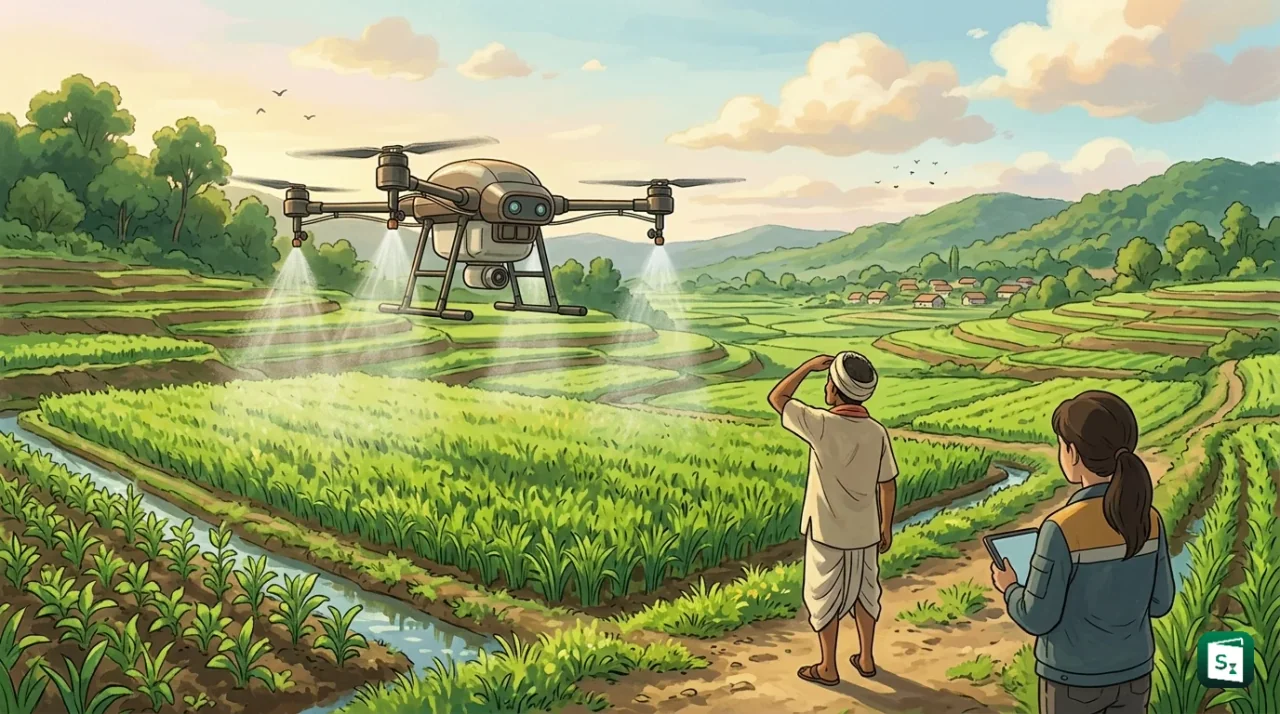
Hyderabad-based women-led DeepTech and defence technology startup AkinAnalytics has launched its indigenous NIKA2 Kisan Medium Drone, which was unveiled by Union Minister for Agriculture and Farmers Welfare and Rural Development Shivraj Singh Chouhan in New Delhi. The multi-payload platform, demonstrated before the Minister around mid-August 2026, is built to bring precision spraying and spreading to farmers and other field-intensive operations. Its launch marks a fresh push for Made in India agricultural drones that combine farm productivity with broader industrial and defence applications.
What Is the NIKA2 Kisan Medium Drone and Who Built It?
NIKA2 is an indigenous Kisan Medium Drone developed by AkinAnalytics, a Hyderabad-based women-led DeepTech and defence technology startup. A Kisan drone is an unmanned aircraft system designed specifically for agriculture, mainly to spray liquid pesticides, fertilisers and nutrients and to spread seeds and granules over fields. The Medium drone tag refers to the classification under the Drone Rules, 2021 of the Ministry of Civil Aviation, where drones with a Maximum All-Up Weight (MAUW) of more than 25 kg and up to 150 kg are placed in the medium category.
The drone was unveiled by Shivraj Singh Chouhan, Union Minister for Agriculture and Farmers Welfare and Rural Development, in New Delhi in mid-August 2026, where he also watched a live demonstration of its capabilities. AkinAnalytics was founded in 2022 by Janaki Pulaparthi, a Computer Science Engineer and ISB alumna, who leads the company as Founder and CEO. She was named among Forbes 40 Under 40 India Leaders 2025 for her work in AI-augmented drone analytics. The startup is headquartered in Jubilee Hills, Hyderabad, Telangana, and presents itself as a Make in India, Go Global venture serving agriculture, aquaculture, plantations, mining, energy, infrastructure and defence.
Beyond hardware, AkinAnalytics builds software layers that turn aerial data into usable insights. It is developing an AI-Augmented Drone Analytics Platform and Digital Twin technologies, which create a virtual copy of physical assets or fields to support inspection, measurement, monitoring and decision making. The company also runs a Directorate General of Civil Aviation (DGCA) authorised Remote Pilot Training Organisation (RPTO) at Amalapuram in Andhra Pradesh, linking indigenous drone manufacturing with pilot training and rural entrepreneurship.
The innovation journey of AkinAnalytics has been backed by several public support programmes. These include NIDHI PRAYAS, which is the National Initiative for Developing and Harnessing Innovations - Promoting and Accelerating Young and Aspiring technology entrepreneurs, Startup India Seed Fund Scheme (SISFS), MeitY SAMRIDH, which is the Ministry of Electronics and Information Technology Startup Accelerator for Product Innovation, Development and Growth, and the iDEX defence innovation ecosystem, which stands for Innovations for Defence Excellence under the Ministry of Defence. The company has also participated in Stanford Seed Spark, exposing it to global entrepreneurship networks.
Key Features and Technology Behind NIKA2
NIKA2 is designed around farmer utility and operational flexibility rather than a single fixed task. Its core promise is that one airframe can perform both spraying and spreading, which reduces the need for separate machines and lowers cost for operators and hiring centres.
The drone carries a 16-litre spraying payload for liquid application and a 12-litre spreading payload for granules or seeds, with some technical briefs listing spreading capacity around 13 kg. It can cover about three acres in a single sortie depending on crop, terrain and weather. An easy payload-change mechanism lets operators switch between the two tanks quickly in the field.
How Terrain-Following and Multi-Payload Systems Work
A central technical feature is terrain-following capability. The drone uses sensors, often phased-array radar and vision systems, to measure height above the crop canopy and adjust its altitude automatically. This lets it fly at a steady height over uneven or sloping land, keeping spray deposition uniform and avoiding crashes into undulating ground.
That feature matters for Indian conditions where fields are not flat. The company has highlighted potential use in plantation regions, including tea estates around Shillong and Meghalaya, where slopes make manual spraying difficult and risky. Similar terrain challenges exist in orchards, hilly farms and reclaimed mining land.
Other operational features include fail-safe systems that trigger return-to-home or controlled landing if battery, signal or navigation anomalies occur, and night-operation capability that allows spraying during cooler evening hours when wind is calmer and chemical evaporation is lower. Applications go beyond paddy and cotton fields to aquaculture feed distribution across fish and shrimp ponds, where uniform aerial spreading can save labour and improve feeding efficiency.
| Feature | Detail in NIKA2 |
|---|---|
| Drone class | Medium category (more than 25 kg and up to 150 kg MAUW under Drone Rules, 2021) |
| Spraying payload | 16 litres |
| Spreading payload | 12 litres (about 13 kg) |
| Coverage | About 3 acres per sortie |
| Key systems | Terrain-following, fail-safe, night-operation, quick payload-change |
| Primary uses | Pesticide and fertiliser spraying, seed and granule spreading, aquaculture feed distribution |
| Wider sectors targeted | Agriculture, aquaculture, plantations, mining, energy, infrastructure, defence |
The platform reflects a shift from viewing drones only as spraying machines to treating them as multi-role field robots that can be redeployed across seasons and sectors.
What Is a Kisan Drone and How Does It Help Farmers?
A Kisan drone, also called an agriculture drone or agri-drone, is an unmanned aircraft used for farm operations. The most common work is precision spraying, where the drone sprays liquid fertilisers, pesticides or nano urea in fine droplets directly over the crop canopy. It can also spread seeds and granular fertilisers, monitor crop health with cameras and sensors, and map field boundaries.
For farmers, the benefits are practical. An agriculture drone can spray one acre in 7 to 10 minutes, compared with 2 to 4 hours by hand with a knapsack sprayer. It uses up to 10 times less water and can cut pesticide use by about 25 percent through targeted application, which also reduces direct contact between workers and chemicals. This helps address labour shortages during peak seasons and improves timely coverage when pest pressure is high.
Common farmer questions around what is Kisan drone, what is drone farming and how do drones help farmers all point to the same idea. Drone farming means using aerial platforms plus data to make farm work more precise, faster and safer. Drones can fly at low altitude, cover large areas without stepping on crops, and reach waterlogged or sloping plots that tractors cannot enter. When combined with analytics, images taken by the drone can also flag crop stress, weed patches or water needs.
There are limits to note. Drones need trained pilots, charged batteries or generators in the field, and clear airspace permissions through the Digital Sky Platform, now increasingly managed via the eGCA system for registration. Flying is not allowed in poor weather, strong winds or near restricted zones, and operators need a valid Remote Pilot Certificate (RPC) for commercial spraying. Cost is another factor, which is why subsidies and hiring models matter.
Government Support for Agriculture Drones in India
India encourages agriculture drones through a mix of aviation rules and farm mechanisation support. The foundation is the Drone Rules, 2021, which simplified registration, created the five weight categories from nano to large, and introduced the Digital Sky compliance framework. Later updates shifted core registration workflows to the eGCA (e-Governance for Civil Aviation) portal while airspace approvals continue to involve Digital Sky checks.
On the agriculture side, the central push is often called the Kisan Drone Yojana or Kisan Drone Scheme, launched by Prime Minister Narendra Modi in February 2022 under the Ministry of Agriculture and Farmers Welfare and linked to the Sub-Mission on Agricultural Mechanization (SMAM). The scheme gives purchase subsidies to make drones affordable. Typical support levels include 50 percent subsidy up to about ₹5 lakh to ₹6 lakh for small and marginal farmers, women, Scheduled Caste and Scheduled Tribe farmers and farmers in the North Eastern states, 40 percent up to ₹4 lakh for other individual farmers, 75 percent up to ₹7.5 lakh for Farmer Producer Organisations (FPOs) and Custom Hiring Centres (CHCs) that rent drones to farmers, and 100 percent support for eligible agricultural training institutes and Krishi Vigyan Kendras (KVKs). These figures are updated periodically, so the exact cap should be checked on the official portal at the time of application.
A linked women-focused programme is the Namo Drone Didi Scheme, approved as a Central Sector Scheme for 2023-24 to 2025-26 with an outlay of ₹1,261 crore. Its target is to provide drones to 15,000 women Self Help Groups (SHGs) under the Deendayal Antyodaya Yojana - National Rural Livelihoods Mission (DAY-NRLM). Selected SHGs get 80 percent subsidy up to ₹8 lakh on the drone package, which includes the drone, accessories, insurance and training, the remaining amount can be financed through the Agriculture Infrastructure Fund (AIF) with a 3 percent interest subvention, and the trained Drone Didi and her helper receive honorariums during operations. The package also includes 15-day pilot training for the drone pilot and shorter training for the assistant, leading to a DGCA Remote Pilot Certificate. The SHG then earns rental income by offering spraying services to local farmers, with programme estimates of at least ₹1 lakh per year per group.
| Applicant category | Subsidy level commonly offered |
|---|---|
| SC, ST, small and marginal, women, North Eastern farmers (individual) | 50 percent, cap around ₹5 lakh to ₹6 lakh |
| Other individual farmers | 40 percent, cap around ₹4 lakh |
| FPOs and Custom Hiring Centres | 75 percent, cap around ₹7.5 lakh |
| Namo Drone Didi women SHGs | 80 percent, cap ₹8 lakh per drone package |
| KVKs, ICAR institutes, universities | Up to 100 percent |
To apply for a Kisan drone subsidy, farmers typically check the central agrimachinery.nic.in portal or their state agriculture portal such as i-Khedut in Gujarat, register with Aadhaar and land details, upload a quotation from a DGCA Type Certified manufacturer, await verification by the District Agriculture Officer, and then receive approval before purchase.
Agriculture drone prices in India vary widely by capability. Entry-level Indian spraying drones may start around ₹4 lakh to ₹5 lakh, while fully equipped medium-category platforms with multiple batteries, chargers and insurance can exceed ₹7 lakh to ₹10 lakh, and imported systems such as the DJI Agras series are listed higher. With subsidy support, the effective cost to the farmer or SHG drops sharply, which is central to adoption.
Why Women-Led DeepTech and Indigenous Drones Matter for India
The business setting for drones in India is strong. The country is already the third largest startup ecosystem globally and public policy aims to make India a global drone hub by 2030. Civil and defence demand are both rising, with estimates that the defence DeepTech market, valued around $6 billion in 2025, could reach $10 billion to $12 billion by 2030, and the military drone segment could triple in value over the same period. Policy tools such as Make in India, Atmanirbhar Bharat, the Production Linked Incentive (PLI) Scheme for Drones, the Drone Shakti initiative and liberalised import curbs on drones support domestic manufacturing.
AkinAnalytics fits this larger story in two ways. First, it is an indigenous or Made in India drone maker, designing and developing hardware and software locally at a time when many Indian assemblers still depend on imported batteries, motors and flight controllers. Indigenous design helps build intellectual property, improve serviceability and align with regulatory preference for Type Certified Indian platforms. Second, it is a women-led startup, a segment the government is actively promoting through schemes like Namo Drone Didi and through support for women in deep technology. Janaki Pulaparthi’s leadership and the company’s training base in Amalapuram directly connect product development with skilling, including training of over 15,000 women SHG members referenced in earlier programmes.
The company also shows how DeepTech creates value beyond the drone itself. By pairing drones with AI and geospatial intelligence, Digital Twins and analytics, it aims to serve sectors where work is spread across large, hazardous or hard-to-reach areas. In defence, similar platforms support surveillance and situational awareness, a field where AkinAnalytics has pointed to a 125-gram Nano Recon Drone concept. In industry, the same data pipeline can inspect power lines, mines or infrastructure. This reuse of a core technology stack across civil and strategic uses is what defines DeepTech, where advances are research heavy but can scale across multiple markets.
Hyderabad is a natural base for this work. The city hosts a dense cluster of aerospace, defence labs, research institutes and incubators, and supports schemes like NIDHI PRAYAS at IIT Hyderabad and state startup missions that help hardware ideas move from prototype grants of up to ₹10 lakh to certified products.
The Road Ahead for NIKA2 and Precision Agriculture
For farmers facing climate variability, NIKA2 offers a tool for timely action. Precision spraying can cut chemical load, save water and reduce health risks by keeping workers away from direct spray. For field-intensive industries, the same terrain-following and night-operation features allow work outside normal hours and in difficult terrain.
The next steps will decide scale. The company will need to expand its service network for batteries, repairs and spare payloads, grow its pool of certified pilots through its RPTO and partners, and build rental models through CHCs and SHGs so that small farmers can hire the service without buying the drone. Continued support through SMAM, Namo Drone Didi, low-interest AIF loans and state top-up subsidies will shape affordability, while DGCA Type Certification and insurance coverage will shape trust among buyers.
Over time, value will increasingly come from data. If the AI-Augmented Analytics Platform matures, the same flight that sprays a field could also produce a map of crop vigour, pest hotspots or water stress, helping farmers decide where to apply inputs next. That shift from spraying as a service to farming as a service is where indigenous multi-payload drones like NIKA2 can move from cost saving to income gain.
Key Takeaways
- NIKA2 Kisan Medium Drone is an indigenous multi-payload agriculture drone launched by Hyderabad-based women-led DeepTech startup AkinAnalytics and unveiled by Union Minister Shivraj Singh Chouhan in New Delhi in mid-August 2026.
- The drone offers a 16-litre spraying payload and a 12-litre spreading payload with a quick payload-change mechanism and can cover about 3 acres per sortie.
- Key operational features include terrain-following capability, fail-safe systems and night-operation capability, enabling use on slopes such as tea estates in Shillong and Meghalaya and in aquaculture feed distribution.
- Under the Drone Rules, 2021, Medium category drones weigh more than 25 kg and up to 150 kg on Maximum All-Up Weight and require DGCA registration, Type Certification and a Remote Pilot Certificate.
- AkinAnalytics was founded in 2022 by Janaki Pulaparthi, a Forbes 40 Under 40 India Leaders 2025 honouree, and operates a DGCA-authorised RPTO at Amalapuram, Andhra Pradesh.
- Government support for agriculture drones includes the Kisan Drone Yojana (2022) under SMAM with subsidies of 40 to 75 percent and the Namo Drone Didi Scheme (2023-26, ₹1,261 crore) offering 80 percent subsidy up to ₹8 lakh for 15,000 women SHGs.