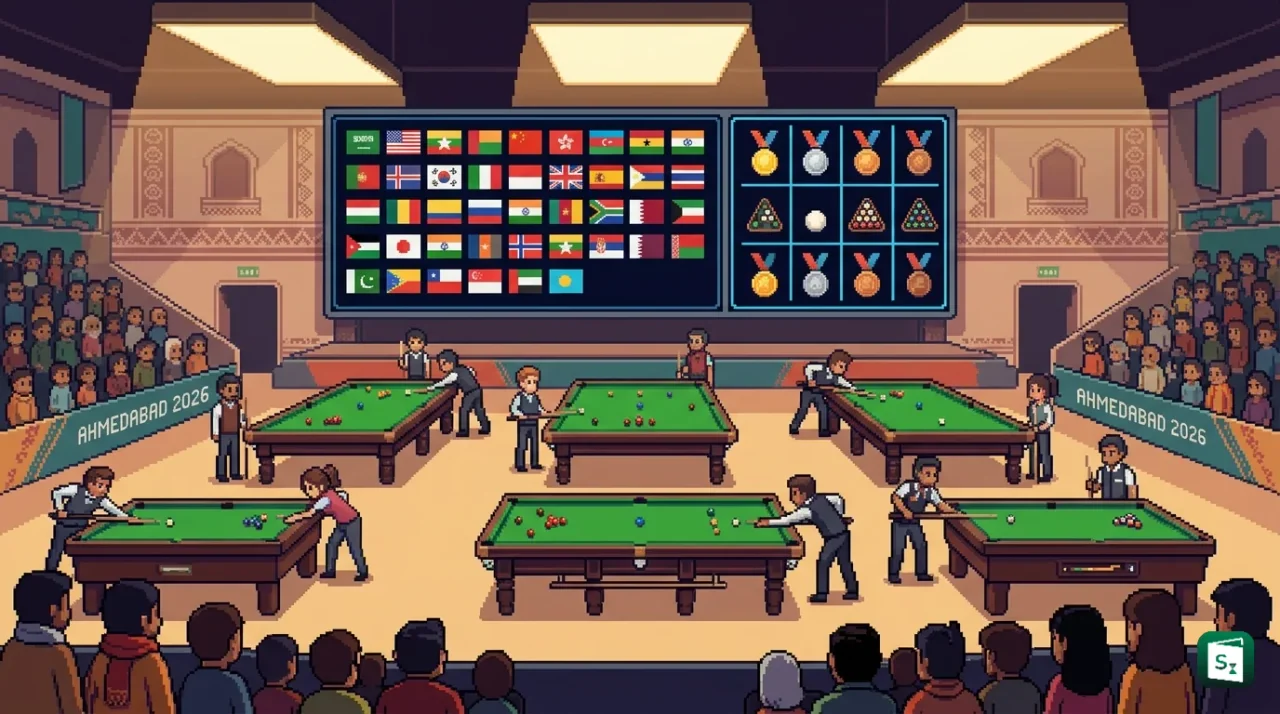
Ahmedabad will host the second edition of the Commonwealth Cue Sports Championships from 7 to 10 October 2026 at the Veer Savarkar Sports Complex in Naranpura, Gujarat. The event will bring together athletes from 45 Commonwealth countries to compete across five disciplines and 10 medal events, with separate competitions for men and women. It will be the first time India hosts the championships, marking a major step for cue sports in the country and for Ahmedabad as an emerging international sports hub.
What Are Cue Sports and How Many Types Are There?
Cue sports are a family of indoor games played with a cue stick used to strike balls on a cloth-covered table bounded by cushions. The cue, a long tapered stick, hits a cue ball which then strikes other balls to score points or pocket them. The term covers all games played on billiard tables, and is often used interchangeably with billiards in a broad sense.
There are three main branches, with many variants within them. Carom billiards is played on a pocketless table with three balls where points are scored by caroms, or hitting both object balls with the cue ball. Pocket billiards or pool is played on a six-pocket table with 16 balls, including disciplines such as 8-ball, 9-ball, 10-ball, Blackball and Heyball. Snooker and English Billiards are played on a large six-pocket table with smaller balls and tighter pockets, with snooker using 22 balls (15 reds, six colours and one cue ball).
The sport in India is governed by the Billiards and Snooker Federation of India (BSFI), the apex body for billiards, snooker, pool and carom. The BSFI was founded in 1926 in Kolkata and is now headquartered at 5/1 Jasma Bhavan Road, Bengaluru, Karnataka. It is affiliated to the World Confederation of Billiards Sports (WCBS), the International Billiards and Snooker Federation (IBSF), the Asian Confederation of Billiards Sports (ACBS) and the Indian Olympic Association (IOA). Its current president is M. C. Uthappa.
Globally, cue sports are coordinated by the WCBS, formed in 1992 and recognised as the international federation for billiards sports. The WCBS brings together its three divisions, the World Pool-Billiard Association (WPA) for pool, the IBSF for snooker and English billiards, and the Union Mondiale de Billard (UMB) for carom. The WCBS is recognised by the International Olympic Committee (IOC) and works with Commonwealth Sport, the body that governs the Commonwealth Games movement.
From Mauritius 2025 to Ahmedabad 2026: What Is the Commonwealth Cue Sports Championship?
The Commonwealth Cue Sports Championships is a dedicated Commonwealth-level championship for cue sports, endorsed by the WCBS and Commonwealth Sport. It offers athletes from Commonwealth nations the chance to compete for Commonwealth medals outside the main Commonwealth Games programme, similar to other Commonwealth championships in sports such as weightlifting and fencing.
The inaugural edition was the Commonwealth Billiards Championship 2025, held from 2 to 6 July 2025 at The Ravenala Attitude Hotel in Balaclava, Mauritius. Hosted by the Mau Pool Organisation and endorsed by the WCBS, the first edition brought together 128 players from 36 Commonwealth nations across four disciplines, snooker, 10-ball pool, Heyball and Blackball, plus a carom demonstration. India finished as one of the top performers, with Vidya Pillai winning women’s Heyball gold and Chitra Magimairaj and Shivam Arora taking silver in women’s 10-ball and men’s Heyball.
Building on that success, the second edition moves to India. The Commonwealth Cue Sports Championships 2026 will be held from 7 to 10 October 2026 at the Veer Savarkar Sports Complex in Ahmedabad, Gujarat. It is organised by Apex Sports Promotion, hosted by the BSFI, and again endorsed by the WCBS and Commonwealth Sport. The World Pool Association (WPA) has published the official Athlete Guide and will oversee the pool disciplines (10-ball, Heyball and Blackball) along with the IBSF for snooker.
The schedule is compact and athlete centred. Athletes will arrive on 7 October 2026, with a mandatory athletes’ meeting at 16:30 that day. Competition will run from 8 to 10 October, with departures on 11 October. Organisers expect participation to grow to 45 countries, with some updates mentioning 46 Commonwealth teams, up from 36 in Mauritius, reflecting rising interest across Africa, Asia, Europe and the Caribbean.
Five Disciplines, Ten Medal Events: What Will Be Played?
The Ahmedabad championships will feature 10 medal events across five disciplines, with separate men’s and women’s events in each discipline. This equal split underlines the commitment to gender parity that was also seen in Mauritius.
The five disciplines are:
| Discipline | What It Is | Table and Balls | Brief Format in Ahmedabad |
|---|---|---|---|
| Snooker | Strategic potting game on a large table. Players alternate potting reds and colours for points, with fouls giving points away. | 12 ft x 6 ft six-pocket table, 22 balls (15 reds, 6 colours, 1 cue ball), balls are 52.5 mm | Men’s and Women’s snooker |
| English Billiards | Classic billiards on a snooker-sized table without continuous potting. Points are scored through cannons (caroms), winning hazards and losing hazards. | 12 ft x 6 ft pocketed table, 3 balls (white, spot white or yellow, and red), 52.5 mm | Men’s and Women’s billiards |
| 10-Ball Pool | Pocket billiards where balls numbered 1 to 10 must be pocketed in rotation. The 10-ball must be last, making it more demanding than 9-ball. | 9 ft six-pocket pool table, 16 balls (cue ball plus 15 object balls, but only 1-10 used), 57.15 mm | Men’s and Women’s 10-ball |
| Blackball | The Commonwealth and European standard form of 8-ball pool. Two groups, reds and yellows, plus black 8-ball, played on smaller tables. | 7 ft six-pocket table, 16 balls (7 reds, 7 yellows, 1 black, 1 cue ball), 51 mm (2 inch) | Men’s and Women’s Blackball |
| Heyball (Chinese 8-Ball) | A hybrid of snooker and pool played with larger balls and snooker-cut pockets. Fast growing, especially in China, with over one million dedicated tables there. | 9 ft six-pocket table with tight rounded pockets, 16 balls, larger than American pool balls | Men’s and Women’s Heyball |
A sixth category, Carom 3-Cushion, will be presented as a demonstration sport only and will not count for medals. This continues the demonstration format used in Mauritius.
All events will follow international rules set by the respective federations, with certified referees, anti-doping controls under WCBS regulations, practice tables, and live streaming arrangements. The WPA will handle draws and technical conduct for 10-ball, Heyball and Blackball, while the IBSF will support snooker and billiards.
Billiards vs Snooker vs Pool: What Is the Difference?
This is one of the most searched questions among new fans, and the difference comes down to three things, the table, the balls and the objective.
Billiards in the strict sense means carom or English billiards on a large table where the aim is to score points by caroms rather than pocketing a set number of balls. Snooker is also played on a large 12 ft table but with 22 balls and very tight pockets, and the aim is to pot reds and colours alternately to score points. Pool covers the family of pocket games on a smaller 7 to 9 ft table where the aim is to pocket your assigned group of balls before the opponent.
| Feature | English Billiards | Snooker | Pool (8-Ball / 10-Ball / Blackball) |
|---|---|---|---|
| Table size | 12 ft x 6 ft | 12 ft x 6 ft | 7 ft (Blackball) to 9 ft (10-ball) |
| Pockets | 6 pockets, tight | 6 pockets, very tight and rounded | 6 pockets, wider |
| Number of balls | 3 | 22 | 16 |
| Ball size | 52.5 mm | 52.5 mm | 51 mm (Blackball) to 57.15 mm (Pool) |
| Objective | Cannons and hazards for points | Pot reds and colours for points | Pocket your group then the 8-ball or 10-ball |
In short, snooker rewards long potting and positional play, billiards rewards control and angles, and pool rewards pattern play and break building.
Is Billiards or Snooker an Olympic Sport?
No. Cue sports are not currently part of the Olympic Games, though they have sought inclusion for decades. The WCBS is recognised by the IOC and cue sports have been part of the World Games, including the 2025 World Games in Chengdu, China where 10-ball, 3-cushion carom and snooker awarded seven gold medals. They are also played at the Asian Games, SEA Games and Asian Indoor Games, and the BSFI is recognised by the Indian Olympic Association. Advocacy continues under the campaign On Cue for 2032, but as of 2026 cue sports remain a Commonwealth championship sport and not an Olympic sport.
Veer Savarkar Sports Complex: Why Ahmedabad Was Chosen
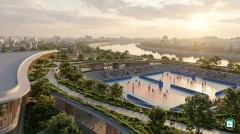
The venue is a statement in itself. The Veer Savarkar Sports Complex is located in Naranpura, Ahmedabad, and was inaugurated on 14 September 2025 by Union Home Minister Amit Shah. Built at a cost of about ₹823 crore to ₹825 crore on 21 acres with a built-up area of about 1,19,000 square metres, it is described as India’s largest sports complex and one of the world’s most modern.
The complex was jointly developed by the Government of India and the Government of Gujarat and is designed to host 18 different sports. It was opened as part of a larger plan to create world-class infrastructure in Ahmedabad, which already houses the Narendra Modi Stadium in Motera, the world’s largest cricket stadium with a capacity of 132,000.
Key features include an aquatics complex built to FINA standards with a 51.5 m x 25 m x 3 m main pool that is adjustable for swimming, artistic swimming and water polo, with seating for 1,750 spectators plus a warm-up pool and Jacuzzi. The campus also has a column-free indoor multi-sports arena, a Sports Centre of Excellence with residential hostels for athletes, accommodation for coaches, medical and nutrition support, and a video analysis theatre for slow-motion technique review. A Community Sports Centre, outdoor courts, Fit India Zone and outdoor sports zone provide community access alongside elite training. The complex offers seven entry gates, parking for 850 four-wheelers and 800 two-wheelers (about 900 vehicles in official releases), a 275 kW solar power plant and a 60 KLD sewage treatment plant, making it a green facility, along with five designated sport zones, utility plazas and fully accessible facilities.
Even before its formal inauguration, the complex hosted the Commonwealth Weightlifting Championship 2025 in August 2025, and it is also listed among venues for the proposed World Police and Fire Games 2029 and the 2030 Commonwealth Games. Its Naranpura address is Gate No. 3, Near Vardan Tower, Next to Swastik Arcade, Nandanvan, Pragatinagar, Naranpura, Ahmedabad, Gujarat 380013, and it is easily accessed from the western Ahmedabad neighbourhoods of Satellite, Bodakdev and Vastrapur. The scale, central location and proven ability to host international events made it a natural choice for a 45-nation cue sports championship.
Organisers, Federations and the Road to Ahmedabad 2030
Four bodies sit at the centre of the 2026 event. The championships are organised by Apex Sports Promotion, hosted by the Billiards and Snooker Federation of India (BSFI), and endorsed by the World Confederation of Billiards Sports (WCBS) and Commonwealth Sport. Technical support comes from the World Pool-Billiard Association (WPA) and the International Billiards and Snooker Federation (IBSF).
This structure mirrors the global governance of cue sports. The BSFI handles national selection, training and ranking in India, while the WPA and IBSF set the international rules and ranking systems for their disciplines. The WCBS acts as the umbrella body that coordinates with multi-sport organisations like Commonwealth Sport and the IOC.
The timing is significant for Gujarat. Ahmedabad has been formally recommended and celebrated as the host city for the 2030 Commonwealth Games, officially known as Amdavad 2030, the 24th Commonwealth Games and the centenary edition. The Games are expected in October 2030 and will be India’s second Commonwealth Games after New Delhi 2010. The Sardar Vallabhbhai Patel Sports Enclave in Motera, which houses the Narendra Modi Stadium, is being expanded as the primary hub, with the Veer Savarkar Sports Complex listed as a key supporting venue. Following Durban’s withdrawal from 2022 and Victoria, Australia’s withdrawal from 2026 that led to a scaled-back Glasgow 2026, Commonwealth Sport has placed strong emphasis on cost control, use of existing venues and sustainable delivery, all areas where Ahmedabad’s recent investments fit well.
Success in 2026 will therefore be watched beyond cue sports. It will test venue operations, athlete services, broadcast delivery and hospitality ahead of 2030, and it aligns with India’s longer ambition to host the 2036 Olympic and Paralympic Games, for which Ahmedabad is the proposed centre. A New Zealand sports delegation and Commonwealth Sport inspection teams have already toured the Veer Savarkar Sports Complex and the Sabarmati Riverfront sports cluster in 2025 and 2026 as part of these reviews.
Why This Championship Matters for India
For India, hosting the second edition is more than a sporting event. It is a chance to build on a strong cue sports tradition. India has produced world champions such as Pankaj Advani (multiple world titles in billiards and snooker), Geet Sethi, Michael Ferreira and Vidya Pillai, and the BSFI’s national championships regularly draw more than 1,000 players across age categories.
The home edition offers ranking visibility for Indian players, exposure to international formats like Heyball and Blackball that are less common domestically, and momentum before the Heyball World Championship scheduled in Pune from 12 to 16 August 2026, which will feature 128 players and a $400,000 prize pool. It also supports the National Sports Policy 2025 and programmes such as Khelo India and Target Olympic Podium Scheme (TOPS), which emphasise grassroots development, sports science, and use of new infrastructure for high-performance training.
For Ahmedabad and Gujarat, the championship showcases the ₹825 crore investment in the Naranpura complex to a Commonwealth audience of 45 nations, reinforces Gujarat’s sports budget focus on elite facilities, and strengthens the city’s brand as a venue for global events, alongside the 11th Asian Aquatics Championship and other international meets lined up through 2029. For cue sports overall, the expansion from 36 to 45 nations in just one year signals growing global reach, gender parity, and digital engagement through platforms such as WPA Live, which streamed all eight tables from Mauritius and will be central again in 2026.
Key Takeaways
- The second edition of the Commonwealth Cue Sports Championships will be held from 7 to 10 October 2026 at the Veer Savarkar Sports Complex, Naranpura, Ahmedabad, Gujarat, the first time India hosts the event.
- The championships will feature 10 medal events across five disciplines, Snooker, English Billiards, 10-Ball Pool, Blackball and Heyball, with separate men’s and women’s events in each.
- Athletes from 45 Commonwealth countries are expected to compete, up from 36 nations at the inaugural edition in Mauritius from 2 to 6 July 2025 at the Ravenala Attitude Hotel.
- The event is organised by Apex Sports Promotion, hosted by the Billiards and Snooker Federation of India (BSFI, founded 1926 in Kolkata, headquartered in Bengaluru) and endorsed by the World Confederation of Billiards Sports (WCBS) and Commonwealth Sport.
- The Veer Savarkar Sports Complex, inaugurated on 14 September 2025 by Union Home Minister Amit Shah at a cost of ₹825 crore on 21 acres with capacity for 18 sports, is India’s largest sports complex and a key venue for the upcoming Amdavad 2030 Commonwealth Games.
- Cue sports, comprising carom billiards, pool and snooker played with a cue stick on cloth-covered tables, are recognised by the International Olympic Committee but are not yet part of the Olympic Games, though they feature in the World Games and Asian Games.